
9 Golf Wrist Hinge Drills to Fix Your Lag and Casting

On this page14
- 01L-to-L Drill
- 02Hinge-and-Hold Drill
- 03Pump Drill
- 04Split-Hand Drill
- 05Trail-Hand-Only Throw Drill
- 06Impact-Bag Hinge Drill
- 07Alignment-Stick Lag Drill
- 08Thumbs-Up Setting Drill
- 09Towel-Under-Arms Drill
- 10How We Ranked These Drills
- 11What a Correct Wrist Hinge Actually Is
- 12How to Match a Drill to Your Fault
- 13Common Mistakes With Wrist Hinge
- 14A Simple 3-Week Hinge Practice Plan
Ranked by how fast each drill fixes the fault that costs the most golfers distance — casting and a lost wrist angle — and how many players it helps at once. Foundational, no-ball drills that retrain the root move rank above narrow specialty fixes.
- Best starting point
L-to-L Drill
Swing back until your lead arm is parallel to the ground and the club points straight up, forming an "L" between arm and shaft, then swing through to a mirror-image "L" on the follow-through. This ranks first because it makes the correct amount of wrist set visible on both sides of the ball — most golfers have never felt a full, symmetrical hinge, and this drill supplies the reference every later drill builds on.
It sits above the hinge-and-hold drill because it fixes the earlier link in the chain: you cannot hold an angle you never set. Do 10 slow reps with a 7-iron before any full swing, and treat it as the warm-up that frames the rest of your golf swing drills.
Fixes: incomplete set, tempo · Ball needed: optional · Reps: 10 slow, 7-iron · Best for: golfers who under-hinge
- Fastest casting cure
Hinge-and-Hold Drill
Take the club to the top, then swing down only to hip height while deliberately keeping the shaft trailing your hands so the angle between lead forearm and shaft stays sharp. Stop and check the club has not "cast" out toward the ball. It earns the number-two spot because casting — throwing the hinge away from the top — is the single most common power leak in amateur golf, and this drill isolates the exact instant it happens.
It ranks just below the L-to-L only because it assumes you already own a full set to hold; pair it with the transition work in our golf swing technique guide and it becomes the quickest fix on this list.
Fixes: casting, lost lag · Ball needed: no · Checkpoint: shaft trails hands at hip height · Best for: early-release players
- Transition fix
Pump Drill
Swing to the top and pause, then "pump" the downswing to hip height two or three times — feeling your lower body start while the wrists stay fully hinged — before releasing through on the final pump. This retrains the sequence so the hinge holds until the hands pass the trail thigh, which is why it outranks the pure feel drills below it: it fixes when you release, not just how it feels.
It is the go-to when your casting comes from rushing the transition rather than a weak set, and it reinforces the tempo you build in dedicated golf swing tempo drills.
Fixes: transition sequence, casting · Ball needed: no · Reps: 2-3 pumps per swing · Best for: rushed transitions
- Release exposer
Split-Hand Drill
Grip the club with your hands separated by two or three inches and make slow half-swings. The split grip exaggerates how the trail hand wants to flip the clubhead past the lead hand through impact, so an early release you couldn't feel before becomes obvious. Your job is to keep the lead wrist flat and leading until the flip disappears.
It ranks below the pump drill because it is a diagnostic more than a full-swing rehearsal — it shows you the fault vividly but does less to rebuild the whole sequence. Still, it is one of the most revealing feels for anyone who scoops, and it pairs well with the beginner fundamentals in golf swing tips for beginners.
Fixes: early release, clubface control · Ball needed: no · Grip: hands split 2-3 in · Best for: scoopers and flippers
- Lag-into-speed
Trail-Hand-Only Throw Drill
Hold the club with only your trail hand and make gentle swings, feeling the wrist hold its hinge and then release like throwing a ball underhand at the target. Done right, the "throw" happens at impact, not from the top — the exact timing that turns stored lag into clubhead speed.
It sits in the middle of the ranking because it targets the payoff of good hinge (speed) rather than the fault itself, so it works best once the earlier drills have stopped your casting. Start at chip height, build up, and chase the distance it unlocks in how to increase golf swing speed.
Fixes: release timing, speed · Ball needed: optional · Build-up: chip height to full · Best for: adding clubhead speed
- Impact proof
Impact-Bag Hinge Drill
Set an impact bag or stack of towels where the ball would be and swing into it slowly, stopping at contact. Freeze and check that your lead wrist is flat and the shaft leans slightly toward the target — proof the hinge released at the ball, not before it. Range balls hide a flip; an impact bag cannot.
It ranks here because it verifies the correct finish position without teaching the motion that gets you there, so it complements rather than replaces the earlier drills. It ties directly into fixing a slice pattern covered in how to stop slicing the golf ball, since a square, forward-leaning face resists the open-face slice.
Fixes: flip at impact, weak strike · Ball needed: no · Checkpoint: flat lead wrist, forward shaft lean · Best for: confirming compression
- Lag feedback
Alignment-Stick Lag Drill
Stick a short alignment rod into the butt end of the grip so it extends past your trail hip, then make slow downswings and keep the rod pointing away from your body. If it jabs your lead side early, you released the hinge too soon. The instant physical feedback is what makes it useful — you feel the fault before you see the ball flight.
It lands below the impact-bag drill because it needs a prop most golfers don't carry and reads more as a plane-and-path check than a hinge rebuild. It doubles as a plane check that supports the work in golf swing path drills.
Fixes: early release, plane · Ball needed: no · Prop: alignment rod in grip · Best for: instant lag feedback
- Direction trainer
Thumbs-Up Setting Drill
Hold the club out in front of you at waist height with arms extended, then hinge the wrists so the club points straight up and your lead thumb points at the sky. This isolates radial deviation — the correct upward cock — and teaches the feel of a pure hinge without the rolling, cupping motion that opens the face.
It ranks near the bottom not because it is wrong but because it is a static, out-of-swing rehearsal: valuable for fixing hinge direction if you cup the wrist, but it doesn't pressure-test the move at speed. Rehearse 15 times, then blend the feel into a normal backswing.
Fixes: hinge direction, over-rotation · Ball needed: no · Reps: 15 static · Best for: cuppers who open the face
- Connection check
Towel-Under-Arms Drill
Tuck a towel or headcover under both armpits and make half-speed swings, hinging the wrists without letting it drop. If the towel falls, your arms and hinge have separated from your body turn — a common cause of a handsy, inconsistent set. Keeping it in place forces the hinge to work with your rotation.
It closes the ranking because it addresses connection more than the hinge itself, so it is the drill you add once the wrist mechanics are sound and the remaining issue is timing between arms and body — the same principle taught for beginners in golf swing tips for beginners.
Fixes: disconnection, arm-only hinge · Ball needed: no · Cue: towel stays pinned · Best for: handsy, disconnected swings
Reader interaction
Build your ranking
Drag the names into the order you think is right — or use the arrows — then submit to see how your list compares with everyone else's.
- L-to-L Drill
- Hinge-and-Hold Drill
- Pump Drill
- Split-Hand Drill
- Trail-Hand-Only Throw Drill
- Impact-Bag Hinge Drill
- Alignment-Stick Lag Drill
- Thumbs-Up Setting Drill
- Towel-Under-Arms Drill
Audience ranking
How everyone ranked them
Built from reader rankings using position-based points.
Golf wrist hinge drills fix the two faults that wreck ball-striking: hinging too late in the backswing and releasing too early in the downswing (casting). The right drills teach you to set the lead wrist early, hold that angle deep into the downswing for lag, and release it at the ball instead of from the top. The nine drills above are ranked so you can start with the highest-leverage fix and work down to the narrower specialty cures.
How We Ranked These Drills
The order weighs two things. First, which fault a drill attacks: casting and a lost wrist angle cost the most golfers the most distance, so drills that stop the early release rank above those that only polish direction or connection. Second, how foundational the drill is — a drill that grooves the whole set (L-to-L) has to come before one that only holds an angle you have already learned to set (hinge-and-hold). No-ball drills that rebuild the root move rank above props and static rehearsals that check a single position.
What a Correct Wrist Hinge Actually Is
The wrist hinge is mostly radial deviation — cocking the lead wrist upward so the shaft rises toward vertical — set gradually as the club swings back, not snapped on at the top. By the top of the backswing your lead wrist should be flat or slightly bowed while the trail wrist loads like a waiter carrying a tray. Get this wrong and everything downstream suffers, which is why hinge belongs alongside grip and takeaway as a foundation covered in how to swing a golf club. If your set feels awkward, check your hold first using how to grip a golf club, because a weak or overly strong grip forces a compensating hinge.
How to Match a Drill to Your Fault
Let your strike tell you which drill to reach for first.
| Your miss | Likely fault | Start with |
|---|---|---|
| Thin, weak, scoopy contact | Casting / early release | Hinge-and-Hold, Split-Hand |
| Steep, chopping angle of attack | Late, abrupt set at the top | L-to-L, Thumbs-Up |
| Full swing but no distance | Lost wrist angle in transition | Pump, Alignment-Stick Lag |
| Handsy, inconsistent set | Arms disconnected from body turn | Towel-Under-Arms |
| Good contact, chasing speed | Release timing | Trail-Hand-Only Throw |
Diagnose the fault first, then drill it — the same targeted approach that makes general golf swing drills work far better than random range reps.
Common Mistakes With Wrist Hinge
Hinging all at once at the top. A late, abrupt set throws off tempo and plane. Start the hinge gradually once the club passes your trail thigh so it finishes smoothly at the top.
Cupping instead of hinging. Bending the lead wrist backward opens the face and produces slices and weak flips. The correct move is upward (radial), not backward — the thumbs-up drill fixes this.
Trying to hold lag consciously on the course. Manufacturing lag by “holding on” mid-round tightens your arms and kills speed. Groove the feel in drills, then trust it and swing freely when you play.
Skipping the no-ball phase. Learning a new hinge while hitting full-speed shots lets old habits win. Every drill above should start with slow, ball-free reps in front of a mirror or phone camera.
A Simple 3-Week Hinge Practice Plan
Week 1 — Feel the set, no ball. Do the L-to-L, thumbs-up, and hinge-and-hold drills, 15 slow reps each, four days this week. No ball, half speed or slower.
Week 2 — Add the ball, stay slow. Keep the same drills but hit soft half-shots after every few reps, watching for a flatter lead wrist and better contact. Add the split-hand drill if you still scoop.
Week 3 — Build to full speed. Layer in the pump drill and trail-hand throw drill, then hit 10 full-speed shots tracking strike and distance. If your contact holds up, take the feel to the range and blend it into full swings.
A reliable wrist hinge is the quiet engine behind consistent iron compression and longer drives. Once the angle holds through impact, you feel it most off the tee, where it powers the release covered in how to hit a driver, and in structured golf driving range practice drills that pressure-test the new move against a real target.
Frequently asked questions
What is the correct wrist hinge in the golf swing?+
The correct hinge is mostly radial deviation — cocking the lead wrist upward so the club rises toward vertical — set gradually as the arms swing back. By the top, the lead wrist is flat or slightly bowed and the trail wrist is loaded like a waiter holding a tray. You then hold that angle into the downswing rather than releasing it early, which is what preserves lag and compression at impact.
When should you hinge your wrists in the golf swing?+
Start the hinge gradually once the club passes your trail thigh, and complete it by the time your lead arm is roughly parallel to the ground. A common fault is hinging too late or all at once at the top, which throws off tempo and plane. A smooth, progressive set that finishes at the top keeps the club on plane and preserves the wrist angle you need for lag on the way down.
How do I stop casting the golf club?+
Casting is releasing the wrist hinge too early in the downswing, dumping the angle before impact. The fastest fix is the hinge-and-hold drill: swing down to hip height while keeping the shaft trailing your hands so the angle stays intact. The pump drill and split-hand drill then retrain the sequence so the release fires at the ball, not from the top. Work them slowly and without a ball first.
Do wrist hinge drills increase swing speed?+
Yes, indirectly. Holding the wrist angle longer stores energy that releases through impact, so more of your speed arrives at the ball instead of leaking early in the downswing. This is why strong ball-strikers with average tempo still generate high clubhead speed. Pair hinge drills — especially the trail-hand throw drill — with a dedicated speed routine for the biggest gain, rather than swinging harder from the top.
Should wrists be loose or firm at the top of the swing?+
Firm but not rigid. The lead wrist should be flat and supported, holding the hinge without tension in the forearms. A wrist that goes loose or cups at the top loses control of the clubface and usually leads to a scoop or flip through impact. Aim for a quiet, stable set, not a death grip — tension in the hands and forearms actually slows the release you are trying to preserve.
How long does it take to fix wrist hinge?+
Most golfers groove a new hinge pattern in two to four weeks of consistent slow reps, provided they practice without a ball first. The move has to survive the jump from half speed to full speed under pressure, which is the slowest part. Short daily sessions of quality reps beat one long weekly bucket of range balls, because the pattern sticks through repetition, not through hitting harder.
Which wrist hinge drill should a beginner start with?+
Begin with the L-to-L drill. It shows you how much wrist set a full swing actually needs, which most beginners underestimate, and it grooves the feel on both the backswing and follow-through. Once a full set feels natural, add the thumbs-up drill to fix hinge direction if you tend to cup the wrist, then move to the hinge-and-hold drill to stop any early release before you take the pattern to full speed.
Sources
Play & tools
Free browser games and tools — no account, no download.
- Play today's Sports Connections — Today's Sports Connections — daily hints, answers, and play the grid.
- Play Guess the NFL Player — A new mystery NFL player every day. Eight guesses, with a clue on each — plus free unlimited mode.
- Explore all our games →
Related golf guides
View all →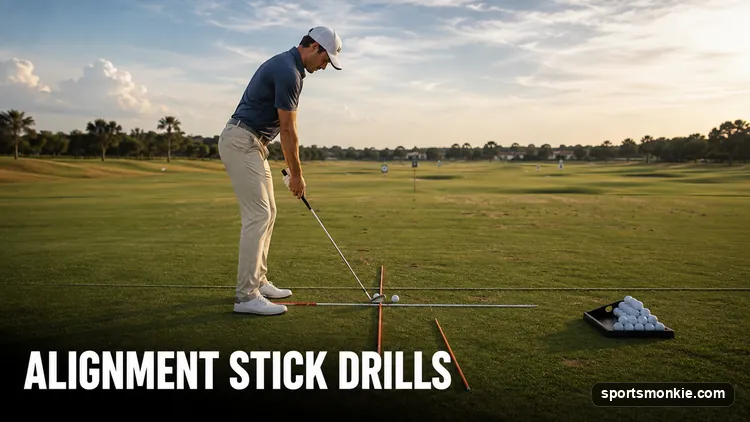
10 Alignment Stick Drills for Golf (Fix Aim, Path & Plane)
Ten alignment stick drills that fix golf's invisible faults—aim, swing path, and plane—using two cheap rods, each with a setup, a cue, and the exact miss it repairs.

8 Golf Backswing Drills to Fix Your Takeaway and Turn (By Fault)
Eight golf backswing drills ranked by impact and matched to the fault each one fixes: wristy takeaway, short shoulder turn, sway, open clubface, and off-plane shaft.

9 Golf Downswing Drills to Fix Your Sequence and Path
Nine golf downswing drills ranked by how directly they fix the over-the-top move, weight shift, and lost lag — each with a cue and the exact fault it repairs.

8 Golf Early Extension Drills to Fix Your Posture and Ball-Striking
8 golf early extension drills ranked from fastest feedback to deepest rebuild. The chair, band, and squat-to-turn drills keep your hips back so you strike it flush.

8 Golf Grip Drills to Fix Your Hands and Stop the Slice
Eight golf grip drills ranked by the fault each one repairs, from a weak slice-causing grip to a death grip that kills speed. Fix your hands before you swing.

9 Golf Posture Drills to Fix Your Setup (With Simple Checkpoints)
Nine golf posture drills, ranked by leverage, that fix the tilt, spine angle, and hip hinge every swing depends on. Each drill has a one-second checkpoint.