
10 Alignment Stick Drills for Golf (Fix Aim, Path & Plane)
On this page16
- 01Railroad-Tracks Aim Drill
- 02Toe-Line-Only Warm-Up Drill
- 03Path Gate Drill
- 04Angled Plane Stick Drill
- 05Ball-Line Contact Drill
- 06Feet-Together Stability Drill
- 07Belt-Line Hip-Turn Drill
- 08Shoulder-Plane Check Drill
- 09Driver Tee-Height Path Drill
- 10Around-the-World Station Drill
- 11How We Ranked These Drills
- 12Why Alignment Sticks Fix What Range Balls Cannot
- 13What You Need Before You Start
- 14At-a-Glance: Which Drill for Your Miss
- 15A Simple 3-Week Practice Plan
- 16When to Put the Sticks Away
Order here runs from the fault most golfers should fix first to the most advanced: a drill ranks higher when it repairs a bigger, more common miss (aim before plane), needs the fewest sticks, and transfers to the course fastest. Work the drills that match your miss, not all ten at once.
- Aim foundation
Railroad-Tracks Aim Drill
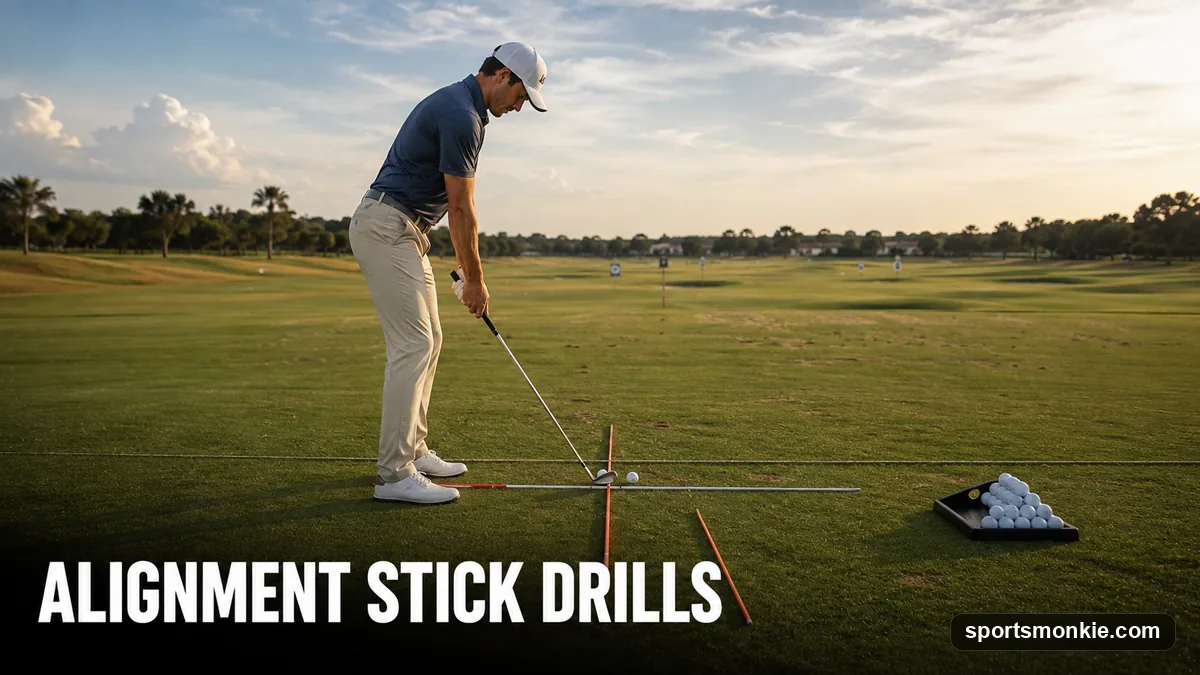
This ranks first because aim is the fault the most golfers own and the one that silently sabotages every other fix. Lay one stick on the ground pointing at your target a few inches outside the ball, and a second parallel along the line of your toes. They form railroad tracks: the ball line points at the flag, your body line runs parallel-left of it for a right-hander. Step in and match feet, hips, and shoulders to the toe stick.
It ranks above the plane and path drills below it because none of those survive bad aim—groove a perfect in-to-out path while aimed 15 yards right and you just curve the ball into a different piece of trouble. Most amateurs aim their body straight at the flag, which is actually aiming right; two or three sessions on the tracks retrains it. Pair it with the setup basics in golf swing tips for beginners.
Sticks: 2 · Fixes: aim, alignment · Payoff: 2-3 sessions · Right-hander body line runs parallel-left
- On-course transfer
Toe-Line-Only Warm-Up Drill
Aim only counts if it survives when the rods come away, so this drill builds the portable version. Set just the toe-line stick, take your stance, then pull the stick and hit the shot trying to hold the same feel. Alternate stick-in, stick-out reps until the squared stance stops feeling like it points left.
It sits second, right behind the aim foundation, because it is the bridge to real golf: under the Rules of Golf you may not set down a stick or any object to help your aim or stance during a round—doing so is a two-stroke penalty (loss of hole in match play) even in practice swings between shots. Build the feel here, per USGA Rule 10.2b, and trust it on the course.
Sticks: 1 · Fixes: on-course aim habit · Rule: no aiming aids in a round · Method: alternate stick-in / stick-out reps
- Slice fix
Path Gate Drill
The slice is the amateur's defining miss, which is why the path gate ranks this high. Angle one stick outward from just inside the ball along your intended in-to-out path, tail pointing right of target for a right-hander. Make slow swings and deliver the clubhead so it travels along and under the stick into impact.
A slicer's out-to-in path clips the stick from outside; staying inside it grooves the in-to-out path that squares the face. It outranks the plane drill below because path is what the ball actually reacts to at impact—plane is a means to it. Pair it with the swing thoughts in how to stop slicing the golf ball.
Sticks: 1 · Fixes: slice, over-the-top path · Speed: start at half · Delivery: club travels under and along the gate
- Plane check
Angled Plane Stick Drill
Push one stick into the ground just outside the ball, angled up to match your address shaft line, then rehearse the backswing so the shaft mirrors that angle halfway back. Hands above the stick mean you are lifting the club too upright; well under it means too flat.
It ranks below the path gate because plane is a cause the ball never sees directly, but above the contact and rotation drills because a wildly off-plane backswing forces compensations that wreck both. This is the cheapest substitute for swing video and reinforces the on-plane feel taught in golf swing technique.
Sticks: 1 · Fixes: steep or flat plane · Check: shaft matches stick at halfway-back · Cheaper than video
- Strike & low point
Ball-Line Contact Drill
Lay a stick flat on the ground pointing at the target, running right along your ball position. Make swings brushing the grass just target-side of the stick so your low point sits ahead of the ball.
Divots that start behind the stick mean you are hitting it fat; consistent brush marks in front train the ball-then-turf strike an iron needs. It ranks here—below the direction drills but above the tempo and rotation work—because crisp contact is what converts a good path into a good shot, yet it only matters once aim and path point you at the target.
Sticks: 1 · Fixes: fat/thin strikes, low point · Target: divot starts ahead of the stick · Club: irons
- Balance & tempo
Feet-Together Stability Drill
Set the toe-line stick, then take your stance with feet only a few inches apart and hit half-shots staying balanced over the stick. A narrow base punishes any lunge or sway, so it forces a smooth, centered turn and syncs your arms with your body.
It sits in the back half because it is a governor, not a direction fix—it cleans up the tempo faults that make the higher drills inconsistent rather than curing a specific miss. It layers naturally onto the rhythm work in golf swing tempo drills.
Sticks: 1 · Fixes: over-swing, sway, tempo · Stance: feet a few inches apart · Shots: half-swings
- Rotation
Belt-Line Hip-Turn Drill
Slide a stick through your belt loops so it points parallel to the target line at address. Turning back, the stick should point behind the ball; through impact it should rotate to point left of target for a right-hander.
This makes hip rotation visible and teaches you to clear the lower body instead of sliding—the exact move that unlocks speed in how to increase golf swing speed. It ranks below the ball-striking drills because it is a power and sequencing upgrade rather than a scoring fix; a golfer who slides but aims and strikes well still breaks 90.
Sticks: 1 (worn) · Fixes: weak hip turn, slide · Back: stick points behind ball · Through: points left of target
- Over-the-top fix
Shoulder-Plane Check Drill
Hold a stick across the front of your shoulders and take your address posture. At the top the stick should point down at or just outside the ball, not way beyond it. In the downswing it must not steepen and point outside the ball line—that steepening is the over-the-top move.
A mirror or phone shows it instantly. It ranks near the bottom not because it is unimportant but because it is diagnostic: it reveals the same over-the-top fault the path gate at rank three already trains you to fix, so most golfers use it to confirm the cure rather than build it.
Sticks: 1 (held) · Fixes: over-the-top, shoulder tilt · Top: points at/just outside ball · Tool: mirror or phone
- Driver slice
Driver Tee-Height Path Drill
For the big stick, angle a path-gate stick outside the ball as in drill three, but set it for a shallower, up-and-through delivery. Rehearse an in-to-out path with a slight upward strike, since the driver is the club a slicer misses with most.
It ranks this late because it is a specialization of the path gate, not a new skill—you should own the iron version first. Combine it with the setup and launch keys in how to hit a driver to turn a tee-box slice into a controlled draw.
Sticks: 1 · Fixes: tee-box slice, launch · Strike: slightly up on the ball · Prereq: master drill 3 first
- Whole-swing transfer
Around-the-World Station Drill
Build a three-stick station—toe line, ball line, and path gate together—then hit a series of shots cycling one focus per swing: aim, then contact, then path, without breaking down the station.
It finishes the list because it is the graduation exercise: it only works once the isolated fixes above feel automatic, and its job is to fuse them into a repeatable full swing. It mirrors the random, target-based reps in golf driving range practice drills that make changes survive to the course.
Sticks: 3 · Fixes: whole-swing transfer · Method: one focus per shot · Use: the finisher, once earlier drills feel automatic
Reader interaction
Build your ranking
Drag the names into the order you think is right — or use the arrows — then submit to see how your list compares with everyone else's.
- Railroad-Tracks Aim Drill
- Toe-Line-Only Warm-Up Drill
- Path Gate Drill
- Angled Plane Stick Drill
- Ball-Line Contact Drill
- Feet-Together Stability Drill
- Belt-Line Hip-Turn Drill
- Shoulder-Plane Check Drill
- Driver Tee-Height Path Drill
- Around-the-World Station Drill
Audience ranking
How everyone ranked them
Built from reader rankings using position-based points.
Alignment stick drills fix the three faults you cannot feel: aim, swing path, and plane. Two cheap fiberglass rods give you the instant visual feedback a mirror or coach normally would. The ten drills above are ordered from the fault most golfers should fix first to the most advanced—work the ones that match your miss rather than all ten at once.
How We Ranked These Drills
Placement rewards three things. First, the size and frequency of the miss the drill repairs: aim errors afflict nearly every amateur and poison every later fix, so aim drills sit at the top, while a driver-specific path tweak sits near the bottom. Second, simplicity—drills that need one stick and transfer to the course fast rank above three-stick stations that only work once the basics are automatic. Third, whether the drill builds a skill or merely diagnoses one; the shoulder-plane check ranks late because it confirms the over-the-top cure that the path gate already trains.
The through-line: get aim, path, and plane honest and better contact follows without changing your actual mechanics. That is why nearly every tour player warms up with two rods framing their feet, and why the alignment-stick path drill anchors our roundup of golf swing drills.
Why Alignment Sticks Fix What Range Balls Cannot
Hitting balls grooves whatever aim and path you already own, so a golfer who unknowingly aims 15 yards right just gets better at compensating. Alignment sticks strip that away by making your errors visible on the ground before you swing.
Aim, path, and plane are the “silent” faults because your eyes lie to you at address and the swing feels on line even when it is not. A stick does not lie. Fix the reference on the ground and the compensations you built to survive a bad reference quietly disappear.
What You Need Before You Start
Buy two 48-inch fiberglass sticks—or use two spare shafts, driveway markers, or garden stakes at home. A third stick unlocks the belt-line and around-the-world drills. Set up on flat ground, pick a specific target such as a yardage sign rather than “out there,” and always build the picture on the ground first, then step in.
If your grip or setup is shaky, fix that first—no aim drill survives a bad hold. Run through how to grip a golf club before you drill.
At-a-Glance: Which Drill for Your Miss
| Your miss | Start with | Sticks |
|---|---|---|
| Pushes and pulls, ball starts offline | Railroad-Tracks Aim | 2 |
| Slice with irons | Path Gate | 1 |
| Slice off the tee | Driver Tee-Height Path | 1 |
| Fat and thin strikes | Ball-Line Contact | 1 |
| Steep or flat backswing | Angled Plane Stick | 1 |
| Weak, sliding lower body | Belt-Line Hip-Turn | 1 (worn) |
| Loses aim on the course | Toe-Line-Only Warm-Up | 1 |
A Simple 3-Week Practice Plan
Week 1 — Aim only. Warm up every session with the railroad-tracks and toe-line-only drills. Do 20 stance-and-hold reps before any full shot so a squared alignment stops feeling like it points left.
Week 2 — Add path and contact. Keep the aim warm-up, then work the path gate and ball-line contact drills at half speed. Hit a real shot after every three or four rehearsals and watch the flight straighten.
Week 3 — Plane and transfer. Layer in the angled plane stick and belt-line hip-turn drills, then finish each session with the around-the-world station at full speed. By now the aim, path, and plane references should hold without conscious thought.
When to Put the Sticks Away
Once your aim and path repeat without the visual, drilling further just delays trusting the swing. Warm up on the sticks, transfer the feel with a few stick-out shots, then play golf reacting to the target—not rehearsing cues mid-round.
The fundamentals these drills groove sit downstream of the whole-swing sequence in how to swing a golf club: get aim, path, and plane honest, and the rest of your practice compounds instead of fighting invisible faults.
Frequently asked questions
What length alignment sticks should I buy?+
The standard is 48 inches, the length most range stations, shaft-plane checks, and belt-line drills are built around. That length lets the stick lie clearly outside the ball, stand in the ground for a plane reference, and slide through your belt loops without poking you. Shorter 36-inch sticks travel better in a carry bag but give you less visible line to aim along, so buy a pair of 48-inch rods first.
Can I do alignment stick drills indoors without hitting balls?+
Yes, and it is one of their best uses. Aim, plane, and rotation are all rehearsals, not ball-strikes, so a hallway, garage, or bedroom works. Set the railroad tracks on the floor and practice matching your stance, or make slow backswings against a plane stick in a doorway. Twenty stance-and-hold reps a day at home groove alignment faster than an occasional range visit, since the fix is a setup habit rather than a swing change.
How many minutes per session and how often should I drill?+
Fifteen focused minutes beats an hour of mindless reps. Warm up every session with the aim drills, then spend the rest on the one or two drills matching your current miss. Frequency matters more than duration for setup habits, so short daily rehearsals—even indoors—out-groove a single long weekly session. Once a reference repeats without conscious thought, rotate it out and give the time to a fault that still needs work.
Do alignment sticks help with putting alignment too?+
They do, within limits. On the practice green you can lay one stick just outside the ball on your start line to check that your putterface and eyes are square, and a second parallel for your stance. It exposes an aim bias fast. Just remember the same rule applies: you cannot leave a stick down to aim during a round, so use it to calibrate in practice, then trust the read when you play.
Are cheap alignment sticks as good as expensive ones?+
For these drills, yes. The rod's only job is to sit straight and be visible, so a two-dollar fiberglass stick, a spare shaft, a driveway marker, or a garden stake all work. Pricier sticks add magnetic connectors, tougher tips, or brighter colors that help visibility, but none of that changes the feedback. Start with a cheap pair, and only upgrade if you want the color contrast on a busy range.
I'm left-handed—do these drills still work?+
Completely—just mirror every direction. Where a drill says your body line runs parallel-left of the target for a right-hander, yours runs parallel-right; where a right-hander's belt stick rotates to point left through impact, yours points right. The setups, cues, and faults are identical, only flipped. Read each drill, swap left for right, and the railroad tracks, path gate, and plane checks all deliver the same feedback.
Sources
Play & tools
Free browser games and tools — no account, no download.
- Play today's Sports Connections — Today's Sports Connections — daily hints, answers, and play the grid.
- Play Guess the NFL Player — A new mystery NFL player every day. Eight guesses, with a clue on each — plus free unlimited mode.
- Explore all our games →
Related golf guides
View all →
8 Golf Swing Path Drills to Stop Coming Over the Top
Golf swing path drills fix the direction your club travels through impact. Use the gate drill, headcover drill, and alignment-stick drill to swing in-to-out and kill your slice.

8 Golf Weight Transfer Drills to Fix Your Weight Shift Fast
Eight golf weight transfer drills ranked by how fast they fix your weight shift, each matched to a specific fault: reverse pivot, hanging back, early extension, or a lazy transition.

9 Golf Driving Range Practice Drills That Transfer to the Course
The 9 best driving range practice drills, ranked by how directly they lower scores — built on random practice, real targets, and a full pre-shot routine that transfers.
8 Best Golf Swing Drills to Fix Your Swing Fast (Ranked by Fault)
The best golf swing drills fix one fault at a time: the alignment-stick drill for path, the step drill for weight shift, and the pump drill for an over-the-top move. Here are 8 drills, ranked by what they repair.
9 Golf Downswing Drills to Fix Your Sequence and Path
Nine golf downswing drills ranked by how directly they fix the over-the-top move, weight shift, and lost lag — each with a cue and the exact fault it repairs.
8 Golf Backswing Drills to Fix Your Takeaway and Turn (By Fault)
Eight golf backswing drills ranked by impact and matched to the fault each one fixes: wristy takeaway, short shoulder turn, sway, open clubface, and off-plane shaft.