
Most Successful Cricket Teams in History: The All-Time Rankings
On this page13
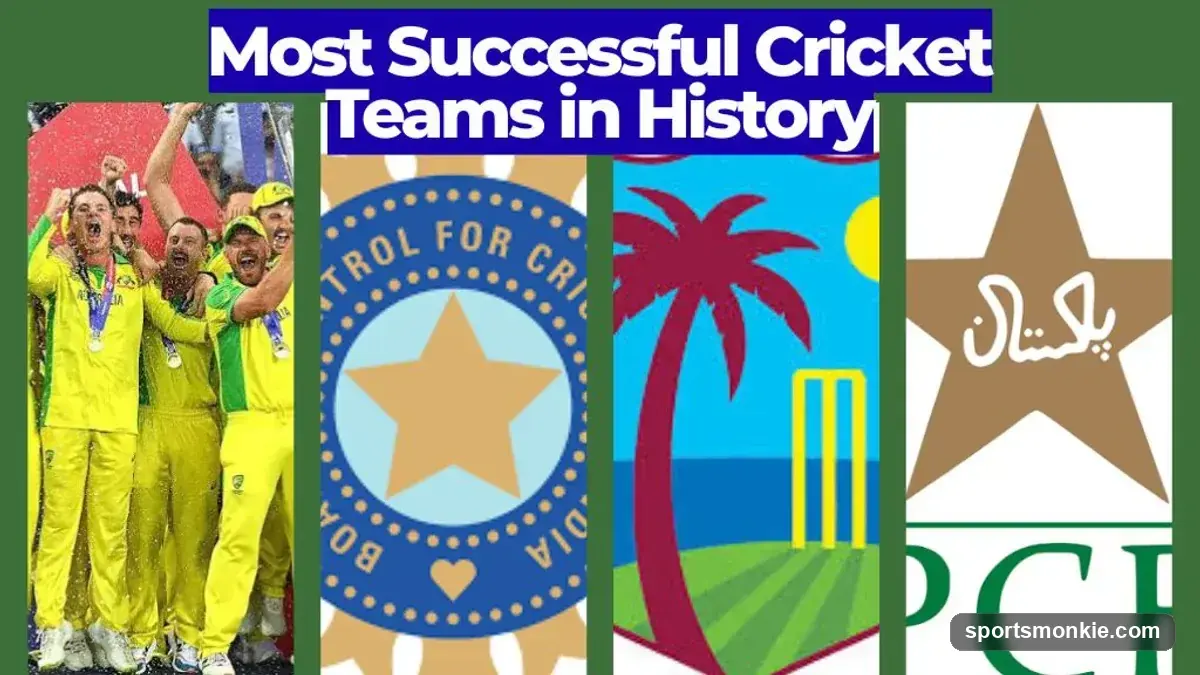
Placement is driven by total ICC titles across all four global trophies, then broken by the length and depth of a team's peak era — a decade of unbeaten Test series outweighs one hot tournament. Trophyless sides earn a spot only through repeated results against established powers.
- Gold standard
Australia
Ten major ICC titles — six ODI World Cups, the 2021 T20 World Cup, the 2006 and 2009 Champions Trophies, and the 2023 World Test Championship — is more than double the tally of any rival, which is why Australia sits clear at the top rather than level with India. Only Australia has won three ODI World Cups back-to-back (1999, 2003, 2007); no other side has managed even two in a row.
The margin is about duration, not one golden tournament. Through the late 1990s and 2000s, under Steve Waugh and then Ricky Ponting, Australia went years without losing a Test series while winning across all three formats at once — the exact "sustained peak" tiebreaker that separates the top of this list.
Titles: 10 · Peak: 1999–2007 · Defining feat: only side with three straight ODI World Cups
- Modern superpower
India
India's seven ICC titles span every format — two ODI World Cups (1983, 2011), two T20 World Cups (2007, 2024), and three Champions Trophies (2002 shared, 2013, 2025) — which puts them second overall, ahead of the West Indies' five. The 2025 Champions Trophy was won without losing a match, making India the tournament's most-decorated side.
Depth is what keeps them near the top rather than reliant on one era. A near-unbeaten home Test record and the deepest fast-bowling stock in their history held India at or around No. 1 in the ICC Test rankings across the 2010s and 2020s, while the IPL — home to the format's biggest run-scorers — rebuilt the sport's economics.
Titles: 7 · Peak: 2007–present · Defining feat: titles in all three global white-ball events plus the Champions Trophy
- Original dynasty
West Indies
Five ICC titles undersell what the West Indies built: they won the first two ODI World Cups outright (1975, 1979), added the 2004 Champions Trophy, then took two T20 World Cups (2012, 2016) once the format existed. They rank above England here because their peak lasted a decade, not a cycle — the Test side went unbeaten in series for more than ten years.
The engine was a four-man pace battery of Roberts, Holding, Garner, and Marshall that never let a batting order breathe across a session. Clive Lloyd and Viv Richards set the template for team dominance that Australia later matched.
Titles: 5 · Peak: 1975–1985 · Defining feat: unbeaten in Test series for over a decade
- White-ball reboot
England
England hold three ICC titles — the 2010 and 2022 T20 World Cups plus the 2019 ODI World Cup — and their signature distinction is holding both white-ball crowns at once, the first team to do so. The 2019 final was decided on boundary countback against New Zealand after the match and Super Over finished level.
They edge Pakistan and Sri Lanka on the same trophy count because the run was a deliberate system, not a one-off. A years-long shift toward aggressive batting after 2015 reshaped how England — and eventually everyone — played one-day cricket.
Titles: 3 · Peak: 2019–2022 · Defining feat: first side to hold the ODI and T20 World Cups simultaneously
- Mercurial force
Pakistan
Pakistan's three ICC titles came under three different captains in three eras: the 1992 World Cup under Imran Khan, the 2009 T20 World Cup under Younis Khan, and the 2017 Champions Trophy, where a side ranked last entering the event beat India in the final. That spread is why they sit level with England and Sri Lanka rather than below them.
The through-line is generational match-winners across decades — Imran, Wasim Akram, Waqar Younis, and later Babar Azam. The unpredictability cuts both ways, but at their best few attacks look more dangerous.
Titles: 3 · Peak: 1992, 2009, 2017 · Defining feat: ICC titles under three separate captains
- Overachiever
Sri Lanka
Sri Lanka's three titles — the 1996 World Cup, the 2014 T20 World Cup, and the 2002 Champions Trophy shared with India after a washout — carry extra weight given the country's size relative to the powers above it. The 1996 win came from opening the batting aggressively before that was standard, a tactic that changed one-day strategy.
It held up because the bowling matched the batting. Paired with Muttiah Muralitharan's spin, Sri Lanka had the tools to beat anyone through the 1990s and 2000s.
Titles: 3 · Peak: 1996, 2002, 2014 · Defining feat: pioneered aggressive ODI openers en route to the 1996 crown
- Drought-breaker
South Africa
South Africa hold two ICC titles — the 1998 Champions Trophy (then the ICC KnockOut) and the 2025 World Test Championship — which ranks them above the one-title sides below. For 27 years in between they were cricket's great underachievers, exiting World Cups on rain rules, Super Overs, and collapses.
That drought ended when they beat Australia at Lord's in the 2025 WTC final, chasing 282 with Aiden Markram's century. It was their first ICC trophy since 1998, not their first ever — a common misconception worth correcting.
Titles: 2 · Peak: 1998, 2025 · Defining feat: 2025 WTC win, a first ICC title in 27 years
- Test breakthrough
New Zealand
New Zealand's single ICC title arrived where few expected it: beating India in the inaugural 2021 World Test Championship final. It ranks them one place below South Africa, who hold two, but above the trophyless sides.
The context is a run of near-misses — losing finalists at the 2015 and 2019 ODI World Cups and the 2021 T20 World Cup, the 2019 defeat coming only on a boundary-countback tiebreaker after both the match and Super Over finished tied. The breakthrough landing in Test cricket, the traditionalists' format, made it resonate.
Titles: 1 · Peak: 2019–2021 · Defining feat: winners of the first World Test Championship
- Giant killers
Bangladesh
No ICC trophy yet, but a record of upsets that earns a ranked place over teams with none of the same scalps. Bangladesh knocked pre-tournament favorites India out of the 2007 World Cup group stage, then beat South Africa in the Super Eights the same year.
They sit above Afghanistan on the strength of a longer track record: home series wins over Australia and England since, plus a 2015 World Cup quarter-final. Progress toward the top table is steady, if still incomplete.
Titles: 0 · Peak: 2007–present · Defining feat: eliminated India from the 2007 World Cup
- Fastest riser
Afghanistan
Afghanistan close the list as the sport's most improbable rise — a program whose players largely learned the game in refugee camps reaching a first ICC semi-final at the 2024 T20 World Cup. They beat Australia by 21 runs in the Super Eights — the 2021 T20 champions and six-time 50-over winners — then edged Bangladesh to book the semi-final.
They rank tenth rather than higher because the results are still isolated rather than sustained, but relative to resources no rise in modern cricket matches it. Rashid Khan's leg-spin remains the attack's spine.
Titles: 0 · Peak: 2024–present · Defining feat: first ICC semi-final, beating Australia along the way
Reader interaction
Build your ranking
Drag the entries into the order you think is right — or use the arrows — then submit to see how your list compares with everyone else's.
- Australia
- India
- West Indies
- England
- Pakistan
- Sri Lanka
- South Africa
- New Zealand
- Bangladesh
- Afghanistan
Audience ranking
How everyone ranked them
Built from reader rankings using position-based points.
The ranking above is built from trophies first and eras second. This section explains how the two were weighed, where the count can mislead, and how the titles break down by format.
How we ranked the teams
Three factors decide the order. Total ICC titles across the four global events — the ODI World Cup, T20 World Cup, Champions Trophy, and World Test Championship — do most of the work, since they are the sport’s most visible measure of success. When teams are level on titles, the tiebreaker is the length and depth of the peak era: a decade of unbeaten Test series counts for more than a single hot tournament, which is why the West Indies rank ahead of England despite a similar trophy gap over the teams below.
The third factor applies only to sides without silverware. Bangladesh and Afghanistan make the list on the strength of repeated results against established powers — knocking India out of a World Cup, beating Australia at a T20 World Cup — rather than on trophies they do not yet hold. That keeps the bottom of the list honest without pretending an upset equals a title.
ICC titles at a glance
| Team | ODI WC | T20 WC | Champions Trophy | WTC | Total |
|---|---|---|---|---|---|
| Australia | 6 | 1 | 2 | 1 | 10 |
| India | 2 | 2 | 3 | 0 | 7 |
| West Indies | 2 | 2 | 1 | 0 | 5 |
| England | 1 | 2 | 0 | 0 | 3 |
| Pakistan | 1 | 1 | 1 | 0 | 3 |
| Sri Lanka | 1 | 1 | 1 | 0 | 3 |
| South Africa | 0 | 0 | 1 | 1 | 2 |
| New Zealand | 0 | 0 | 0 | 1 | 1 |
The 2002 Champions Trophy is counted for both India and Sri Lanka, who shared the title after the final was washed out. Figures current through the 2025 Champions Trophy and 2025 WTC final.
Why trophy count isn’t the whole story
Raw title totals reward longevity and format breadth, but they flatten context. The Champions Trophy and WTC did not exist for most of the West Indies’ peak, so their five trophies understate a side that went unbeaten in Test series for more than ten years. Conversely, an ODI World Cup won on a countback tiebreaker sits in the same column as one won by 100 runs.
Era also matters for what a title was worth. Winning the 1975 World Cup came against a smaller field than winning in 2023, and dominance at home says less than dominance away — the reason a team’s Test record over years, not one series, carries so much weight in the tiebreakers. For the matches where these sides actually settled the argument on the field, the best World Cup matches feature the same handful of nations clustered at the top of this table.
Frequently asked questions
Which country has won the most ICC Cricket World Cups?+
Australia has won the men's ODI Cricket World Cup six times — in 1987, 1999, 2003, 2007, 2015, and 2023 — comfortably the most of any nation. India and the West Indies are next with two apiece. Australia is also the only side to have won three consecutive editions, taking the 1999, 2003, and 2007 tournaments in a row under Steve Waugh and Ricky Ponting.
Which team has won the most total ICC trophies across all formats?+
Australia leads with 10 major ICC titles: six ODI World Cups, the 2021 T20 World Cup, two Champions Trophies (2006, 2009), and the 2023 World Test Championship. India rank second with seven after their undefeated 2025 Champions Trophy win, and the West Indies are third with five. The count covers the ODI World Cup, T20 World Cup, Champions Trophy, and World Test Championship.
Has South Africa ever won an ICC trophy before 2025?+
Yes. South Africa won the 1998 ICC KnockOut Trophy — the event now known as the Champions Trophy — beating the West Indies in the final under Hansie Cronje. That makes their 2025 World Test Championship title their first ICC trophy in 27 years, not their first ever. The persistent 'never won anything' framing is a myth; the accurate description is a long drought finally ended at Lord's.
Which team has won the most T20 World Cups?+
India, the West Indies, and England have each won the men's T20 World Cup twice, the joint-most of any nation. India won in 2007 and 2024, the West Indies in 2012 and 2016, and England in 2010 and 2022. Australia (2021), Pakistan (2009), and Sri Lanka (2014) have one apiece. No side has yet won three men's T20 World Cups.
Who has won the ICC World Test Championship?+
Three teams have won the title across its first three cycles. New Zealand beat India in the inaugural 2021 final, Australia beat India in the 2023 final, and South Africa beat Australia in the 2025 final at Lord's. The WTC has become a route to a first-ever ICC trophy for New Zealand and a drought-ending one for South Africa, adding weight to Test cricket's global standing.
Which was the greatest cricket team of all time?+
The two most-cited are the West Indies of the late 1970s and 1980s and Australia of the late 1990s to mid-2000s. The West Indies went unbeaten in Test series for over a decade behind a four-man pace attack; Australia won three straight ODI World Cups while dominating Tests. Trophy count favors Australia, but for pure fear factor over a sustained run the West Indies have the stronger case.
Sources
Play & tools
Free browser games and tools — no account, no download.
- Play today's Sports Connections — Today's Sports Connections — daily hints, answers, and play the grid.
- Play Guess the NFL Player — A new mystery NFL player every day. Eight guesses, with a clue on each — plus free unlimited mode.
- Explore all our games →
Related cricket guides
View all →
Most Successful Cricket Captains of All Time
The 12 most successful cricket captains ever, ranked by ICC trophies won and win records — from MS Dhoni's white-ball treble to Graeme Smith's Test mark.
Greatest Batsmen in Cricket History, Ranked
The 12 greatest batsmen in cricket history ranked — Bradman, Tendulkar, Lara, Richards, Sobers, Kohli and more, with the averages, runs and records behind each name.
Longest Six in Cricket History: Shahid Afridi's Disputed 153m Claim, Ranked
Shahid Afridi's 153–160m six at the Wanderers in 2013 is the most-cited longest six in cricket history, but independent remeasurement puts it closer to 100–120m. Every major claim from 1856 to 2026, ranked and fact-checked.

Shortest Test Matches in Cricket History
The shortest Test matches ever, measured by balls bowled: from the 642-ball Cape Town record of 2024 back to the two-day classics of 1888, 1932 and 2021.
C.K. Nayudu: India's First Test Cricket Captain
C.K. Nayudu captained India in its first Test in 1932 and became the first cricketer to win the Padma Bhushan. Meet the tiger of Indian cricket.
Greatest All-Rounders in Cricket History, Ranked
The 12 greatest all-rounders in cricket history, ranked from Garfield Sobers to Ben Stokes, each with the Test batting and bowling numbers that back the case.