
Greatest Batsmen in Cricket History, Ranked
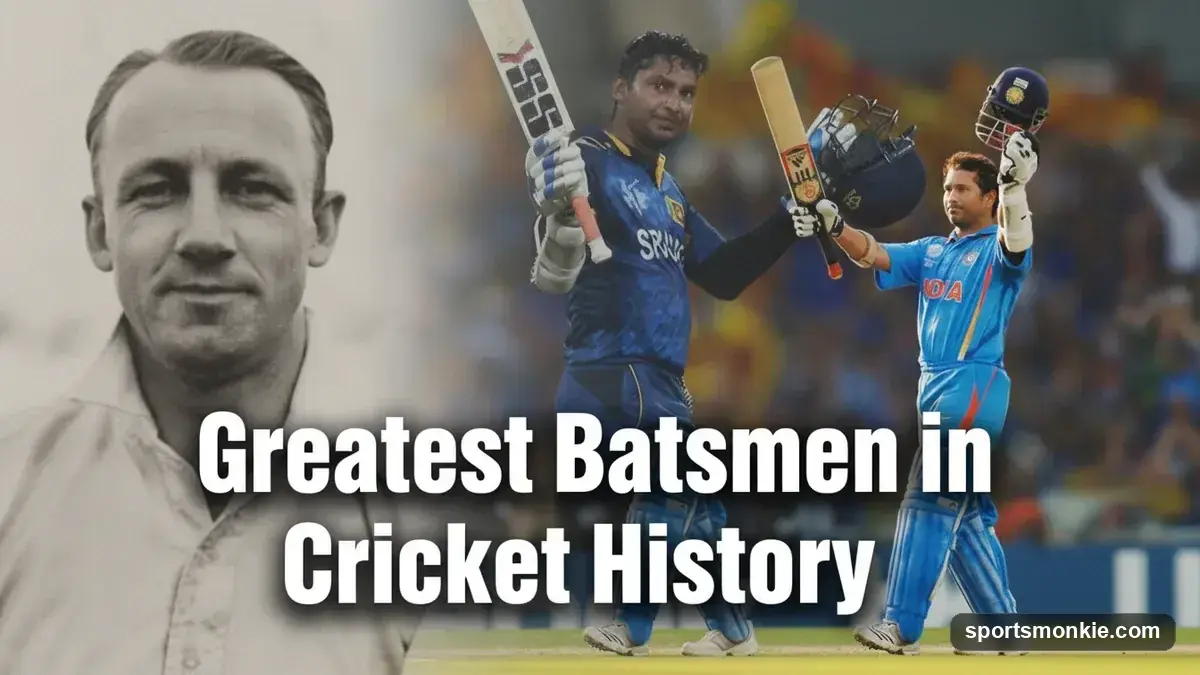
On this page17
- 01The greatest batsmen at a glance
- 02Don Bradman
- 03Sachin Tendulkar
- 04Brian Lara
- 05Vivian Richards
- 06Garfield Sobers
- 07Jacques Kallis
- 08Ricky Ponting
- 09Kumar Sangakkara
- 10Virat Kohli
- 11AB de Villiers
- 12Sunil Gavaskar
- 13Steve Smith
- 14How we ranked these batsmen
- 15Average versus volume: why the yardsticks disagree
- 16Why eras make direct comparison hard
- 17At a glance: the numbers behind the ranking
Placement is weighted first on career batting average against top-level bowling, then on total runs and the size of the individual records held, with cross-format impact used to separate close calls. A short peak loses to a decade of sustained output; a single big innings does not outrank a career.
The greatest batsmen at a glance
| Rank | Batter | Defining record |
|---|---|---|
| 1 | Don Bradman | Test average: 99.94 |
| 2 | Sachin Tendulkar | Record 15,921 Test runs |
| 3 | Brian Lara | Record Test score: 400 not out |
| 4 | Vivian Richards | Era-defining pace and strike rate |
| 5 | Garfield Sobers | Test average 57.78 plus elite all-round value |
| 6 | Jacques Kallis | 13,289 Test runs |
- In a category of one
Don Bradman
Bradman ranks first because the gap between him and everyone else is the largest in the sport, not because of any single innings. He played 52 Tests for Australia between 1928 and 1948 and finished with a Test average of 99.94 — no batter with a comparable career length has averaged even 65. Statisticians who measure the distance between the best and second-best in any major sport routinely cite his average as the biggest such gap that exists.
He scored 29 centuries in 80 innings against attacks that had no video analysis and no protective gear beyond a cap. He needed four runs in his final innings to close on exactly 100, was bowled second ball for a duck, and the number has stood untouched ever since.
Team: Australia · Career: 1928–1948 · Test avg: 99.94 · Defining feat: highest Test average ever, by ~40 points
- Career run leader
Sachin Tendulkar
Tendulkar ranks above the other high-volume names because no one has scored more runs in the history of the game. His 15,921 Test runs from 200 matches, at 53.78, sit nearly 3,000 clear of the next batter on the all-time list. Add 18,426 ODI runs at 44.83 and his international total crosses 34,000 runs with 100 centuries — a figure now used as shorthand for career longevity itself.
He debuted for India at 16 and retired 24 years later. What kept him at the top for so long was a textbook method he adjusted across two decades without ever abandoning its core.
Team: India · Career: 1989–2013 · Test runs: 15,921 · Defining feat: most Test and international runs ever
- Record-breaker
Brian Lara
Lara ranks here on the strength of the individual records no one else holds. His 11,953 Test runs came at 52.88 across 131 matches for the West Indies, but the number that defines him is 400 not out, scored against England in Antigua in 2004 and still the highest score in Test history. He had held the record before with 375 in 1994, lost it to Matthew Hayden's 380 in 2003, then took it back.
He also owns first-class cricket's individual record of 501 not out. What set him apart from other big scorers was timing over power — even his largest innings looked unhurried. His off-field profile is covered in our Brian Lara net worth breakdown.
Team: West Indies · Career: 1990–2007 · Test runs: 11,953 · Defining feat: 400* — highest Test score ever
- The intimidator
Vivian Richards
Richards ranks above pure accumulators because he combined intimidation with real statistical substance. He played 121 Tests for the West Indies between 1974 and 1991, scoring 8,540 runs at 50.23, and added 6,721 ODI runs at just under 47. The averages undersell him: he attacked at a strike rate a full generation before T20 made that normal.
He did it without a helmet, against some of the quickest bowling the sport has produced. Few batters have paired that level of on-field menace with numbers this durable.
Team: West Indies · Career: 1974–1991 · Test avg: 50.23 · Defining feat: era-defining strike rate, no helmet
- All-round genius
Garfield Sobers
Sobers ranks this high on his batting alone, before the all-round record is even mentioned. His 8,032 Test runs came at 57.78 across 93 matches for the West Indies between 1954 and 1974, including a then-record 365 not out in 1958 — a mark that stood for 36 years until Lara passed it.
Then add the other columns: 235 Test wickets and 109 catches. He is generally regarded as the most complete all-rounder the game has produced, and his batting on its own still belongs in this company.
Team: West Indies · Career: 1954–1974 · Test avg: 57.78 · Defining feat: batting great + 235 Test wickets
- Relentless accumulator
Jacques Kallis
Kallis ranks just below Sobers on the same axis — batting worthy of the top group, backed by a bowling record almost no one else carries. He retired in 2014 with 13,289 Test runs at 55.37 for South Africa while also taking 292 Test wickets and holding 200 catches. His ODI career added another 11,579 runs at 44.36.
Where Sobers is remembered for style, Kallis is remembered for output — a return no other player in cricket history has matched across bat, ball and slip cordon at once.
Team: South Africa · Career: 1995–2014 · Test runs: 13,289 · Defining feat: 13,000+ runs and 292 wickets
- Consistency at scale
Ricky Ponting
Ponting ranks on breadth rather than a single peak. He scored 13,378 Test runs at 51.85 across 168 matches for Australia, and was even more prolific in one-day cricket, where his 13,704 runs came at a strike rate that matched his intent at the crease.
He captained Australia to back-to-back World Cup titles in 2003 and 2007 and scored runs in every condition, from Australian bounce to English seam and Indian spin. That 17-year consistency is what separates him from batters with a higher ceiling but a shorter prime.
Team: Australia · Career: 1995–2012 · Test runs: 13,378 · Defining feat: two World Cups as captain
- Master of the long innings
Kumar Sangakkara
Sangakkara ranks here on a record that rewards batting big and often: the most Test double centuries by any player, 11 in total. He finished with 12,400 Test runs at 57.40 for Sri Lanka, built on patience over flash, and added 14,234 ODI runs at just under 42.
He rarely produced the highlight-reel single innings that define others on this list. His method was to convert starts into daylong occupations, series after series, with a technique that held up in every condition he faced.
Team: Sri Lanka · Career: 2000–2015 · Test avg: 57.40 · Defining feat: 11 Test double centuries (record)
- Modern white-ball king
Virat Kohli
Kohli ranks below the pure Test specialists because his red-ball average sits lower — he retired from Test cricket in May 2025 with 9,230 runs and 30 centuries from 123 matches at 46.85. His case for this group is built in white-ball cricket instead: a record 54 ODI centuries, passing Tendulkar's mark of 50 during the 2023 World Cup, and an ODI average near 58.7 — the highest of any batter with 10,000-plus runs in the format.
Across 311 ODIs he has scored 14,797 runs, trailing only Tendulkar all-time. Few players have paired that white-ball dominance with a genuine Test record.
Team: India · Career: 2008–present · ODI centuries: 54 (record) · Defining feat: highest ODI average at 10,000+ runs
- The innovator
AB de Villiers
De Villiers ranks on a record that reset the format's limits: the fastest ODI century in history, reached in 31 balls against the West Indies in 2015. He retired in 2018 with a Test average of 50.66 and an ODI average of 53.50 — figures that hold up on their own before the highlight reel.
Nicknamed "Mr 360" for scoring to every part of the ground, he blended orthodox technique with shots barely attempted in international cricket before him, and pushed limited-overs batting somewhere new.
Team: South Africa · Career: 2004–2018 · ODI avg: 53.50 · Defining feat: 31-ball ODI century (fastest ever)
- The pioneer opener
Sunil Gavaskar
Gavaskar ranks on being first past a barrier no one had reached: the first batsman to 10,000 Test runs, finishing in 1987 with 10,122 runs at 51.12 from 125 matches. He did it while opening — the position most exposed to a fresh new ball — and mostly without a helmet.
His hardest work came against the West Indies pace units widely regarded as the most hostile the sport has seen. The technique he built against that bowling became the template Indian batting followed for a generation.
Team: India · Career: 1971–1987 · Test runs: 10,122 · Defining feat: first to 10,000 Test runs
- The modern anomaly
Steve Smith
Smith ranks last here only because his story is still being written — his numbers already belong higher. He passed 10,000 Test runs in January 2025 and now sits above 10,700 at an average near 56, among the highest of any batter with 10,000-plus Test runs, per his ESPNcricinfo profile.
Built around an unorthodox trigger movement and exceptional judgment of length, his method has drawn Bradman comparisons from Australian selectors and former players — comparisons Smith himself has consistently played down.
Team: Australia · Career: 2010–present · Test runs: 10,700+ · Defining feat: elite average across 10,000+ Test runs
Reader interaction
Build your ranking
Drag the names into the order you think is right — or use the arrows — then submit to see how your list compares with everyone else's.
- Don Bradman
- Sachin Tendulkar
- Brian Lara
- Vivian Richards
- Garfield Sobers
- Jacques Kallis
- Ricky Ponting
- Kumar Sangakkara
- Virat Kohli
- AB de Villiers
- Sunil Gavaskar
- Steve Smith
Audience ranking
How everyone ranked them
Built from reader rankings using position-based points.
The order below is an argument, not a fact — but it is an argument built on the same few numbers every time. This section explains how those numbers were weighed, why the two main yardsticks so often disagree, and where era makes direct comparison unreliable.
How we ranked these batsmen
Four inputs decide placement, in priority order. First is career batting average against top-level bowling, because it measures how good a batter was per innings rather than how long they played. Second is total runs, which rewards sustained output over a decade or more. Third is the size of the individual records held — a world-record score or a format-defining century. Fourth, used only to break close calls, is impact across formats.
Bradman’s average puts him alone at the top; nothing else in the ranking is close to unanimous. Below him, the list favors players who accumulated for well over a decade at the top level over shorter careers with a higher peak. Figures are drawn from ESPNcricinfo’s official records and are current as of August 2026; active players’ numbers will move.
Average versus volume: why the yardsticks disagree
The two headline stats reward opposite things. A batting average is largely era-neutral and favors efficiency — Bradman and Sobers sit near the top on this measure with far fewer runs than the volume leaders. Total runs reward longevity and durability, which is why Tendulkar, Kallis and Ponting dominate that column despite lower averages.
Neither is “right” on its own. A player who retires early with a brilliant peak can top the average charts and still sit mid-table on runs; a 20-year career can pile up runs while the average drifts down. This ranking treats average as the primary filter and uses total runs to separate players who are otherwise close.
Why eras make direct comparison hard
Bradman never faced a white-ball format, a reverse-swinging older ball under lights, or a bowler working from a laptop of his weaknesses. Modern batters play far more cricket per year, against faster bowling data, but also with better protective gear and flatter pitches. Comparing a 1930s Test average to a 2020s one is never fully clean.
The list handles this by leaning on average — the stat that travels best across generations — while crediting records that simply did not exist earlier, such as the fastest ODI century. That is why modern white-ball greats appear alongside players who retired before one-day cricket was invented.
At a glance: the numbers behind the ranking
| Rank | Batsman | Country | Test avg | Test runs | Defining record |
|---|---|---|---|---|---|
| 1 | Don Bradman | Australia | 99.94 | 6,996 | Highest Test average ever, by ~40 points |
| 2 | Sachin Tendulkar | India | 53.78 | 15,921 | Most Test and international runs |
| 3 | Brian Lara | West Indies | 52.88 | 11,953 | 400* — highest Test score |
| 4 | Vivian Richards | West Indies | 50.23 | 8,540 | Era-defining strike rate |
| 5 | Garfield Sobers | West Indies | 57.78 | 8,032 | Batting great + 235 Test wickets |
| 6 | Jacques Kallis | South Africa | 55.37 | 13,289 | 13,000+ runs and 292 wickets |
| 7 | Ricky Ponting | Australia | 51.85 | 13,378 | Two World Cups as captain |
| 8 | Kumar Sangakkara | Sri Lanka | 57.40 | 12,400 | 11 Test double centuries (record) |
| 9 | Virat Kohli | India | 46.85 | 9,230 | 54 ODI centuries (record) |
| 10 | AB de Villiers | South Africa | 50.66 | 8,765 | 31-ball ODI century (fastest) |
| 11 | Sunil Gavaskar | India | 51.12 | 10,122 | First to 10,000 Test runs |
| 12 | Steve Smith | Australia | ~56 | 10,700+ | Elite average past 10,000 runs |
Frequently asked questions
Why is Bradman ranked first if Tendulkar scored more runs?+
Because the two measure different things. Tendulkar's 15,921 Test runs reward a 24-year career and are the most in history, but volume rises with longevity. Bradman's 99.94 average measures how good he was per innings, and it is roughly double most all-time greats. When one player is that far ahead on the quality yardstick, total runs from a longer career do not close the gap.
Has any batsman come close to Bradman's 99.94 average since?+
No one with a substantial career has. Among batters with 20-plus Tests, the next-best career averages sit in the high 50s and low 60s — names like Sobers (57.78), Sangakkara (57.40) and Kallis (55.37). That leaves a gap of nearly 40 points between Bradman and the rest, which is why his figure is treated less like a record and more like a fixed marker for the sport.
Where do white-ball greats like Kohli and de Villiers rank against Test specialists?+
Lower than their talent alone suggests, because this list leans on Test average, where both trail the pure red-ball names. Kohli's Test average of 46.85 and de Villiers' 50.66 sit below Sobers, Kallis and Sangakkara. They make the ranking on records that did not exist in earlier eras — Kohli's 54 ODI hundreds, de Villiers' 31-ball century — rather than on Test numbers.
Why isn't a T20 specialist included on the list?+
T20 internationals are too short a format to build the career body of work this ranking rewards. Averages swing wildly over a handful of overs, and the format has existed only since 2005, so no player has the two-decade sample the top names carry. Several batters here, including Kohli and de Villiers, were elite in T20 too — but their case rests on Test and ODI records, not the shortest format.
Do these rankings favor batsmen from older eras?+
They try not to. Older players benefit from settled, complete careers, but modern batters face year-round schedules, faster bowling data and more formats. The list balances this by weighting career average — which travels across eras — while also crediting modern records like the fastest ODI century that earlier generations never had a chance to set. Bradman leads on average; several picks are active players.
What's the difference between judging a batsman on average versus total runs?+
Average measures quality per innings and is largely era-neutral, so it favors efficient batters like Bradman and Sobers. Total runs measure accumulated output and reward longevity, favoring Tendulkar, Kallis and Ponting. A short, brilliant career can top the average charts while sitting mid-table on runs. This list uses average as the primary filter, then total runs to separate players who are close on quality.
Sources
Play & tools
Free browser games and tools — no account, no download.
- Play today's Sports Connections — Today's Sports Connections — daily hints, answers, and play the grid.
- Play Guess the NFL Player — A new mystery NFL player every day. Eight guesses, with a clue on each — plus free unlimited mode.
- Explore all our games →
Related cricket guides
View all →
Most Successful Cricket Teams in History: The All-Time Rankings
Every major cricket nation ranked by ICC titles: Australia's 10 trophies, the West Indies dynasty, India's seven, and South Africa's 2025 WTC breakthrough.
Longest Six in Cricket History: Shahid Afridi's Disputed 153m Claim, Ranked
Shahid Afridi's 153–160m six at the Wanderers in 2013 is the most-cited longest six in cricket history, but independent remeasurement puts it closer to 100–120m. Every major claim from 1856 to 2026, ranked and fact-checked.
Most Successful Cricket Captains of All Time
The 12 most successful cricket captains ever, ranked by ICC trophies won and win records — from MS Dhoni's white-ball treble to Graeme Smith's Test mark.
Greatest All-Rounders in Cricket History, Ranked
The 12 greatest all-rounders in cricket history, ranked from Garfield Sobers to Ben Stokes, each with the Test batting and bowling numbers that back the case.
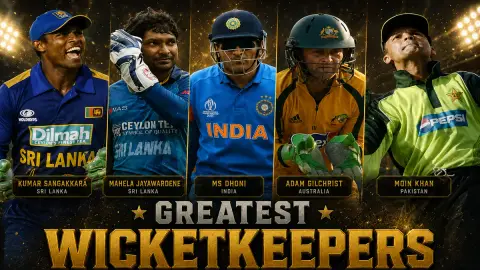
Greatest Wicketkeepers in Cricket History, Ranked
The 13 greatest wicketkeepers in cricket history, ranked and named — Gilchrist, Dhoni, Sangakkara, Boucher, Healy, Knott and more, with their dismissal records.
Best Cricket Coaches Ever: 12 Greatest Ranked (2026)
John Buchanan leads our best cricket coaches ranking. See the all-time top 12 plus the 2026 cases for Gautam Gambhir, Andrew McDonald and Gary Kirsten.