
How Big Is a Soccer Field? Official Dimensions Explained
On this page6
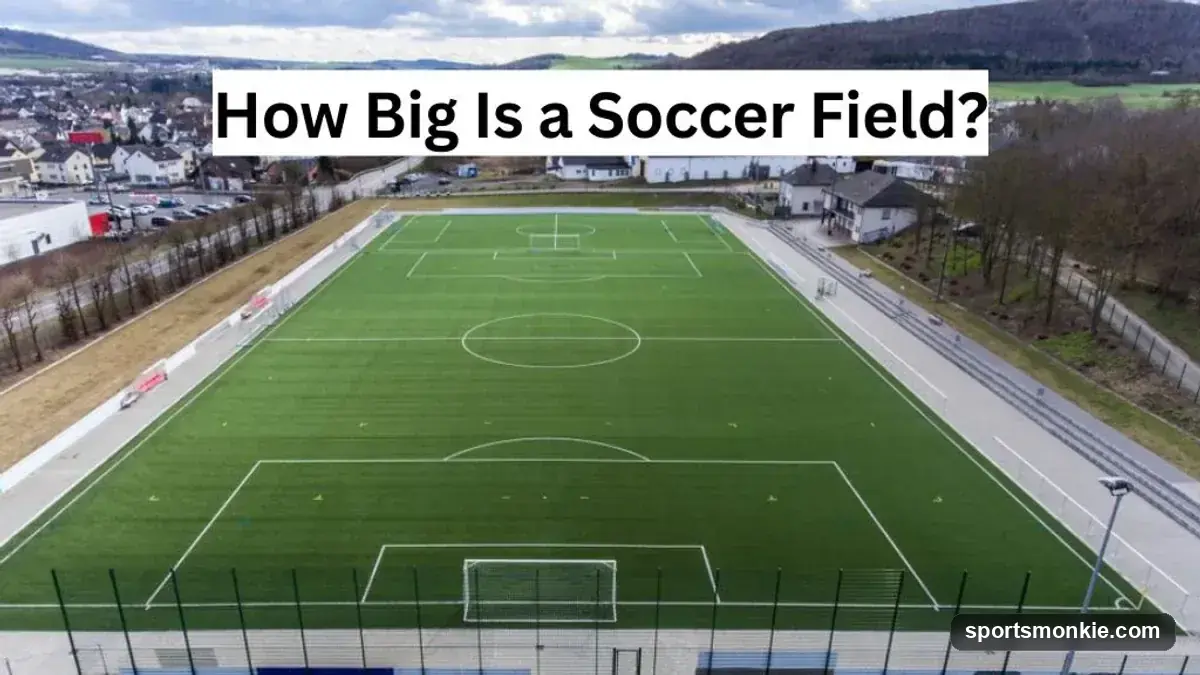
No two soccer stadiums necessarily use the same size pitch, and that’s by design. FIFA’s Laws of the Game set a range rather than a fixed number: 90 to 120 metres long, 45 to 90 metres wide for domestic play, narrowing to 100-110 by 64-75 metres once a match goes international.
Official FIFA dimensions at a glance
| Measurement | Domestic match | International match |
|---|---|---|
| Length (touchline) | 90–120 m (100–130 yds) | 100–110 m (110–120 yds) |
| Width (goal line) | 45–90 m (50–100 yds) | 64–75 m (70–82 yds) |
| Goal width | 7.32 m (8 yds) | 7.32 m (8 yds) |
| Goal height | 2.44 m (8 ft) | 2.44 m (8 ft) |
| Penalty spot distance | 11 m (12 yds) from goal line | 11 m (12 yds) |
| Centre circle radius | 9.15 m (10 yds) | 9.15 m (10 yds) |
Goal dimensions and marking measurements are fixed regardless of pitch size.
Key markings on a soccer pitch
Every regulation pitch shares the same set of markings:
- Centre circle — 9.15 m radius; opposing players must stay outside it at kick-off
- Penalty area — 40.32 m wide, 16.5 m deep; fouls inside lead to a penalty kick
- Goal area — smaller box inside the penalty area, 18.32 m wide and 5.5 m deep; goalkeeper’s domain
- Penalty spot — 11 m from the goal line; where penalty kicks are taken
- Corner arc — quarter-circle of 1 m radius at each corner flag
Why the size range exists
Most sports with a ball and a field settled on one fixed size long ago. Soccer never did, largely because pitches were built into existing stadiums well before anyone standardized the sport, and the Laws of the Game simply codified the range that already existed. Most professional clubs now sit toward the larger end of that range, since more space on the pitch tends to reward teams that pass and press rather than play direct.
How pitch size affects the game
Pitch dimensions have a tangible effect on playing style:
- Larger pitches create more space, favoring technically gifted teams that press and circulate possession
- Smaller pitches compress space, cutting down the time players have on the ball, which often suits more physically direct teams
- Home advantage — some clubs pick pitch dimensions, within the legal range, that suit their own style and unsettle visiting teams
That is why pitch size belongs next to tactics. A wide field changes how soccer formations stretch, press and recover, while a tight field makes direct play and compact defending more natural.
Comparison with other sports
| Sport | Field/court length | Width |
|---|---|---|
| Soccer (football) | 90–120 m | 45–90 m |
| American football | 109 m (incl. end zones) | 48.8 m |
| Rugby union | up to 100 m (in-goal separate) | 68–70 m |
| Cricket (oval) | Varies | Varies |
Futsal and small-sided variations
Futsal, the indoor version of the game, is played on a much smaller court: 25 to 42 metres long, 15 to 25 metres wide. Five-a-side and other small-sided formats shrink the dimensions further still, and those sizes come from local associations rather than FIFA. For the playing rules that go with that smaller court, see our futsal rules guide.
Want more on the theme? Read ECNL vs MLS NEXT next.
For the wider context, we break down Futsal vs Indoor Soccer separately.
Frequently asked questions
What are the official dimensions of a soccer field?+
FIFA laws state that a soccer field must be 90–120 metres (100–130 yards) long and 45–90 metres (50–100 yards) wide. For international matches, the range is narrower: 100–110 metres long and 64–75 metres wide.
Is a soccer field the same size as an American football field?+
No. An American football field is 100 yards long between end zones, with a fixed width of about 53.3 yards. A soccer pitch is typically wider and can be longer depending on the venue.
Why do soccer field sizes vary between stadiums?+
FIFA's Laws of the Game allow a range of dimensions rather than a single fixed size, giving clubs flexibility to fit pitches within existing stadium structures. However, pitch dimensions within a league are often regulated more tightly to ensure consistent play conditions.
What is the recommended standard soccer pitch size?+
For elite matches, a pitch of 105 by 68 metres (about 115 by 74 yards) is the widely recommended standard, and UEFA requires it for its top competitions. It sits comfortably within FIFA's international range and has become the default for most modern professional stadiums.
How big is the penalty area on a soccer field?+
The penalty area is 40.32 metres (44 yards) wide and extends 16.5 metres (18 yards) out from the goal line. Fouls by the defending team inside it usually result in a penalty kick, taken from the spot 11 metres (12 yards) from goal.
What are the maximum and minimum sizes for a soccer pitch?+
Under FIFA's Laws of the Game, a domestic pitch can be as long as 120 metres and as short as 90 metres, and as wide as 90 metres or as narrow as 45 metres. International matches use a tighter band of 100–110 metres long and 64–75 metres wide.
Can a soccer pitch be made of artificial turf?+
Yes. FIFA permits approved artificial and hybrid surfaces as well as natural grass, provided they meet quality standards and are coloured green. Many stadiums in cold climates and lower divisions use artificial or hybrid pitches, though most elite clubs still prefer natural grass.
Sources
Play & tools
Free browser games and tools — no account, no download.
- Play 38-0 — Sign a 4-4-2 of all-time football legends and chase a perfect 38-0 league season — perfect, not just unbeaten.
- Explore all our games →
Related football guides
View all →
Soccer Ball Weight and Pressure: Official FIFA Standards
A FIFA-approved match ball must weigh 410 to 450 grams and be inflated to 0.6-1.1 atmospheres (8.5-16 psi) at sea level under the Laws of the Game.
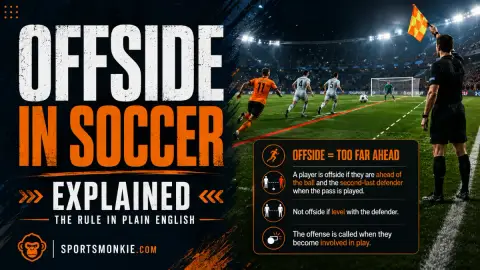
Offside in Soccer Explained: The Rule in Plain English
Offside is called when an attacker is nearer the goal than the ball and the second-last defender as the ball is played. See how the offside rule works.
How Tall Is a Tennis Net? Official Height and Dimensions
A tennis net is 91.4 cm (3 ft) tall at the centre and 107 cm (3 ft 6 in) at the posts. These ITF measurements apply to all sanctioned tennis play.
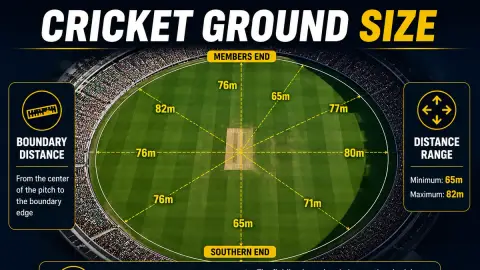
Cricket Ground Size: Dimensions, Boundaries & Field Layout
There is no fixed cricket ground size: ICC playing conditions set a boundary of 65 to 90 yards from the pitch centre, so grounds vary widely in shape and scale.

How Long Is a Soccer Game? Full Time, Stoppage & More
A soccer game is 90 minutes, split into two 45-minute halves. Add stoppage time, extra time, and penalties and it can stretch well beyond two hours.
Carrick Benches Fernandes for Bournemouth and Calls It Pure Football
Michael Carrick dropped Manchester United captain Bruno Fernandes for Sunday's Bournemouth game days after Fernandes criticised his tactics following the 4-1 loss at Como, insisting the call was pure football.