
Cricket Ground Size: Dimensions, Boundaries & Field Layout
On this page6
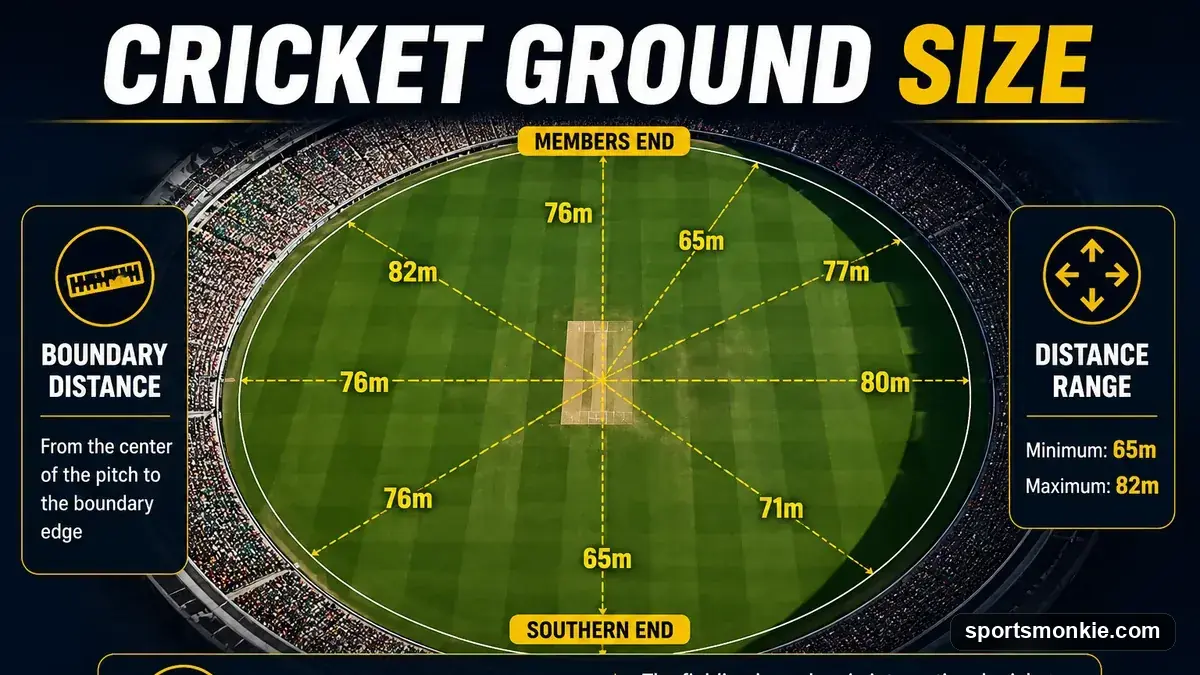
A cricket ground has no single fixed size, and the Laws of Cricket do not give it one. Law 19 simply requires the umpires to fix the boundary before the toss. The familiar numbers — 65 to 90 yards from the centre of the pitch — come from the ICC playing conditions that govern international matches, not from the Laws themselves. The pitch at the middle is always 22 yards long, but the outfield, boundary distances, and overall shape vary from ground to ground.
Football pitches are all roughly the same size; cricket grounds are not, and never have been. A six that clears the rope at one venue would be a routine catch at another, because grounds are free to be lopsided within the ICC’s range and most of them are.
What the ICC playing conditions actually require
| Measurement | Minimum | Maximum |
|---|---|---|
| Boundary from pitch centre, men’s internationals | 65 yards (59.43 m) | 90 yards (82.29 m) |
| Boundary from pitch centre, women’s internationals | 60 yards (54.86 m) | 70 yards (64.0 m) |
| Straight boundary, both ends (ICC ground requirement) | 70 yards (64.0 m) | — |
| Playing area across, square of the pitch | 150 yards (137.16 m) | — |
| Gap between boundary rope and perimeter fencing | 3 yards (2.74 m) | — |
Two things are worth being precise about. First, these are requirements for international cricket set by the ICC’s clause 19, not by the MCC Laws — club and school grounds are bound by neither. Second, the rules carry a written exemption: a ground already approved to host international cricket that cannot meet the 65-yard minimum is excused from it. That is why a handful of long-established Test venues still play with a short boundary in one direction. The three-yard gap between rope and fencing exists so fielders can chase and dive without hitting an advertising board.
The pitch within the ground
At the centre of any cricket ground sits the pitch, a rectangular strip 22 yards (20.12 metres) long and 10 feet (3.05 m) wide. Those numbers never change, no matter how big or small the ground around it is. What varies is everything beyond it: the outfield and the boundary.
| Pitch element | Dimension |
|---|---|
| Pitch length (stump to stump) | 22 yards / 20.12 m |
| Pitch width | 10 feet / 3.05 m |
| Popping crease, in front of the stumps | 4 feet / 1.22 m |
How ground size actually affects the game
Long boundaries punish batters who try to clear the rope and reward the ones who can find gaps and run hard between the wickets. Short boundaries do the opposite: mis-hits carry for six, and totals in T20 and ODI cricket climb. Tournament organisers know this, which is why major events sometimes specify minimum boundary distances at host venues, so a small ground doesn’t turn into a batting carnival that skews the whole competition.
Notable cricket grounds and their sizes
| Ground | Country | Notable feature |
|---|---|---|
| Narendra Modi Stadium | India | World’s largest by capacity, about 132,000 seats |
| Melbourne Cricket Ground (MCG) | Australia | Among the largest playing areas, roughly 174 m x 149 m fence to fence |
| Lord’s Cricket Ground | England | Iconic slope across the ground |
| Eden Gardens | India | Large seating capacity, urban ground |
| Newlands | South Africa | Table Mountain backdrop, mid-sized ground |
Published boundary figures for individual grounds should be treated with care. Very few venues publish official measurements, ropes are moved between formats and even between matches on the same tour, and the numbers that circulate online are often estimates rather than surveyed distances.
Oval vs circular grounds
Most cricket grounds are oval or roughly circular, unlike a rectangular football pitch, and that shape means the boundary at mid-on can sit noticeably closer or further than the one behind the keeper at fine leg. Nobody corrects for this. Both teams play on the same ground in the same match, so the asymmetry cancels out fairly enough over an innings.
The other markings on the ground
The 30-yard marking is not a true circle: it is two semicircles of 30-yard radius, each drawn from the middle stump at one end, joined by two lines parallel to the pitch. It defines the fielding-restriction zone in limited-overs cricket. The square is the prepared strip of turf at the centre where the actual pitches are cut, often several across a season so the ground doesn’t wear one strip down to dust. Everything else, outside the square and the pitch itself, is the outfield.
Boundary requirements are revised periodically in the ICC playing conditions. Figures here reflect the conditions current in July 2026; check the ICC’s published playing conditions for the version in force for a given series.
Frequently asked questions
What is the standard size of a cricket ground?+
Cricket grounds do not have a single fixed size. The MCC Laws of Cricket set no dimensions at all — Law 19 only says the umpires must fix the boundary before the toss. The numbers people quote come from ICC playing conditions for international matches, which require no boundary shorter than 65 yards (59.43 m) or longer than 90 yards (82.29 m) from the centre of the pitch.
What is the minimum boundary size in cricket?+
For men's international cricket the ICC minimum is 65 yards (59.43 m) from the centre of the pitch. The ICC's ground requirements also ask for at least 70 yards (64 m) on the straight boundaries at each end and a playing area at least 150 yards (137.16 m) across square of the pitch. A three-yard (2.74 m) gap must separate the boundary rope from any perimeter fencing or advertising boards.
Can a ground host internationals if its boundaries are shorter than 65 yards?+
Yes. The ICC playing conditions include an explicit exemption: any ground already approved to host international cricket that cannot meet the minimum boundary dimension is exempt. That grandfather clause is why several long-established venues still play international matches with a boundary under 65 yards in at least one direction.
Which is the biggest cricket ground in the world?+
The Narendra Modi Stadium in Ahmedabad, India, is the world's largest cricket ground by seating capacity at about 132,000. By playing area the Melbourne Cricket Ground is among the biggest, with an arena roughly 174 m by 149 m fence to fence.
Why do cricket grounds vary in size?+
Because nothing in the Laws of Cricket fixes a ground's dimensions. The ICC's minimum and maximum boundary distances apply to international matches only, and even then older venues are exempt. Many grounds were built to fit the land available or are shared with other sports, so boundaries differ between venues and often between directions on the same ground.
Are the boundary rules the same in women's international cricket?+
No. The ICC women's playing conditions use a smaller range: no boundary shorter than 60 yards (54.86 m) and none longer than 70 yards (64 m) from the centre of the pitch, against 65 to 90 yards in the men's game.
What is the 30-yard circle on a cricket ground?+
It is not really a circle. The marking is two semicircles of 30 yards (27.43 m) radius, each centred on the middle stump at one end of the pitch and joined by two lines parallel to the pitch. It defines the fielding-restriction zone in limited-overs cricket, capping how many fielders may stand outside it in each phase of an innings.
Sources
Play & tools
Free browser games and tools — no account, no download.
- Play today's Sports Connections — Today's Sports Connections — daily hints, answers, and play the grid.
- Play Guess the NFL Player — A new mystery NFL player every day. Eight guesses, with a clue on each — plus free unlimited mode.
- Explore all our games →
Related cricket guides
View all →
Cricket Pitch Length in Feet: Test, ODI & T20 Dimensions
A cricket pitch is 22 yards (66 feet / 20.12 m) long in Test, ODI, and T20 - the length is the same across all senior formats; only the overs differ.
Ultimate Frisbee Rules Explained: Field Size, Stall Count and Fouls
Ultimate frisbee rules explained for beginners: players, field size, scoring, turnovers, stall count, pulls, fouls, picks, travels and Spirit of the Game.
What Is a Dead Ball in Cricket? Rule and Common Situations
A dead ball is a delivery from which no runs score and no batter is out. Learn when the ball goes dead, who decides, and why it matters in a tight finish.
DLS Method in Cricket Explained: How Rain Targets Are Set
The Duckworth-Lewis-Stern (DLS) method resets targets in rain-hit limited-overs cricket using overs and wickets left. Here's the logic, with examples.
Padel Court Dimensions and Space Needed
Official padel court dimensions from the 2026 FIP rules: 20m x 10m court size, net height, service lines, walls, ceiling height and build footprint.
Pickleball Court Dimensions and Space Needed
Official pickleball court dimensions: 20 x 44 ft lines, 30 x 60 ft minimum playing surface, 34 x 64 ft preferred space, kitchen, net and layout.