
Why Do Soccer Players Flop? Diving and Simulation Explained
On this page5
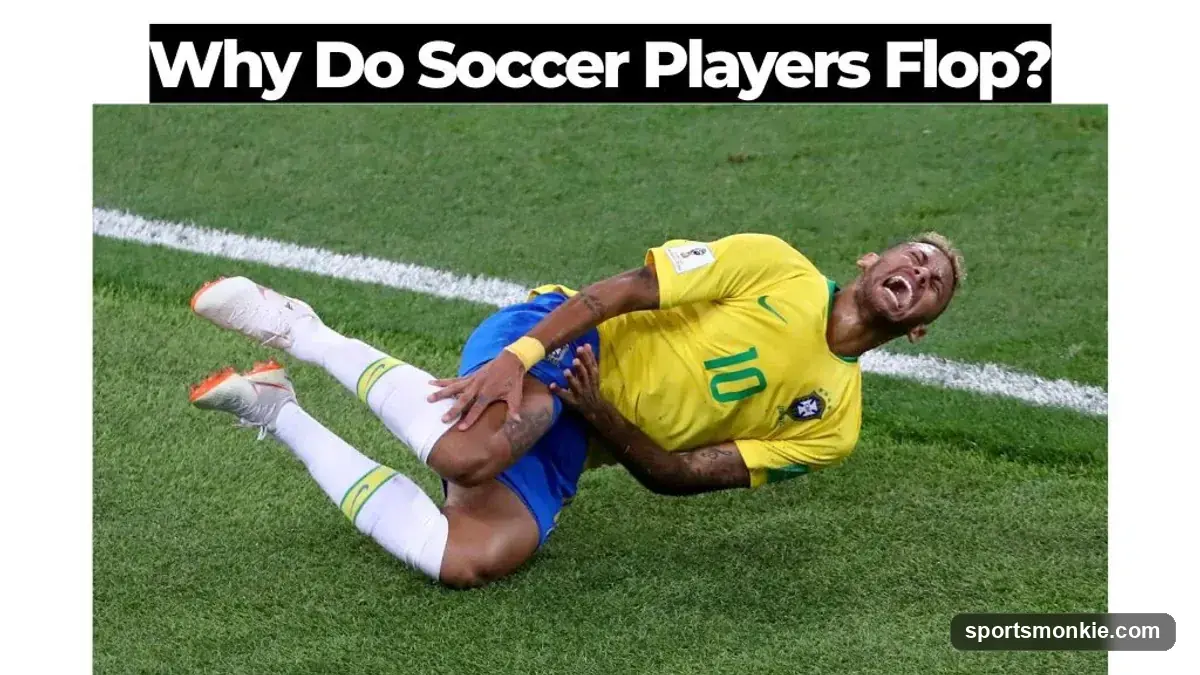
A striker takes a light brush on the shoulder inside the box and goes down like he’s been shot. Replays show barely any contact. The referee points to the spot anyway. That single decision, worth close to a goal on its own, is why flopping keeps happening no matter how many pundits complain about it. Officially it’s called simulation, and it’s a yellow-card offence, but the reward for pulling it off can outweigh the risk of getting caught.
Nobody agrees on how to talk about it. Some call it cheating that chips away at the sport’s credibility; others shrug and call it gamesmanship, just another edge to find in a contact sport with a lot of grey area. Either way, the behavior only makes sense once you look at what’s actually on offer, how hard it is for referees to catch, and what the game has tried to do about it.
Why Players Flop: The Incentive Structure
The core reason simulation occurs is straightforward: the rewards can be enormous.
| Potential Outcome | Value to the Team |
|---|---|
| Free kick in a dangerous area | Scoring opportunity, set piece |
| Penalty kick | Roughly 75-80% conversion rate, close to a guaranteed goal |
| Opponent yellow card | Restricts that player’s tackling for the rest of the match |
| Opponent red card | Numerical advantage for up to 90 minutes |
In a sport where one goal often decides the match, winning a penalty through simulation can change the result outright. Getting a yellow card in exchange for that looks like a fine trade to a lot of players.
Why Referees Struggle to Catch It
A few things work against the officials here.
Speed. Matches move fast, and referees are often watching from a single angle, twenty or thirty yards away, with no time to rewind.
Real contact usually exists. Most dives aren’t invented from nothing. A defender’s boot grazes an ankle, and the attacker turns a stumble into a collapse. Spotting the exaggeration in that split second is harder than spotting a pure fake.
Reputation cuts both ways. A player already known as a diver gets less benefit of the doubt; a player with a clean reputation gets more, fairly or not.
Why It’s Worse in Some Leagues Than Others
Simulation rates shift depending on the league and the football culture around it, though no top competition is free of it. Players respond to whatever incentive structure they’re playing under. Where diving goes unpunished and keeps winning matches, it becomes part of how a team plays, not an occasional cheat. It’s also worth saying that some of what looks like diving starts as a genuine flinch, a player protecting his body from a hard, late challenge rather than manufacturing contact from nothing.
What the Game Has Tried
Yellow cards. Under Law 12, deliberate simulation is unsporting behavior and draws a yellow card. In practice, referees hand these out less than the rule implies, mostly because certainty is hard to reach in real time.
VAR. Now standard at the World Cup, the Champions League, and most major domestic leagues, VAR lets officials review penalty decisions after the fact. It can overturn a wrongly awarded penalty and card a player caught faking contact.
After-the-match review. A few leagues have experimented with disciplinary panels that watch footage once the game is over and hand out bans for clear dives that slipped past the referee.
Referee training. FIFA and IFAB now publish guidance specifically aimed at helping referees tell a genuine foul reaction from a staged one.
Does It Still Work?
At the top level, with VAR watching, simulation inside the penalty area succeeds less often than it used to. Outside the box, in leagues without video review, or in youth football, it still works about as well as it ever did, because there’s no footage to check.
For the incidents that made simulation famous in the first place — Rivaldo’s face-clutch against Turkey, Ashley Young’s “greatest dive of all time,” and more — see our ranking of the funniest comedy fouls in football.
Frequently asked questions
What is flopping called in soccer?+
In soccer, flopping is officially called simulation. It refers to a player deliberately falling or exaggerating contact to deceive the referee into awarding a free kick, penalty, or a card against an opponent.
What happens if a soccer player is caught diving?+
A player caught simulating a foul receives a yellow card for unsporting behaviour under Law 12 of the Laws of the Game. VAR (Video Assistant Referee) can also overturn wrongly awarded penalties and issue cards for simulation.
Why do referees not always punish diving in soccer?+
Referees must make split-second decisions with limited viewing angles, and the line between a genuine reaction to contact and deliberate simulation is often difficult to judge in real time. VAR has improved detection in top-level competitions.
Sources
Play & tools
Free browser games and tools — no account, no download.
- Play 38-0 — Sign a 4-4-2 of all-time football legends and chase a perfect 38-0 league season — perfect, not just unbeaten.
- Explore all our games →
Related football guides
View all →
Offside in Soccer Explained: The Rule in Plain English
Offside is called when an attacker is nearer the goal than the ball and the second-last defender as the ball is played. See how the offside rule works.
What Is Tackling in Soccer? Types, Rules, and Technique
Tackling in soccer is a defensive skill used to dispossess an opponent. Learn the types of tackles, when they are legal, and what makes a tackle a foul.

Morgan Gibbs-White Blasts VAR Over-reliance After Forest's Ipswich Draw
Forest's captain agreed Issa Diop's yellow was probably right, but asked why VAR had to intervene at all, while Oliver Glasner called it a clear red.

Why Did Marmoush's Goal Stand After He Caught Van Ewijk With an Elbow?
Omar Marmoush's first Tottenham goal survived a VAR check for an elbow on Milan van Ewijk. Lampard thought it would go; Hackett says doubt means it stands.

Why Could VAR Not Send Off Morgan Rogers at Everton?
Three former referees said Morgan Rogers should have been punished for his tackle on James Garner at Everton. VAR could not give him a second yellow. Here is why.

Botman Escapes a Red Card at Newcastle as Jackson Says He Nearly Broke His Leg
Sven Botman stayed on after a VAR check for serious foul play against Aston Villa, with the referee's own published words calling the challenge reckless.