
Why Are Tennis Balls Pressurized? The Science Explained
On this page7
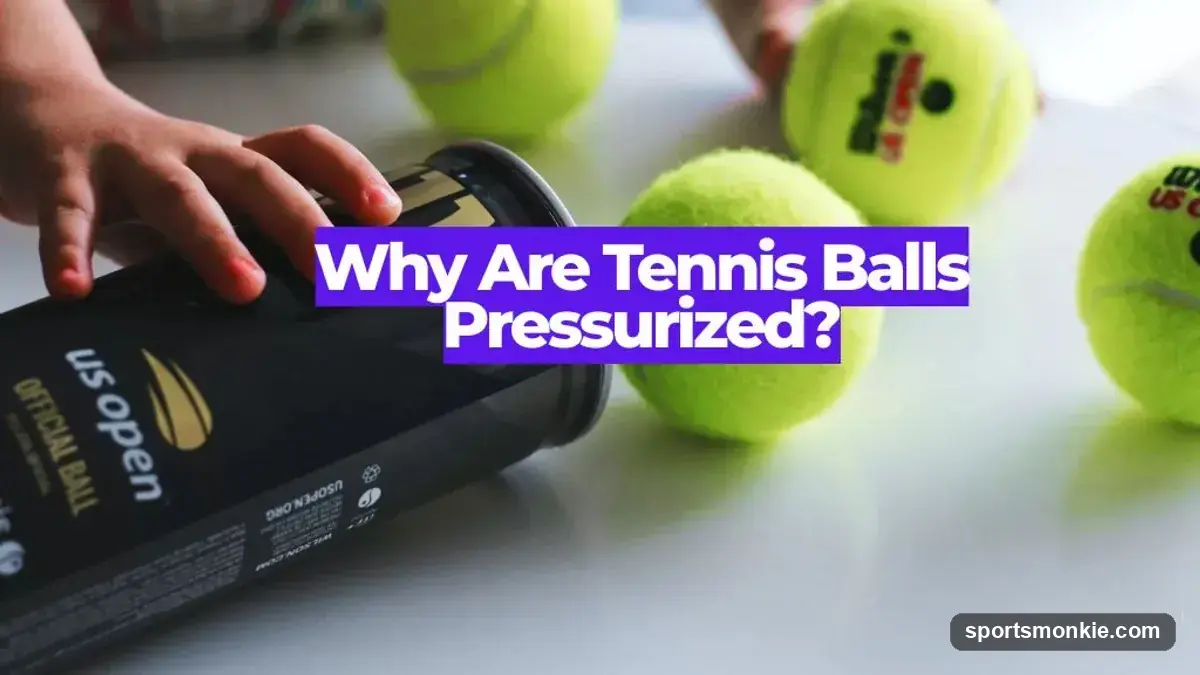
Crack open a new can of tennis balls and you’ll hear a hiss. That’s not packaging flair, it’s the reason the balls inside still bounce. Pop that seal and the clock starts: within weeks, even balls that never touch a court will play flatter, because the air pressure that makes them lively begins leaking out the moment the can opens.
How a tennis ball is built
A pressurized ball has two parts. Two half-shells of vulcanized rubber get joined into a hollow core, then a felt cover, usually a nylon-wool blend, gets glued over the outside to control how it moves through the air and grips the court. Inside that rubber shell sits air or nitrogen pumped in above normal atmospheric pressure. That trapped gas is what makes the ball feel alive instead of like a dead lump of rubber.
Why pressure equals bounce
Hit the ground and the ball flattens for a fraction of a second. The compressed air inside pushes back against that flattening and shoves the ball back into shape, which is what sends it rebounding off the court. The bigger the pressure gap between inside and outside, the snappier that rebound, and the higher the ball jumps.
| Ball Type | Bounce Source | Lifespan |
|---|---|---|
| Pressurized | Internal air pressure | Short — degrades with play and time |
| Pressureless | Dense rubber core material | Long — suitable for practice/machines |
Why balls go dead
Rubber seems airtight, but it isn’t quite. Gas slowly works its way through the rubber wall over weeks and months, a process called permeation, and as it escapes, the internal pressure drops and the shell softens. Players feel it as a ball that thuds instead of pings, heavier in the hand and shorter off the strings.
Why the can is pressurized too
Cans of tennis balls are pressurized to match the pressure inside the balls themselves, so nothing leaks out before a player ever opens the can. Crack the seal and that protection ends: the balls start equalizing with room air right away, which is why players who care about consistency open a fresh can shortly before they play rather than days ahead.
Altitude changes everything
A standard ball is tuned to bounce within ITF limits at sea level. Take it up to altitude, where the surrounding air is thinner, and the same ball suddenly bounces higher and faster, because the pressure gap between inside and outside has effectively grown. That’s why the ITF approves separate high-altitude and low-pressure balls for elevated cities. Mexico City and Bogotá both use them for sanctioned play.
What the ITF actually regulates
Ball specs aren’t left to manufacturers to decide on their own. The ITF sets limits on:
- Diameter
- Weight
- Bounce height from a fixed drop height onto a set surface
- Compression under load
Every ball used on the ATP and WTA tours or at a Grand Slam has to clear these tests, regardless of brand.
Where pressureless balls fit in
Pressureless balls aren’t legal for tour-level competition. They bounce differently and sit heavier in the hand. But they’re the standard choice for:
- Ball machines, since they can absorb thousands of hits without going dead
- Beginner lessons
- Rally and drilling sessions
- Anyone who just wants balls that last
Their aging runs the opposite direction from pressurized balls too. Instead of softening, they harden with wear, which changes how they play over time rather than killing the bounce outright.
Frequently asked questions
Why are tennis balls pressurized?+
Tennis balls are pressurized to give them their lively, consistent bounce. The internal air pressure keeps the rubber shell firm and springy. Without internal pressure, the rubber would be too soft and the ball would bounce too low and feel dead.
Do tennis balls lose pressure over time?+
Yes. The pressurized gas inside slowly diffuses through the rubber wall over time. This is why tennis balls lose their bounce after use and why unopened cans — which are also pressurized — preserve balls for longer.
What is a pressureless tennis ball?+
Pressureless tennis balls have a thicker, denser rubber core that provides bounce through the material itself rather than internal air pressure. They do not go dead like pressurized balls and are commonly used for practice, ball machines, and beginners because they last much longer.
Sources
Play & tools
Free browser games and tools — no account, no download.
- Play today's Sports Connections — Today's Sports Connections — daily hints, answers, and play the grid.
- Play Guess the NFL Player — A new mystery NFL player every day. Eight guesses, with a clue on each — plus free unlimited mode.
- Explore all our games →
Related tennis guides
View all →
Why Do Tennis Balls Have Fuzz? The Real Aerodynamic Reason
Why do tennis balls have fuzz? The wool-nylon nap doubles aerodynamic drag, slows the ball, grips spin, and meets ITF's 56.0-59.4g spec.

Why Do Tennis Players Grunt? The Science Behind It
Tennis players grunt because the sharp exhale at ball contact stabilises the core, releases tension and can boost power. It's a habit from early training.
What Color Is a Tennis Ball? The Science Behind the Yellow-Green
Tennis balls are officially optic yellow, a shade between yellow and green. It was adopted in 1972 to improve visibility on colour television broadcasts.
What Is Deuce in Tennis? Score, Advantage, and Tiebreaks
Deuce in tennis means both players have reached 40, so one player must win two straight points to take the game.
What Is Hawk-Eye in Tennis? How Electronic Line Calling Works
Hawk-Eye uses multiple cameras and ball-tracking software to judge whether a tennis shot landed in or out.
Walkover vs Retirement in Tennis: What Is the Difference?
A walkover happens before a match begins; a retirement happens after play starts. The distinction affects results, records and tournament administration.