
What Is Tennis Elbow? Causes, Symptoms, and Treatment
On this page7
Most people who get tennis elbow have never held a racket. Painters, plumbers, carpenters, and anyone who spends the day gripping tools or typing can end up with the same tendon damage as a club player with a shaky backhand. The name stuck because the injury was first described in tennis players, not because the sport causes most cases.
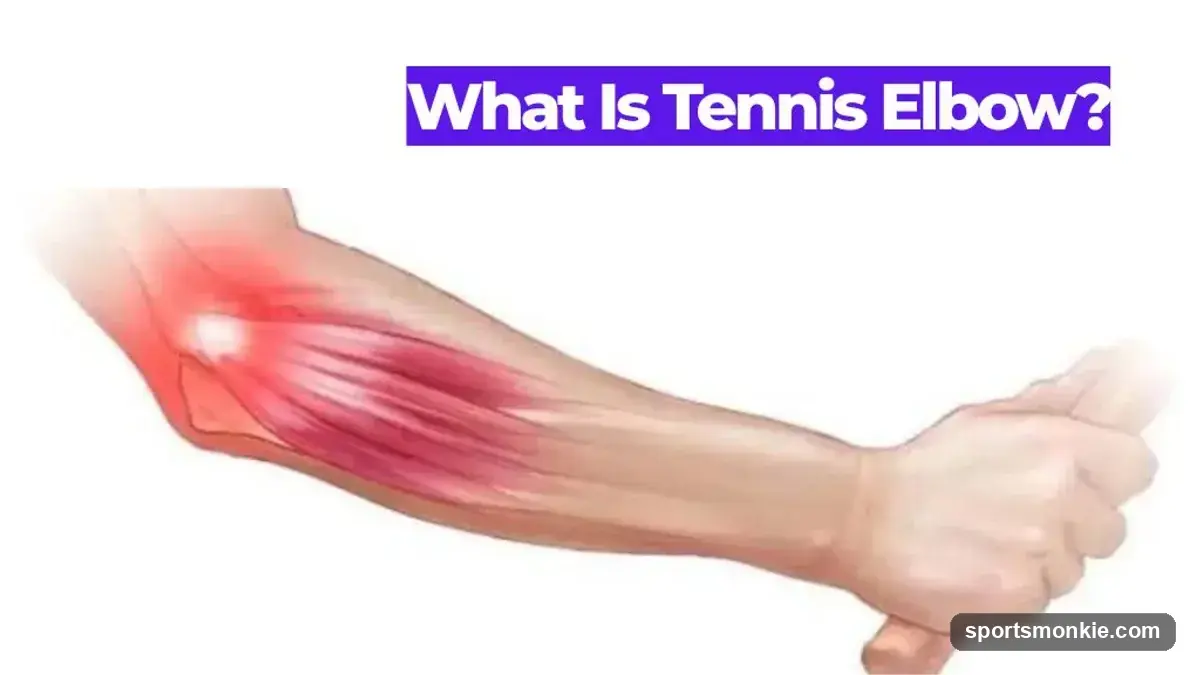
What Is the Lateral Epicondyle?
It’s the bony bump on the outer side of the elbow. Several forearm muscles that extend the wrist and fingers share a tendon that attaches there. Overwork those muscles through repeated gripping or wrist extension, and the tendon gets irritated, develops small tears, and you’re left with tennis elbow.
Common Causes
| Cause Category | Examples |
|---|---|
| Racket sports | Tennis (especially backhand technique), squash, badminton, padel |
| Occupational | Painting, plumbing, carpentry, butchery, typing |
| Everyday activities | Repeated lifting, using a screwdriver, prolonged mouse use |
In tennis, the usual culprit is backhand technique: a bent wrist or too much forearm in the swing loads the lateral tendons more than they can handle. String tension, grip size, and frame stiffness can make it worse too.
Symptoms
- Pain and tenderness on the outside of the elbow
- Weakness in the wrist and forearm
- Pain that worsens when gripping, lifting, or twisting the forearm, like turning a door handle
- Discomfort that radiates down the forearm toward the wrist
- Stiffness when straightening the arm fully
It usually builds gradually. Most people can’t point to a single moment it started.
Diagnosis
A doctor or physiotherapist typically diagnoses it with a physical exam, checking how much pain shows up when the wrist is extended against resistance. Ultrasound or MRI gets used occasionally, mostly to confirm tendon damage or rule out something else.
Treatment Options
Conservative treatment works for most people:
- Rest and activity modification. Cut back on whatever movement triggers the pain.
- Ice. Short applications to the outer elbow help with acute inflammation.
- Physiotherapy. Eccentric strengthening exercises for the forearm extensors do most of the heavy lifting in recovery.
- Counterforce brace. A strap below the elbow reduces load on the tendon during activity.
- Anti-inflammatory medication. NSAIDs like ibuprofen help with short-term pain.
- Corticosteroid injections. Useful for temporary relief, though they don’t necessarily improve long-term outcomes.
- PRP therapy. Platelet-rich plasma injections show up in persistent cases to help the tendon heal.
- Surgery. A last resort, considered only after months of conservative treatment haven’t worked.
Prevention in Tennis Players
- Hit the backhand with a stable wrist, not a flicked forearm.
- Use a grip size that fits your hand; too small forces the forearm muscles to work harder.
- Try lower string tension to cut down on shock transmission.
- Build forearm strength gradually, and don’t skip the warm-up.
- Ramp up playing volume slowly instead of jumping straight into heavy hitting.
Tennis Elbow vs. Golfer’s Elbow
The two get confused often enough that it’s worth laying out side by side:
| Condition | Affected Side | Tendons Involved |
|---|---|---|
| Tennis elbow (lateral epicondylitis) | Outside of elbow | Wrist extensor tendons |
| Golfer’s elbow (medial epicondylitis) | Inside of elbow | Wrist flexor tendons |
Both come from overusing tendons, just on opposite sides of the elbow and involving different muscle groups.
Frequently asked questions
What causes tennis elbow?+
Tennis elbow is caused by repetitive strain on the tendons that attach the forearm muscles to the lateral epicondyle (the bony bump on the outside of the elbow). It is common in racket sports due to gripping and swinging, but also affects painters, carpenters, plumbers, and desk workers who perform repetitive arm movements.
How long does tennis elbow take to heal?+
Most cases of tennis elbow resolve within several months with rest, physiotherapy, and conservative treatment. Severe or neglected cases can take longer. Surgery is rarely needed but may be considered when conservative methods fail after an extended period.
How is tennis elbow treated?+
First-line treatment includes rest, activity modification, ice application, physiotherapy exercises to strengthen the forearm, and anti-inflammatory medication. Bracing (a counterforce strap worn below the elbow) can reduce strain during activity. In persistent cases, steroid injections or platelet-rich plasma (PRP) therapy may be used.
Who is most likely to get tennis elbow?+
It most commonly affects adults between about 30 and 50, and appears far more often in people who do repetitive arm work than in tennis players. Painters, carpenters, plumbers, butchers, and heavy computer users are all prone to it, regardless of whether they play any racket sport.
Can you still play tennis with tennis elbow?+
It is usually best to rest or reduce play while symptoms are active, as continuing can worsen the tendon damage and lengthen recovery. If you do play, a counterforce brace, lower string tension, and a corrected backhand technique can reduce load on the tendon. Seek advice for persistent pain.
Does tennis elbow go away on its own?+
Many mild cases improve on their own over several months if the aggravating activity is reduced, since the tendon can heal with rest. Recovery is faster and more reliable with physiotherapy and activity changes. Ignoring it and continuing the strain often makes it linger far longer.
When should you see a doctor about tennis elbow?+
See a clinician if the pain persists for several weeks despite rest, worsens, disturbs sleep, or comes with noticeable weakness or numbness in the hand. Persistent or severe symptoms may need physiotherapy, imaging, or other treatment beyond self-care to rule out related problems and guide recovery.
Sources
Play & tools
Free browser games and tools — no account, no download.
- Play today's Sports Connections — Today's Sports Connections — daily hints, answers, and play the grid.
- Play Guess the NFL Player — A new mystery NFL player every day. Eight guesses, with a clue on each — plus free unlimited mode.
- Explore all our games →
Related tennis guides
View all →
What Is Deuce in Tennis? Score, Advantage, and Tiebreaks
Deuce in tennis means both players have reached 40, so one player must win two straight points to take the game.
What Is Hawk-Eye in Tennis? How Electronic Line Calling Works
Hawk-Eye uses multiple cameras and ball-tracking software to judge whether a tennis shot landed in or out.
Walkover vs Retirement in Tennis: What Is the Difference?
A walkover happens before a match begins; a retirement happens after play starts. The distinction affects results, records and tournament administration.
Clay Court Tennis: Surface, Rules, and Why It Plays So Slow
Clay court tennis is the slowest surface with the highest bounce. See red vs. green clay, sliding, ball marks, upkeep, and why Nadal owns it.
Grass Court Tennis: Why the Fastest Surface Plays So Different
Grass court tennis is the fastest, lowest-bouncing surface in the sport, per ITF's own pace rating. How Wimbledon's ryegrass shapes serve-and-volley play.
Hard Court Tennis: Construction, Speed, and Why It's the Most Common Surface
Hard court tennis is played on rigid acrylic-coated asphalt or concrete, the medium-fast, most consistent surface used at the US Open and Australian Open.