
What Is Tagging Up in Baseball?
On this page5
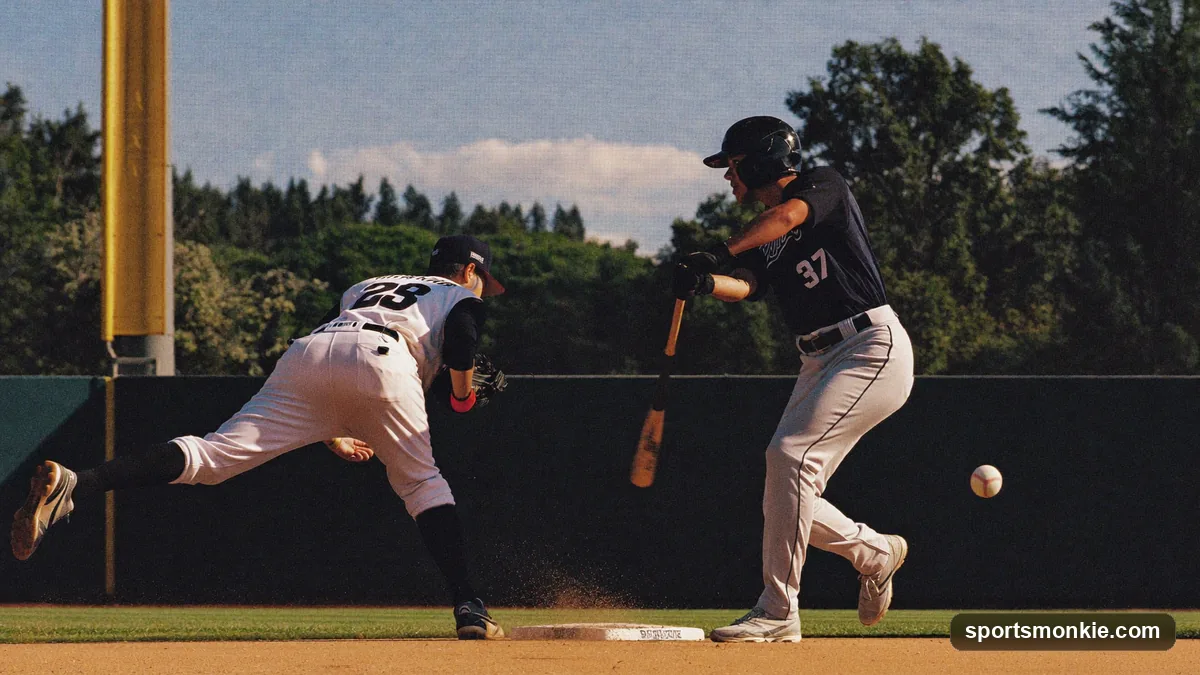
Tagging up is a baserunning rule: on a caught fly ball, a runner may only advance if he is touching his base at the moment the ball is caught. He “tags up” by staying on the base, then takes off once the catch is made. Leave early and the defense can appeal for an out. It’s what makes the sacrifice fly possible.
How tagging up works
When a fly ball is hit, a baserunner has a choice: commit to advancing, or stay put in case it’s caught. If he wants to advance on a catch, he must keep a foot on his base until the fielder secures the ball, then sprint to the next base and beat the throw.
Leave early and you’re out
If the runner leaves before the catch, the defense can throw to his base and appeal. If the umpire rules he left early, he’s out — even if he already reached the next base. That appeal play is why runners are drilled to watch the catch and time their jump.
The sacrifice fly
Tagging up is the reason a sacrifice fly exists: a deep fly caught for an out that still lets a runner tag from third and score. The batter isn’t charged an at-bat for the productive out. No tag-up rule, no sac fly.
Which runners can tag
| Runner on | Can tag to |
|---|---|
| Third | Home (most common) |
| Second | Third |
| First | Second |
Whether a runner goes depends on the depth of the fly and the strength of the outfielder’s arm.
Where it fits
Tagging up is one of baseball’s core baserunning rules, alongside the dropped third strike, the ground-rule double, and the infield fly rule — and it is closely tied to the sacrifice fly. New to the game? Start with our baseball terminology glossary. For more, see our baseball guides.
Frequently asked questions
What does tagging up mean in baseball?+
Tagging up means a baserunner stays in contact with his base until a fly ball is caught, and only then tries to advance to the next base. The rule prevents runners from getting a running head start on a ball that might be caught. Once the fielder secures the catch, the runner is free to go, racing the throw to the next base.
When can a runner tag up?+
A runner can tag up and advance on any caught fly ball, line drive, or fair or foul fly, as long as he retouches his base at or after the moment of the catch. He must wait for the catch; if he leaves before the ball is caught, he has to return to his base or risk being called out on appeal. Runners most often tag up on deep fly balls to the outfield.
What happens if a runner leaves the base too early?+
If a runner leaves before the fly ball is caught — a 'baserunning' violation — the defense can appeal by throwing to that base after the catch. If the umpire agrees the runner left early, he is called out, even if he had already reached the next base safely. This appeal play is why runners are coached to watch the catch and time their departure precisely.
What is a sacrifice fly?+
A sacrifice fly is a fly ball caught for an out that still lets a runner tag up and score, usually from third base. The batter is not charged with an at-bat because he 'sacrificed' himself to drive in the run. It is one of the most common productive outs in baseball and exists entirely because of the tagging-up rule — no tag-up, no sac fly.
Can you tag up on any base?+
Yes. Runners on first, second, or third can all tag up on a caught fly ball, though whether they try depends on how deep the ball is and how strong the fielder's arm is. Tagging from third to score is the most common because home is the most valuable base, but a runner on second can tag to third, or first to second, on a deep enough fly.
Do you have to tag up on a ground ball?+
No. Tagging up only applies to caught balls in the air. On a ground ball, there is no catch to wait for, so runners advance under the normal force and steal rules. The tag-up requirement is specifically about fly balls and line drives that are caught — the runner must be on his base when the ball is secured before he can legally advance.
How does tagging up relate to other baseball rules?+
It is one of baseball's core baserunning rules, alongside situational quirks like the [dropped third strike](/dropped-third-strike-rule/), the [ground-rule double](/what-is-a-ground-rule-double/), and the [infield fly rule](/infield-fly-rule/). All of them govern when and how runners can advance, which is a big part of the sport's strategy that casual fans often miss.
Sources
Play & tools
Free browser games and tools — no account, no download.
- Play 162-0 — Draft nine and see if your roster can survive a flawless 162-game MLB season.
- Explore all our games →
- Analyze a trade — Compare both sides of a fantasy baseball trade before you accept.
- Run the MLB predictor — Simulate the MLB postseason bracket down to a World Series champion.
- Open the ERA calculator — Work out earned run average from earned runs and innings pitched — handles the .1/.2 thirds convention.
- Explore all our free sports tools →
Related baseball guides
View all →
How Many Innings Are in a Baseball Game? (9 in MLB)
A baseball game has nine innings in MLB, the minors, and college. High school plays seven and Little League six. Here's every level, plus how long games last.
What Is a Grand Slam in Baseball?
A grand slam in baseball is a home run hit with the bases loaded, scoring all four runners for the maximum four runs possible on a single swing.
What Is a Sacrifice Fly in Baseball? Rule, Scoring, RBI Explained
A sacrifice fly in baseball is a fly out that scores a runner from third base. Learn the official rule, scoring, RBI, and how it differs from a sac bunt.
Dropped Third Strike Rule in Baseball, Explained
On an uncaught third strike, the batter can try to reach first base if it's unoccupied or there are two outs — the strikeout doesn't automatically end the at-bat.
What Is a Ground-Rule Double in Baseball?
A ground-rule double awards the batter two bases when a fair ball bounces over the outfield fence or is out of play. Runners advance two bases from where they were.

What Is the Designated Hitter (DH) in Baseball?
The designated hitter bats in place of the pitcher and never plays the field. Since 2022 the universal DH applies in both the American and National Leagues.