
What Is Deuce in Tennis? Scoring Rules Fully Explained

On this page6
Deuce is the score 40–40 within a single tennis game, where both players are tied and neither can win on the next point alone. From deuce, one player must win two points in a row to take the game: the first earns “advantage,” and the second closes it out. If they lose that second point, the score goes back to deuce — a cycle that can repeat many times.
How tennis scoring works up to deuce
Within a single game, tennis names points instead of just counting them:
| Points Won | Score Name |
|---|---|
| 0 | Love |
| 1 | 15 |
| 2 | 30 |
| 3 | 40 |
| 3 (tied) | Deuce (40–40) |
Normally four points wins a game. But once both players reach 40 — three points each — a simple four-point finish line no longer applies. That tie is deuce, and it forces the game to keep going until someone builds a clear cushion.
What happens after deuce
From deuce, a player needs a two-point margin to close out the game:
- Deuce (40–40): The score is level.
- Advantage: One player wins a point and holds “advantage” (or “ad”).
- Game: If the player with advantage wins the next point too, the game is over.
- Back to deuce: If the other player wins that next point instead, the score resets to deuce.
There is no cap on how many times this cycle repeats under traditional scoring. Games that stretch 10, 15 or more points past the first 40–40 do happen at the professional level, occasionally running to 20-plus deuces.
Advantage in vs. advantage out
Two shorthand phrases tell you who is ahead once the game passes deuce:
- Ad in (or “advantage server”): The server holds the advantage.
- Ad out (or “advantage receiver”): The receiver holds the advantage.
They are a quick way for players and spectators to track who is one point from winning the game at any given moment, without waiting for the full umpire call.
The no-ad rule
Some formats skip the deuce cycle entirely using no-ad scoring:
- At 40–40, the very next point — a single deciding point — wins the game.
- There is no advantage point and no bouncing back to deuce.
- The receiving side chooses which half of the court to return from.
No-ad scoring keeps matches from running long, so it is standard in most professional doubles (including the ATP and WTA tours as of 2026) and common in college and recreational leagues. In mixed doubles, the deciding point is served to the receiver of the same gender as the server.
Why is it called deuce?
Most accounts trace “deuce” to the French deux, meaning two — a nod to the two consecutive points required to close out the game from that tied position. A competing theory links it to old English card-game terminology, but the French origin is the one most commonly cited.
Deuce in a tiebreak
Tiebreaks do not use the word “deuce” at all. Points are counted straight up (1, 2, 3…), and once the score reaches 6–6, a player still needs to win by two clear points. It is the same underlying win-by-two idea as deuce, just labelled differently: 6-all, then 7–6, 8–7 and onward until someone opens up that two-point gap.
Related terms and common misconceptions
Deuce is often confused with a tiebreak, but they are separate mechanisms: deuce governs a single game, while a tiebreak decides a tied set. A common mistake is assuming a game must end after four points — deuce exists precisely because a close game cannot end on a single point. Terms worth knowing alongside deuce include “advantage” (the one-point lead after deuce), “break point” (a chance to win the opponent’s service game), and “game point” (any point that would win the game if taken).
Frequently asked questions
What does deuce mean in tennis?+
Deuce means both players are tied at 40–40 within a single game. From that point, one player must win two consecutive points to win the game. Winning the first post-deuce point earns 'advantage,' and winning the very next point closes out the game.
Can deuce happen more than once in a game?+
Yes. If a player holds advantage but then loses the next point, the score returns to deuce. Under traditional (advantage) scoring there is no cap on this, so a single game can pass through deuce many times before someone opens a two-point gap.
What is no-ad scoring in tennis?+
In no-ad (no advantage) scoring, the first player to win the point at deuce takes the game outright, with no advantage point. The receiving side usually chooses which half of the court to receive from. It is used to keep matches shorter and is standard in most professional doubles.
What is the difference between 'ad in' and 'ad out'?+
'Ad in' means the server holds the advantage after deuce, so the server is one point from winning the game. 'Ad out' means the receiver holds the advantage. Both are quick verbal shorthands so players and spectators know who leads without waiting for the umpire.
Why is it called deuce?+
The most commonly cited origin traces deuce to the French 'deux,' meaning two, referring to the two consecutive points needed to win from 40–40. A competing theory links it to old card-game terminology, but the French derivation is the explanation most sources favour.
Does a tiebreak have deuce?+
No. Tiebreaks count points as plain numbers (1, 2, 3…) and never use the word deuce. However, the win-by-two principle still applies: once a tiebreak reaches 6–6, a player must lead by two clear points to win, so 7–6, 8–7 and so on mirror the logic of deuce.
Is deuce the same in singles and doubles?+
The 40–40 tie itself is identical. The difference is which scoring format is used: traditional advantage scoring is standard in singles, while most professional doubles now use a no-ad deciding point at deuce to speed up play.
Sources
Play & tools
Free browser games and tools — no account, no download.
- Play today's Sports Connections — Today's Sports Connections — daily hints, answers, and play the grid.
- Play Guess the NFL Player — A new mystery NFL player every day. Eight guesses, with a clue on each — plus free unlimited mode.
- Explore all our games →
Related tennis guides
View all →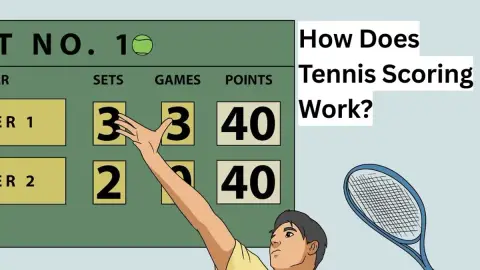
How Does Tennis Scoring Work? Points, Games, Sets Explained
Tennis scoring runs 15, 30, 40, game; games build into sets and sets into a match. See a clear breakdown of how tennis scoring works at every level.

What Does Ad Mean in Tennis? Advantage Scoring Explained
Ad in tennis means advantage, the point after deuce when one player needs one more to win. Win it to take the game; lose it and the score returns to deuce.

What Is a Break Point in Tennis?
A break point is a point that, if won by the returner, wins the game against the server. Here is what it means, why it matters so much, and related terms.

How Does a Tiebreak Work in Tennis?
A tennis tiebreak decides a set locked at 6-6. First to 7 points wins, but you must lead by two. Here's scoring, serving order, and when tiebreaks happen.
What Is Deuce in Tennis? Score, Advantage, and Tiebreaks
Deuce in tennis means both players have reached 40, so one player must win two straight points to take the game.
Walkover vs Retirement in Tennis: What Is the Difference?
A walkover happens before a match begins; a retirement happens after play starts. The distinction affects results, records and tournament administration.