
What Is a Cricket Bat Called? Names, Parts, and Rules
On this page6
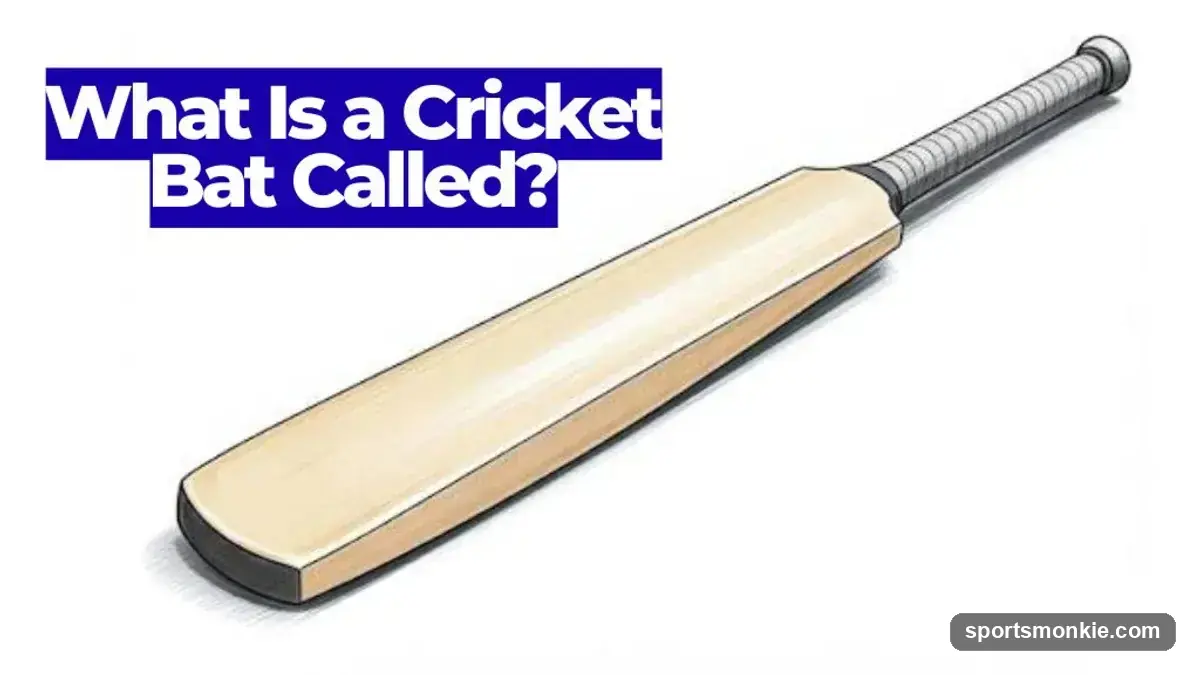
Ask a commentator what’s in a batter’s hands and you’ll get a straight answer: a cricket bat. No trade name, no technical term hiding behind it, unlike a lot of sports gear that carries some separate manufacturer’s label the public never uses. But listen a bit longer and you’ll hear the same object called something else entirely.
Why people call it “the willow”
“He’s swinging the willow beautifully” or “the willow is talking today” both just mean the bat is working. The nickname comes from English willow (Salix alba var. caerulea), the specific type of white willow that’s been shaped into cricket bat blades for centuries. Bat makers favor it because it combines toughness and light weight with the ability to absorb an impact without splitting apart.
The parts of a cricket bat
| Part | Description |
|---|---|
| Blade | The flat main body of the bat; the hitting surface |
| Face | The flat front of the blade where contact is made |
| Spine | The raised ridge along the back of the blade; provides structural strength |
| Sweet spot | The area on the face where impact transfers most efficiently to the ball |
| Edges | The sides of the blade; balls hit off the edge travel unpredictably |
| Toe | The very bottom of the blade |
| Shoulder | The curved area where the blade widens toward the handle |
| Handle | The narrow upper section; made from cane and rubber |
| Grip | The outer covering of the handle, usually made from rubber |
What the laws actually say
MCC Law 5 caps a cricket bat at 96.52 cm (38 inches) in length and 10.8 cm (4.25 inches) in blade width. Total depth, spine included, can’t exceed 6.7 cm (2.64 inches), and the edges are capped at 4 cm (1.57 inches). Those numbers exist because modern manufacturing can build a bat with a huge sweet spot or oversized edges that would hand batters an unfair advantage, so the laws hold the geometry in check.
English willow vs Kashmir willow
| Type | Origin | Quality | Price Range |
|---|---|---|---|
| English Willow | UK (mostly Suffolk/Essex) | Grade 1-5 (1 being best) | Higher; varies widely by grade |
| Kashmir Willow | Kashmir region | Generally lower performance | More affordable |
Top professionals play with Grade 1 or Grade 2 English willow, identifiable by straight, tight grain lines that signal dense, resilient wood. Seven or more visible straight grains on the face usually points to better quality, though that’s a rule of thumb rather than a guarantee. Kashmir willow costs a fraction as much and dominates recreational and junior cricket for exactly that reason.
The handle
The handle is Sarawak cane, typically built with a V- or H-splice for flexibility and shock absorption, with rubber strips worked in to dampen vibration further. It’s bound with twine before the grip goes on. Flexibility matters more than people assume: a handle that soaks up too much vibration feels dead in the hands and gives no feedback, while one that’s too stiff will sting badly on a mishit.
Why bat weight matters
Professional bats generally run between 2 lb 7 oz and 3 lb, roughly 1.1 to 1.36 kg. A heavier bat hits the ball harder but takes more strength to control through the shot; a lighter one lets the batter generate faster bat speed. Most professionals today aren’t chasing the heaviest bat they can swing. They want big edges and a pronounced spine, the features that maximise the trampoline effect off the face, at a weight they can still move quickly.
Related guides
Frequently asked questions
What is a cricket bat called in cricket?+
A cricket bat is called a cricket bat. There is no alternative official name. Informally, players and commentators sometimes call it the 'willow' because the blade is traditionally made from white willow (Salix alba var. caerulea).
What wood is a cricket bat made from?+
Cricket bats are made from white willow — specifically English willow (Salix alba var. caerulea) for top-grade bats, or Kashmir willow for lower-cost bats. The handle is made from cane, often with rubber inserts, bound with twine and a rubber or leather grip.
What are the main parts of a cricket bat?+
The main parts are the blade (the flat hitting surface), the spine (the raised ridge on the back of the blade), the toe (the bottom of the blade), the shoulder (where the blade meets the handle), and the handle (the narrow upper section a batter holds).
Sources
Play & tools
Free browser games and tools — no account, no download.
- Play today's Sports Connections — Today's Sports Connections — daily hints, answers, and play the grid.
- Play Guess the NFL Player — A new mystery NFL player every day. Eight guesses, with a clue on each — plus free unlimited mode.
- Explore all our games →
Related cricket guides
View all →
Cricket Bat Weight: What Weight Do Cricketers Use?
Most professional cricketers use bats weighing 2 lb 7 oz to 2 lb 12 oz (about 1.1-1.25 kg). The Laws cap blade size but set no weight limit at all.
Best Cricket Bats: What to Look for and Top Brands
The best cricket bat depends on your level, preferred weight, and budget. This guide covers the key specs and the brands players consistently rate highest.
Cricket Ball Size and Weight: Full Comparison by Format
A cricket ball weighs 155.9-163 g with a circumference of 22.4-22.9 cm in men's cricket. Women's and youth balls are slightly smaller and lighter.
What Is a Dead Ball in Cricket? Rule and Common Situations
A dead ball is a delivery from which no runs score and no batter is out. Learn when the ball goes dead, who decides, and why it matters in a tight finish.
DLS Method in Cricket Explained: How Rain Targets Are Set
The Duckworth-Lewis-Stern (DLS) method resets targets in rain-hit limited-overs cricket using overs and wickets left. Here's the logic, with examples.
What Is LBW in Cricket? Leg Before Wicket Explained
LBW means the ball would have hit the stumps but struck the pad first. Here are the exact conditions umpires check and how DRS decides close calls.