
Tennis Court Surfaces Explained: Hard, Clay, Grass, and More
On this page7
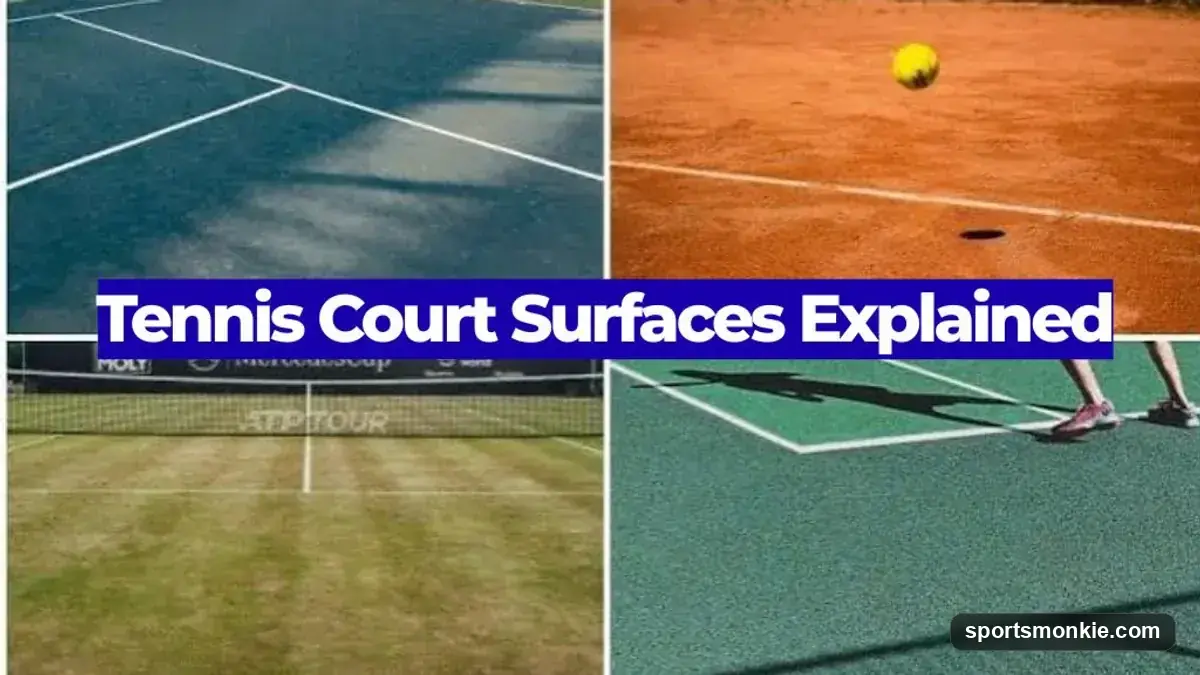
Tennis is played on four main surface types — grass, hard, clay, and carpet — and each one changes how the ball bounces and how quickly it travels after landing. Grass is the fastest, with a low, skiddy bounce; clay is the slowest, with a high, heavy bounce; hard courts sit in the middle with a predictable rebound. Carpet, once common indoors, has all but vanished from the professional game.
That single variable — what the ground does to the ball — explains why Rafael Nadal could win 14 French Opens on clay yet spend years chasing the same form on grass. It is why serious fans eventually learn the surfaces: they decide who dominates which months of the calendar.
The four main tennis surfaces
The International Tennis Federation (ITF) grades courts using a Court Pace Rating, a measure of how much a surface slows the ball after it bounces. Every classified court falls into one of five bands, from Category 1 (Slow) to Category 5 (Fast). That one number explains a lot about why the same player can look unbeatable in June and ordinary in September.
| Surface | ITF pace | Bounce | Signature event |
|---|---|---|---|
| Grass | Fast (Cat. 5) | Low, skiddy | Wimbledon |
| Hard | Medium-slow to medium-fast (Cat. 2–4) | Consistent, predictable | Australian Open, US Open |
| Clay | Slow (Cat. 1) | High, heavy | Roland Garros (French Open) |
| Carpet | Fast (Cat. 5) | Low, varies by type | Formerly indoor tour |
Grass courts
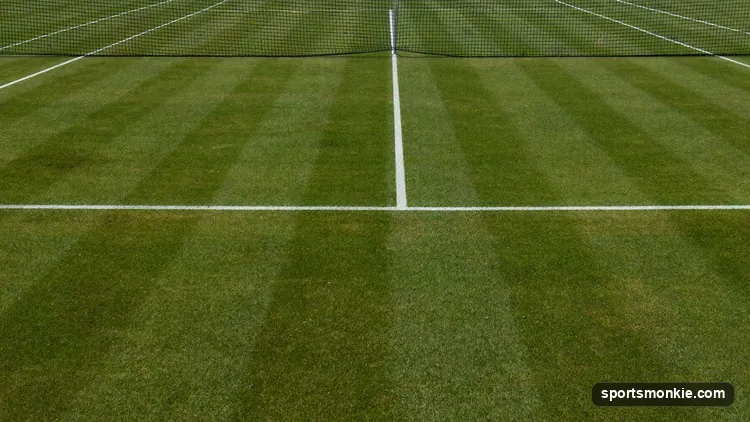
Grass is tennis’s original surface, and Wimbledon is the only Grand Slam still played on it. The ball skids low after bouncing, cutting the time a baseliner has to set up a shot and rewarding players who serve big or finish points at the net. The surface changes the bounce, but not the layout — every court shares the same tennis court dimensions regardless of what it is made of.
Keeping a grass court playable takes constant mowing, watering, and rolling, which is part of why it is expensive and rare outside the UK and Australia. Weather and wear also limit how long a grass season can realistically run.
Playing style advantage: serve-and-volley players, big servers, flat hitters.
Hard courts
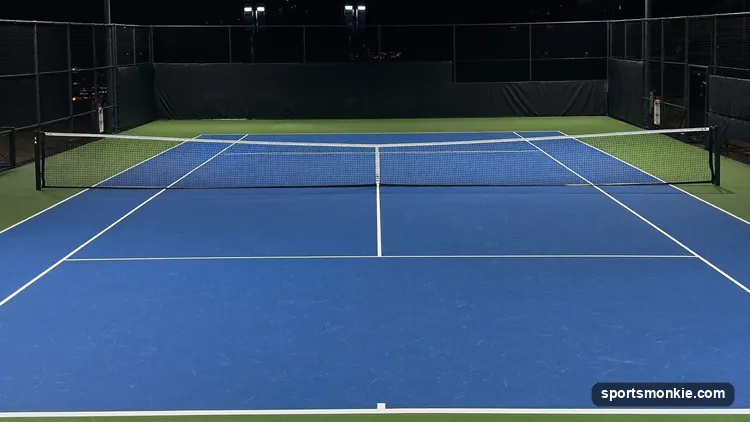
Hard courts are asphalt or concrete under an acrylic top layer, splitting the difference between grass and clay: medium pace with a bounce you can predict. That neutrality is why hard courts hand no built-in edge to either power or defence.
As of 2026 the Australian Open plays on GreenSet (rated Category 4, medium-fast) and the US Open on Laykold (Category 2, medium-slow), which replaced the long-used DecoTurf in 2020. Both are blue hard courts, yet Melbourne plays measurably quicker than New York. Globally, hard courts are what most people actually play on, from public parks to private clubs.
Playing style advantage: all-round players; hard-hitting baseliners.
Clay courts
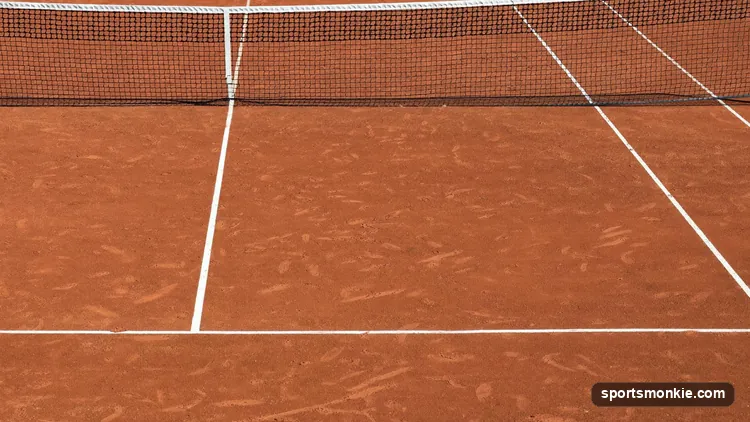
Clay, made from crushed brick, shale, or stone, dominates in Europe and South America. Because it is slow and bounces high, a defender gets extra time to chase down shots that would be clean winners elsewhere. Learning how to hit topspin pays off most here, since the extra bounce turns heavy spin into a genuine weapon. Rallies stretch longer, and consistency starts to matter more than raw power.
Roland Garros runs on red clay, and it is where Nadal built most of his legend, pairing heavy topspin with footwork and stamina that mattered less on faster courts. Generating that kind of spin often comes down to how a player holds the racket, so it helps to understand how tennis grips shape your game before adapting to a slower surface.
Playing style advantage: heavy topspin baseliners, grinders, defensively strong movers.
Carpet courts
Indoor carpet — woven or synthetic — was once a fixture of the indoor ATP and WTA calendar. It played fast with a low bounce, but governing bodies phased it out over consistency and movement concerns, and most indoor events switched to hard courts. As of 2026 no top-level tour events use it, though the ITF still lists carpet as a Category 5 (Fast) surface.
How surface affects match strategy
Even a top-ten player can look ordinary off their best surface. Serve-first players tend to climb during grass season, while clay specialists can jump from mid-table to French Open contenders almost overnight. That volatility is exactly why a Career Grand Slam — winning all four majors across all four surface conditions — is treated as such a rare marker of a complete player.
Surface and injury
Clay gives a little underfoot and lets players slide, which is part of why it is considered easiest on the joints. Hard courts are the opposite: the firmness sends more force up through the ankles, knees, and hips match after match. Plenty of players build their schedules specifically to limit how much hard-court tennis they play in a season.
Frequently asked questions
Which tennis surface is the fastest?+
Grass courts are the fastest surface in tennis and, along with carpet, the ITF rates them Category 5 (Fast). The ball skids low and stays close to the ground after bouncing, giving the returner less time to react. This is why big servers and net-rushers have always fared well at Wimbledon.
Why is clay considered the slowest surface?+
Clay slows the ball considerably and produces a high bounce, which is why the ITF classifies it Category 1 (Slow). The loose granular top layer absorbs pace from groundstrokes and gives the defender extra time to retrieve. The result is longer rallies that reward baseline consistency, footwork, and heavy topspin over raw power.
What surface is the US Open played on?+
The US Open is played on a hard court surfaced with Laykold, an acrylic-cushioned system that replaced DecoTurf in 2020. The ITF rates it Category 2 (Medium-slow), so despite being a hard court it plays a touch slower than Melbourne. Hard courts are the most common surface worldwide and give a predictable, consistent bounce.
How does the ITF measure court speed?+
The ITF assigns every classified surface a Court Pace Rating using a machine that fires balls at a fixed speed and angle, then measures how the surface affects friction and rebound. The results place a court into one of five bands, from Category 1 (Slow) to Category 5 (Fast). This lets tournaments describe pace objectively rather than by feel.
Is the Australian Open the same surface as the US Open?+
Both are hard courts, but they are not identical. Since 2020 the Australian Open has used GreenSet, rated Category 4 (Medium-fast), while the US Open uses Laykold at Category 2 (Medium-slow). That gap means the ball comes through noticeably quicker in Melbourne than in New York, even though both look like similar blue hard courts on television.
Why has carpet almost disappeared from professional tennis?+
Indoor carpet was once common on the ATP and WTA calendars because it was quick to lay and fast to play on. Governing bodies phased it out over concerns about consistency and player movement, and most indoor events switched to hard courts. As of 2026 no top-level tour events use carpet, though the ITF still classifies it as a Category 5 (Fast) surface.
Which surface is easiest on the body?+
Clay is generally considered the most forgiving because the loose top layer lets players slide and gives a little underfoot, reducing impact on the joints. Hard courts are the harshest, sending more force up through the ankles, knees, and hips. Many players deliberately limit their hard-court schedule to manage long-term wear and tear.
Sources
Play & tools
Free browser games and tools — no account, no download.
- Play today's Sports Connections — Today's Sports Connections — daily hints, answers, and play the grid.
- Play Guess the NFL Player — A new mystery NFL player every day. Eight guesses, with a clue on each — plus free unlimited mode.
- Explore all our games →
Related tennis guides
View all →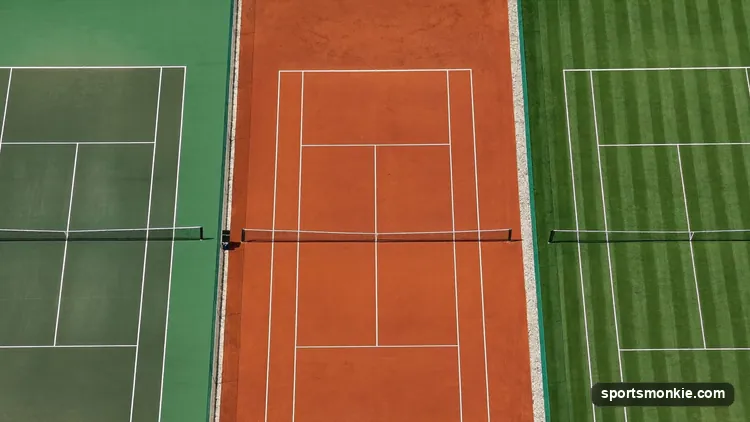
Types of Tennis Courts: Hard, Clay, Grass & Carpet Explained
The 4 types of tennis courts are hard, clay, grass, and carpet. See how each changes speed and bounce, and which surface every Grand Slam uses.
Grass Court Tennis: Why the Fastest Surface Plays So Different
Grass court tennis is the fastest, lowest-bouncing surface in the sport, per ITF's own pace rating. How Wimbledon's ryegrass shapes serve-and-volley play.
Clay Court Tennis: Surface, Rules, and Why It Plays So Slow
Clay court tennis is the slowest surface with the highest bounce. See red vs. green clay, sliding, ball marks, upkeep, and why Nadal owns it.
Hard Court Tennis: Construction, Speed, and Why It's the Most Common Surface
Hard court tennis is played on rigid acrylic-coated asphalt or concrete, the medium-fast, most consistent surface used at the US Open and Australian Open.
Tennis Court Lines Explained: Every Line, Named and Defined
Tennis court lines explained: baseline, sidelines, service line, centre service line, centre mark and net — ITF dimensions, singles vs doubles, in/out rule.
Tennis Court Dimensions and Space Needed
Official tennis court dimensions: 78 ft long, 36 ft wide for doubles, 27 ft for singles, plus total space needed, net height, lines and run-off.