
Shortest NBA Players in History: Small Stars Who Dominated
On this page8
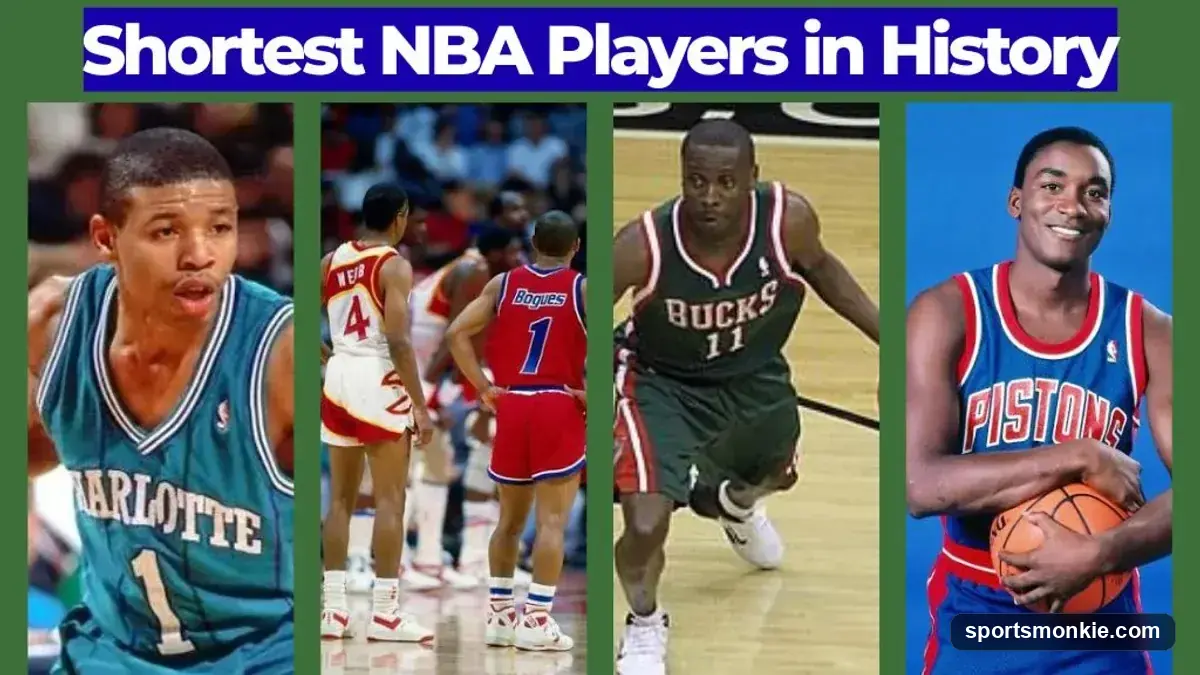
Muggsy Bogues, at 5 ft 3 in (1.60 m), is the shortest player in NBA history, ahead of Earl Boykins (5 ft 5 in) and Spud Webb (5 ft 7 in). With the average NBA player standing around 6 ft 6 in, anyone under 5 ft 10 in is a statistical outlier — yet these undersized guards didn’t just survive at the sport’s highest level. Several became stars.
What the record measures
There is no official “shortest player” trophy in basketball, so the record is simply drawn from listed heights in league rosters and reference databases such as Basketball Reference and Wikipedia. Listed heights can drift by an inch depending on the source and whether a player is measured in shoes, but the top of the list has stayed remarkably consistent. Muggsy Bogues at 5 ft 3 in sits alone at the bottom, with no one shorter ever recorded in a regular-season NBA game.
Why playing short is so hard
Height is a genuine, structural advantage in basketball. Taller players shoot over defenders, contest passing lanes, rebound, and finish at the rim more easily. A player giving up a foot or more must find other ways to win, and the short players who lasted shared a recognizable set of traits:
- Elite speed and quickness that taller defenders struggled to match
- A low center of gravity for sharper cuts and tighter defense on ball-handlers
- Strong court vision and passing to run an offense
- Relentless on-ball defense, often using quick hands to bother much taller opponents
- Basketball IQ sharp enough to compensate for what their frame could not
The shortest players in NBA history
A handful of names define this list. Each earned real minutes rather than a novelty roster spot.
Muggsy Bogues (5 ft 3 in) is the benchmark. Drafted 12th overall by the Washington Bullets in 1987, he played 14 seasons — the longest career of any player listed at 5 ft 6 in or shorter. His quickness made him a steals threat, and his passing kept him useful as a genuine starting point guard for four franchises, most memorably the Charlotte Hornets.
Earl Boykins (5 ft 5 in) is the second-shortest player ever. Weighing roughly 135 pounds, he was famously strong for his size and is the shortest player to score 30 or more points in an NBA game. He carved out a 13-season career across nine teams as a scoring spark off the bench.
Spud Webb (5 ft 7 in) authored the most famous highlight in short-player history, and his career spanned more than a decade as a steady point guard.
Isaiah Thomas (5 ft 9 in) turned into one of the game’s great late-round success stories, finishing among the league’s top scorers during his peak with Boston.
Nate Robinson (5 ft 9 in) became the first three-time Slam Dunk Contest champion, a fan favorite wherever he played across an 11-season career.
Leaderboard: shortest NBA players
| Rank | Player | Height | Era | Role |
|---|---|---|---|---|
| 1 | Muggsy Bogues | 5 ft 3 in (1.60 m) | 1987–2001 | Point guard |
| 2 | Earl Boykins | 5 ft 5 in (1.65 m) | 1998–2012 | Point guard |
| 3 | Spud Webb | 5 ft 7 in (1.70 m) | 1985–1998 | Point guard |
| 3 | Yuki Kawamura | 5 ft 7 in (1.70 m) | 2024– | Point guard |
| 5 | Isaiah Thomas | 5 ft 9 in (1.75 m) | 2011–2024 | Point guard |
| 5 | Nate Robinson | 5 ft 9 in (1.75 m) | 2005–2015 | Guard |
Muggsy Bogues: the standard at the top
Tyrone “Muggsy” Bogues is still the reference point for what an undersized player can achieve. At 5 ft 3 in he guarded much taller players night after night without ever looking out of place, using elite quickness to jump passing lanes and disrupt ball-handlers. His 14 seasons remain the longest for any player his height, and his run with the Charlotte Hornets in the 1990s made him one of the most recognizable figures of the era. He is widely regarded as the greatest short player the league has produced.
Spud Webb and the 1986 dunk title
The most replayed moment in short-player history came in 1986, when Spud Webb, at 5 ft 7 in, won the Slam Dunk Contest over his own Atlanta Hawks teammate — reigning champion Dominique Wilkins. Powered by a reported 42-inch vertical, Webb’s win is still cited almost every year the contest returns as proof that leaping ability is not the exclusive property of the tall.
The current short-player standard (2025-26)
As of the 2025-26 season, the tradition continues with Yuki Kawamura, a 5 ft 7 in guard from Japan who reached the NBA with the Memphis Grizzlies and played the 2025-26 season with the Chicago Bulls, making him the shortest active player in the league. His presence keeps the undersized-guard archetype alive in the modern, spacing-driven NBA. (All statuses as of mid-2026.)
The lesson short players teach
These players are proof that the NBA rewards more than size. Height is a real advantage — no argument there — but each of the names above built a career, and in several cases a legacy, out of everything else the game demands: quickness, vision, defense, and nerve. That is why a 5 ft 3 in point guard remains one of basketball’s most enduring underdog stories.
Frequently asked questions
Who is the shortest player ever to play in the NBA?+
Tyrone 'Muggsy' Bogues, who stood 5 ft 3 in (1.60 m), is the shortest player in NBA history. He was drafted 12th overall in 1987 and played 14 seasons as a capable starting point guard. No player listed shorter than Bogues has ever appeared in a regular-season NBA game.
Who is the second-shortest player in NBA history?+
Earl Boykins, at 5 ft 5 in (1.65 m), is the second-shortest player ever. Despite weighing around 135 pounds, he was famously strong for his size and is the shortest player to score 30 or more points in a single NBA game. He played 13 seasons across nine franchises.
Who is the shortest active NBA player as of 2026?+
Yuki Kawamura, a 5 ft 7 in (1.70 m) guard from Japan, is the shortest player on an NBA roster as of the 2025-26 season. He has appeared for teams including the Memphis Grizzlies and Chicago Bulls, making him the standard-bearer for undersized guards in the current era.
How did short players succeed in the NBA?+
Short NBA players typically compensated with exceptional speed, quickness, court vision, and playmaking. Many were elite point guards who used their low center of gravity as an advantage on defense and in change-of-direction moves. Relentless competitiveness and high basketball IQ were common threads.
Is there a minimum height requirement to play in the NBA?+
No, the NBA has no minimum height requirement. Players are evaluated purely on ability, regardless of stature. That is why players as short as 5 ft 3 in have carved out long, productive careers at the highest level of the sport.
Did any short player win the NBA Slam Dunk Contest?+
Yes. Spud Webb, at 5 ft 7 in, won the 1986 Slam Dunk Contest over teammate Dominique Wilkins, one of the sport's most famous underdog moments. Nate Robinson, at 5 ft 9 in, later became the first three-time Slam Dunk Contest champion, winning in 2006, 2009, and 2010.
How tall is the average NBA player compared to these short players?+
The average NBA player stands around 6 ft 6 in, which makes anyone under about 5 ft 10 in a statistical outlier. The shortest players in league history gave up roughly a foot or more to the typical opponent, yet several became All-Stars or fan favorites.
Is Muggsy Bogues in the Basketball Hall of Fame?+
As of 2026, Muggsy Bogues has not been inducted into the Naismith Memorial Basketball Hall of Fame. He remains one of the most recognizable and beloved figures in NBA history, and his 14-season career as the shortest player ever is widely regarded as one of the game's great overachievement stories.
Sources
Play & tools
Free browser games and tools — no account, no download.
- Play 82-0 — Draft five, one per position, and see if your lineup can go a flawless NBA season.
- Play Era Ball — Draft an all-time NBA roster from a single era, then simulate a season and chase a perfect run.
- Play 32-0 — Draft five college basketball legends, one per position, and chase a perfect 32-0 national title.
- Explore all our games →
- Get the printable bracket — Download and print a blank tournament bracket to fill out by hand.
- Open the TS% calculator — Calculate TS% from points, field goal attempts and free throw attempts — scoring efficiency in one number.
- Explore all our free sports tools →
Related basketball guides
View all →
Most Consecutive Games Played in NBA History
A.C. Green holds the NBA record with 1,192 consecutive games, the 'Iron Man.' The full durability list, and why load management makes it unbreakable.
Most Points by a Rookie in NBA History
Wilt Chamberlain scored 2,707 points as a rookie in 1959-60, the NBA record. Full leaderboard of top rookie scoring seasons, plus the PPG mark.

Best Regular-Season Record in NBA History
The 2015-16 Warriors went 73-9, the best regular-season record in NBA history. The full leaderboard of the winningest NBA teams, explained.
The Biggest Comeback in NBA History
The Utah Jazz erased a 36-point deficit against the Denver Nuggets in 1996, the biggest comeback in NBA history. The full leaderboard, explained.
Longest Win Streaks in NBA History
The 1971-72 Lakers hold the NBA record with 33 straight wins. The full leaderboard of the longest winning streaks in league history, explained.

The Biggest Contracts in NBA History
Jayson Tatum's 5-year, $314M supermax is the largest NBA contract by total value as of 2025. The full list of record deals, dated and explained.