
Shortest Football Players Who Dominated the Beautiful Game
On this page4
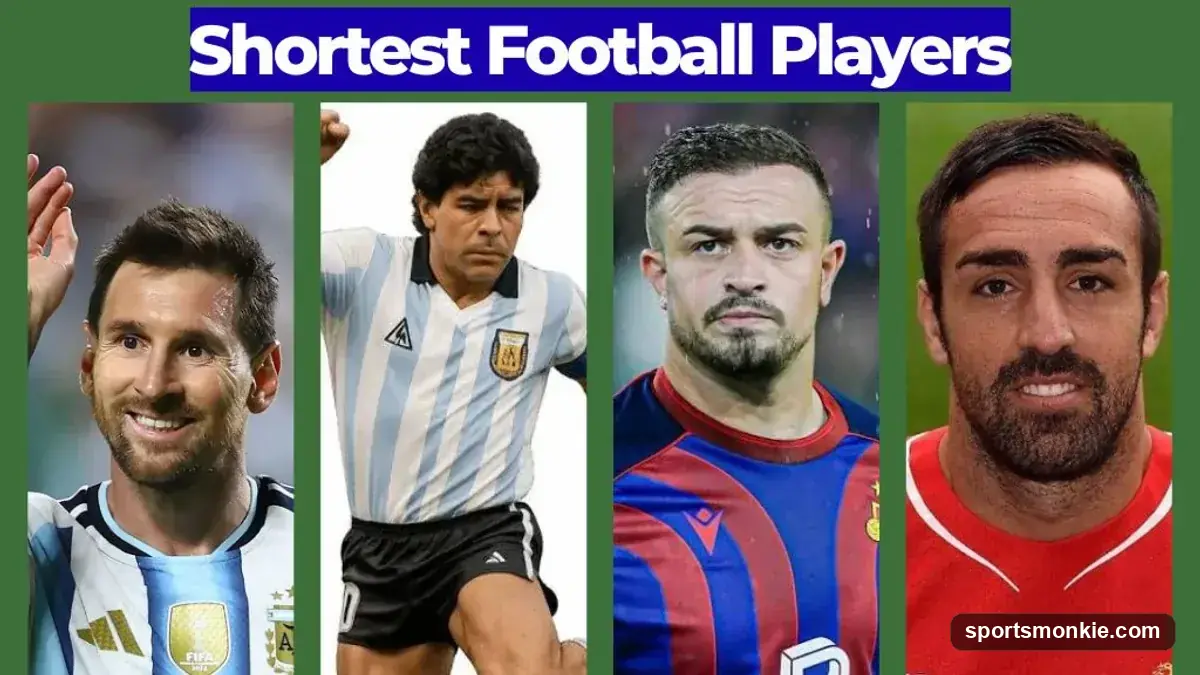
Diego Maradona stood a shade under 5 ft 6 in and once carried Argentina through a World Cup while defenders half a foot taller failed to get near him. Football has never cared much about height, and its history is full of players who proved that a low centre of gravity and a good first touch beat size in almost every situation short of defending a corner kick.
Why Short Players Can Excel in Football
Unlike basketball or volleyball, football rarely rewards height outside a couple of positions. The ball spends most of the match on the ground, and the skills that decide games, dribbling, first touch, passing, vision, quick acceleration, have little to do with how tall someone is.
Being short even helps in a few specific ways:
- Lower centre of gravity, harder to knock off the ball
- Tighter turning circle, quicker changes of direction in tight spaces
- Faster acceleration over short distances, useful in 1v1 situations
- Better balance when shifting body weight while dribbling
Notable Short Elite Footballers
| Player | Approx. Height | Position | Career Notable For |
|---|---|---|---|
| Diego Maradona | ~165–168 cm | Attacking Midfielder | 1986 World Cup, Napoli legend |
| Lionel Messi | ~170 cm | Forward / Attacking Mid | Record Ballon d’Or wins, World Cup 2022 |
| Xherdan Shaqiri | ~169 cm | Winger | Multiple top European leagues, World Cups |
| Andrés Iniesta | ~171 cm | Central Midfielder | World Cup 2010 winning goal, Barcelona legend |
A closer look at the clearest cases:
Maradona is still the most celebrated short player the game has produced. At roughly 165–168 cm, he had, by most accounts, the best individual dribbling ability football has ever seen, and a stocky, powerful build that made him nearly impossible to dispossess cleanly even when opponents got a foot in.
Messi, at around 170 cm, dealt with a growth hormone deficiency as a child, treatment for which Barcelona ended up funding after he moved to Spain as a teenager. The condition that once threatened to end his career before it started may have shaped the obsessive technical polish that later defined him.
Shaqiri, around 169 cm, built a stocky, explosive frame that let him hold his own physically despite giving up several inches to most opponents. His low centre of gravity made him one of the harder wingers of his generation to dispossess in a straight foot race for the ball.
Andrés Iniesta, at 171 cm, wasn’t the shortest name on this list, but he’s regularly cited as the player who redefined what a deep-lying playmaker could do without needing size to control a midfield.
Positions Where Height Matters Most (and Least)
| Position | Height Relevance | Why |
|---|---|---|
| Goalkeeper | Very high | Must reach the crossbar and dominate aerial crosses |
| Centre-back | High | Aerial duels are central to the role |
| Striker (hold-up play) | Moderate | Flick-ons and link-up play aided by physical presence |
| Winger / Wide forward | Low | Speed and agility dominate over height |
| Attacking midfielder | Low | Technical quality and movement matter more |
| Defensive midfielder | Moderate | Some physical battles, but positioning matters more |
The Growth Hormone Narrative in Football
Messi’s case gets the most attention, but it’s not isolated. Several South American clubs and academies have faced scrutiny over the years for how they weigh small, technically gifted children against bigger ones at trials. European academies have historically leaned toward physically mature players at youth level, a tendency researchers call the relative age effect, but the long-term track record makes a strong case that technical ability predicts senior success better than early physical size ever did.
Frequently asked questions
What is the shortest height for a professional footballer?+
Professional footballers under 160 cm (around 5 ft 3 in) are extremely rare. Most short elite players stand between 160–170 cm. The position matters too — goalkeepers almost never fall below 180 cm, while attacking midfielders and wingers can thrive at much shorter heights.
Does height matter in football?+
Height matters for some positions — particularly goalkeepers and central defenders, where aerial duels are frequent. For attacking players, midfielders, and wingers, a lower centre of gravity can actually be an advantage, contributing to balance, agility, and close control.
Who is the shortest player to win the Ballon d'Or?+
Lionel Messi, who stands at approximately 170 cm (5 ft 7 in), has won the Ballon d'Or more times than any other player. Diego Maradona, also around 165–168 cm, won the award in 1979 and 1986.
Sources
Play & tools
Free browser games and tools — no account, no download.
- Play 38-0 — Sign a 4-4-2 of all-time football legends and chase a perfect 38-0 league season — perfect, not just unbeaten.
- Explore all our games →
Related football guides
View all →
Tallest Soccer Players Ever: The Full Ranked List
Simon Bloch Jorgensen (210 cm), Kristof van Hout (208 cm) and Tomas Holy (206 cm) top the list of the tallest soccer players ever, ranked with heights and positions.

Most Expensive Houses Owned by Football Players, Ranked
The most expensive houses owned by footballers, ranked. David Beckham's Holland Park mansion tops the list near $40 million, with reported values and locations.
Best Football Agents: The 10 Most Powerful Names in the Game
Ranked: the 10 most powerful football agents right now, from Jorge Mendes and Rafaela Pimenta to Pini Zahavi, with the clients and deals that put them there.
Strongest Football Players: 10 Names Ranked
The strongest football players ranked and named, from Adebayo Akinfenwa's legendary FIFA strength rating to Erling Haaland and Victor Osimhen bullying defenders in 2026.
Shortest NBA Players in History: Small Stars Who Dominated
The shortest NBA players ever stood under 6 feet yet competed, and often thrived, at the sport's highest level. Meet the most notable in league history.
Carrick Benches Fernandes for Bournemouth and Calls It Pure Football
Michael Carrick dropped Manchester United captain Bruno Fernandes for Sunday's Bournemouth game days after Fernandes criticised his tactics following the 4-1 loss at Como, insisting the call was pure football.