
Most Tattooed NBA Players: The 10 Most Inked Bodies in the League
On this page15
Placement rewards two things: how much skin is actually covered — bonus weight for the neck, hands, and face that most players still leave bare — and cultural impact, meaning whether a player's ink changed what the league treated as acceptable. Coverage decides the top of the list; impact is why two players with less total ink still rank inside the top four.
- Full-body benchmark
Chris "Birdman" Andersen
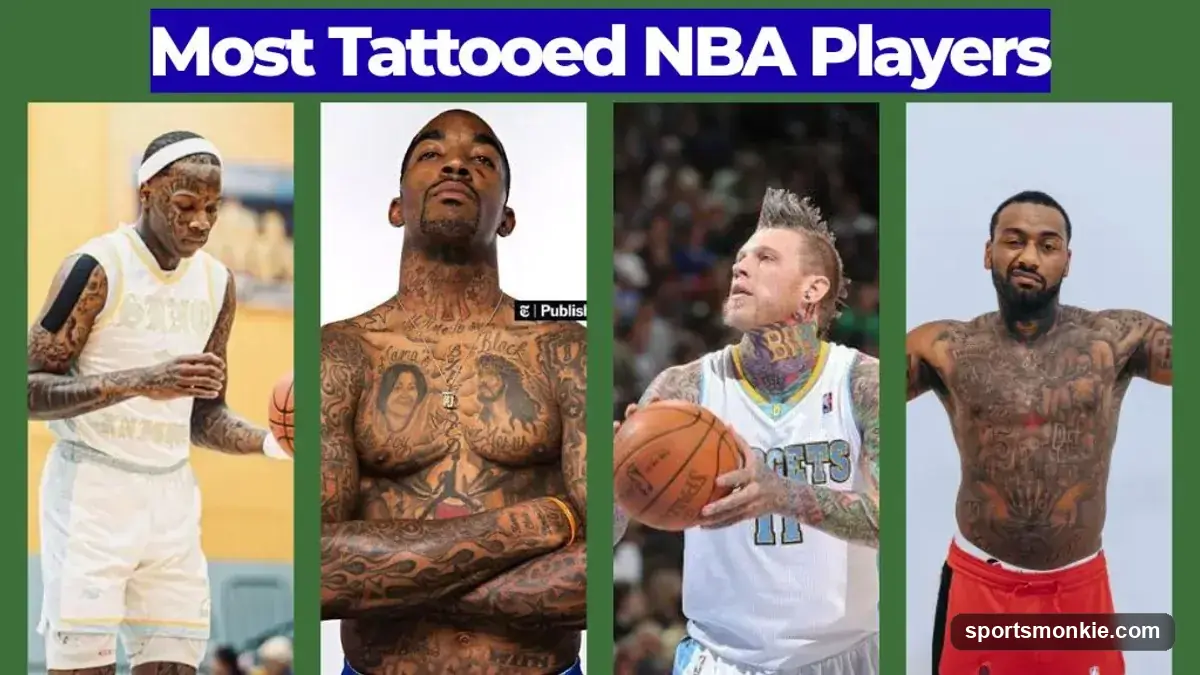
Andersen is the name reference lists reach for first when they rank the NBA's most tattooed player, and the reason is placement, not just volume. His ink runs across the neck, face, arms, chest, and back — the jawline-and-throat real estate almost every other player leaves untouched. That completeness is why he edges J.R. Smith for the top spot: Smith has a comparable count, but Andersen went past the collar earlier and more fully.
The "Free Bird" lettering across his neck became as identifiable as his shot-blocking, and it followed him from Denver to a championship run in Miami. He built a persona around the look at a time when going that far up the neck was still rare.
Career: 2001–2017 · Coverage: neck, face, chest, back, full sleeves · Signature: "Free Bird" neck script
- ~70-and-counting
J.R. Smith
Smith is here on sheer density. Asked to count his tattoos in a New York Times Q&A, he put it at "around 70-something" — coverage that extends onto his hands, up his neck, and close to his face across a 16-season career. It's the accumulation, not one headline piece, that teammates kept bringing up.
He ranks just below Andersen because his facial and throat coverage is less complete, but the gap is narrow. By the back end of his career there was little bare skin left to work with, something Smith has joked about himself.
Career: 2004–2020 · Coverage: hands, neck, torso, scalp · Own estimate: "around 70-something"
- The pioneer
Dennis Rodman
Rodman doesn't have the most ink on this list, and he ranks third anyway because he is the reason the players below him could get inked without a second thought. He wore visible tattoos through his rebounding-title years with the Pistons, Spurs, and Bulls, when almost no one else in the league did — Allen Iverson himself credits Rodman as the one who came first.
That is a genuine professional risk in the early 1990s, when the NBA was tightly managing its image. He ranks above the more numerically tattooed players beneath him because impact, not count, carries this slot.
Career: 1986–2000 · Role: first to make visible ink part of an NBA persona · Peak: 5x champion, 7x rebounding leader
- The normalizer
Allen Iverson
Iverson entered the league in 1996 and turned tattoos into a mainstream signature. His "Only the Strong Survive" shoulder script — which he has said references his upbringing and the obstacles he came through — paired with sleeves and neck ink, became the template other heavily tattooed players got measured against. Tyson Chandler was among those who cited it as direct inspiration.
He sits above the pure-coverage names lower down because his influence, alongside his standing as a former MVP and scoring champion, moved the whole culture. Rodman went first; Iverson made it normal.
Career: 1996–2010 · Signature: "Only the Strong Survive" shoulder script · Impact: 2001 MVP, style-defining
- Early-2000s ink
Kenyon Martin
Martin's dense chest and full-sleeve work made him one of the most visibly inked stars of the early 2000s, matching his physical, above-the-rim game. He carried that coverage into All-Star weekends and nationally televised playoff runs when heavy ink was still novel at that level.
He ranks below the pioneers because his tattoos followed the trend rather than starting it, but he helped push the look into the mainstream alongside Iverson rather than treating it as fringe.
Career: 2000–2015 · Coverage: chest, full sleeves · Role: mainstreamed heavy ink at the star level
- Journeyman canvas
DeShawn Stevenson
Stevenson's sleeve and torso work spread across a long journeyman career through Utah, Washington, Dallas, and beyond, and it kept expanding year over year rather than arriving in one early burst. He is regularly grouped with Andersen among the most heavily tattooed players of his era.
His most talked-about piece — an Abraham Lincoln portrait tied to his hometown and the "$5" bill nickname fans gave it — is the kind of specific, personal reference that separates his collection from generic coverage.
Career: 2000–2013 · Coverage: full sleeves, torso, neck · Signature: Lincoln "$5" portrait
- Pop-culture sleeves
Wilson Chandler
Chandler's arms read like a fan's scrapbook: comic-book characters, cartoon references including Beavis and Butt-Head, and hip-hop homages such as Eazy-E. It is a more eclectic, pop-culture-driven collection than anyone else on this list, built around personal fandom rather than family or hometown tributes.
That distinctiveness is why he lands here over players with comparable square footage — his ink is instantly identifiable rather than a generic full sleeve.
Career: 2007–2020 · Coverage: full arms · Theme: comics, cartoons, hip-hop homages
- Fastest coverage
Dorell Wright
Wright added roughly 45 tattoos in about five years, one of the fastest documented rates of coverage the league has seen. What began as a handful of pieces with the Heat became extensive arm, chest, and back work by his Golden State and Portland years.
His "G.H.O.S.T." shoulder lettering — "Go Hard Or Stop Trying" — and a portrait of his mother anchor a collection built on personal meaning, not just volume. The pace outstripped nearly everyone above him, even if the total coverage does not.
Career: 2004–2017 · Count: ~45 tattoos in ~5 years · Signature: "G.H.O.S.T." shoulder script
- Modern autobiography
Kyle Kuzma
Kuzma shows how fast a present-day player can assemble a dense, deeply personal collection — a "100" emoji, an all-seeing eye inside the elbow, and tributes to his hometown of Flint, Michigan. His ink reads as autobiography, continuing a trend stars like LeBron James helped normalize among today's players.
He ranks below the veterans because his coverage, while extensive, doesn't reach the neck-and-face completeness of the top names. As an active player, that total is still climbing.
Career: 2017–active · Coverage: arms, torso · Signature: Flint, Michigan tributes
- Rapid modern build
Jordan Clarkson
Clarkson built an extensive collection within about four years of entering the league, including a large peace sign on his knee, and it has kept growing through his Lakers, Cavaliers, and Utah stints. The speed of that build puts him alongside Dorell Wright as one of the quickest transformations on this list.
He closes the ranking because his coverage, while broad, sits a step behind the density and neck-to-face reach of the names above him — but among active players, few have added ink faster.
Career: 2014–active · Coverage: arms, legs, torso · Signature: peace sign on the knee
Reader interaction
Build your ranking
Drag the names into the order you think is right — or use the arrows — then submit to see how your list compares with everyone else's.
- Chris "Birdman" Andersen
- J.R. Smith
- Dennis Rodman
- Allen Iverson
- Kenyon Martin
- DeShawn Stevenson
- Wilson Chandler
- Dorell Wright
- Kyle Kuzma
- Jordan Clarkson
Audience ranking
How everyone ranked them
Built from reader rankings using position-based points.
The cards above rank the players; the sections below explain how we ordered them, why the estimates come with caveats, and how tattoo culture went from a PR problem to a rookie-day norm.
How We Ranked the List
Two inputs decide placement. The first is coverage: total estimated ink and how much of the body it reaches, with extra weight for the neck, hands, and face — the spots most players still leave bare and the truest test of commitment. The second is cultural impact: whether a player’s ink changed what the league and its fans treated as acceptable.
Coverage sets the top of the board, which is why Andersen and Smith lead. Impact is why Rodman and Iverson sit inside the top four despite carrying less total ink than several players below them — without those two, the modern tattoo era doesn’t happen on the same timeline. Where placements are close, we noted the direct comparison inside each card.
Why the Counts Are Estimates
No one keeps an official tattoo ledger, so treat specific numbers as informed approximations. The most reliable figures come from the players themselves — Smith’s “around 70-something” is a direct quote, and Wright’s ~45 is widely reported from his own accounting during his playing days. Numbers for players who never gave a count are best read as “extensive coverage,” not exact totals. We’ve phrased them that way on purpose: a tattoo count is a moving target for any active player, and even retired players rarely settled on a final figure.
The Rule That Actually Governs NBA Tattoos
Fans often assume the league restricts ink. It doesn’t — not personal ink. The only live rule is commercial: the NBA Operations Manual bars players from displaying any commercial, promotional, or charitable logo on the body during games. The clearest recent test was LaMelo Ball in 2023, told to cover an “LF” tattoo the league read as promoting his clothing brand, a stance it later softened. Personal tattoos — tributes, scripture, hometown pride — sit entirely outside that policy.
At a Glance
| Rank | Player | Era | Why they rank here |
|---|---|---|---|
| 1 | Chris “Birdman” Andersen | 2001–2017 | Most complete coverage, incl. neck and face |
| 2 | J.R. Smith | 2004–2020 | ~70 by his own count; hands, neck, scalp |
| 3 | Dennis Rodman | 1986–2000 | First to make visible ink an NBA persona |
| 4 | Allen Iverson | 1996–2010 | Mainstreamed the sleeved-up superstar look |
| 5 | Kenyon Martin | 2000–2015 | Dense early-2000s chest and sleeve work |
| 6 | DeShawn Stevenson | 2000–2013 | Steadily expanding full-career coverage |
| 7 | Wilson Chandler | 2007–2020 | Distinct pop-culture and hip-hop sleeves |
| 8 | Dorell Wright | 2004–2017 | ~45 tattoos in roughly five years |
| 9 | Kyle Kuzma | 2017–active | Fast-growing modern, personal collection |
| 10 | Jordan Clarkson | 2014–active | Extensive coverage built in ~four years |
The New Generation
Players now often arrive with collections finished before their rookie season. Ja Morant and Zion Williamson entered the league already heavily inked — a reversal from the era this list covers, when visible tattoos were treated as a risk rather than a signature. It’s a sharp contrast with the players in SportsMonkie’s look at the greatest NBA players, many of whom came up when ink was still discouraged. Tattoos have shifted from a statement into a default, part of the same individual-expression instinct fans track in everything from players’ hair choices to signature celebrations.
Frequently asked questions
Who is the most tattooed NBA player of all time?+
Chris 'Birdman' Andersen and J.R. Smith are the two names cited most often. Andersen usually gets the edge for near full-body coverage that reaches his neck and face — areas most players avoid — while Smith once put his own count at 'around 70-something' in a New York Times interview. Between the two, placement and completeness give Andersen the nod on most reference lists, with Smith a very close second.
How many tattoos does J.R. Smith actually have?+
There's no official audit, but Smith addressed it directly in a 2018 New York Times Q&A and estimated 'around 70-something.' The coverage runs down to his hands, up his neck, and close to his face after 16 NBA seasons. Treat 70 as his own rough figure rather than a verified count — even Smith framed it as an estimate, since he kept adding pieces throughout his career.
Did Dennis Rodman or Allen Iverson start the NBA tattoo trend?+
Rodman came first. He wore visible tattoos through the early-to-mid 1990s, well before it was common, and Iverson himself has credited Rodman as the pioneer. Iverson's role was different but just as important: entering the league in 1996, he made heavily tattooed, sleeved-up looks a mainstream superstar signature. Rodman took the early risk; Iverson normalized it league-wide over the following decade.
Does the NBA have a rule against tattoos?+
There's no league-wide ban on personal tattoos. The one restriction is commercial: the NBA Operations Manual prohibits displaying any commercial, promotional, or charitable logo on a player's body during games. In 2023 the league told Hornets guard LaMelo Ball to cover an 'LF' tattoo tied to his clothing brand, citing that policy, before later easing its stance. Personal, non-commercial ink is unrestricted.
Which active NBA players are the most tattooed?+
Kyle Kuzma and Jordan Clarkson built large, personal collections quickly and are the most tattoo-forward names still playing. Stars including LeBron James and Kevin Durant carry extensive, well-documented ink too, though it isn't their defining trait the way it is for players higher on this list. Because these are active players, their coverage keeps growing season to season rather than sitting at a fixed total.
Why do so many NBA players get tattoos?+
Ask a player about a specific piece and you usually get a real story rather than a generic answer. The recurring themes are family tributes, hometown pride, religious faith, and specific personal milestones — Dorell Wright's mother portrait and Kyle Kuzma's Flint tributes are typical. Visible ink also became a form of individual identity once the league stopped discouraging it in the 2000s, turning the body into a running personal record.
Sources
Play & tools
Free browser games and tools — no account, no download.
- Play 82-0 — Draft five, one per position, and see if your lineup can go a flawless NBA season.
- Play Era Ball — Draft an all-time NBA roster from a single era, then simulate a season and chase a perfect run.
- Play 32-0 — Draft five college basketball legends, one per position, and chase a perfect 32-0 national title.
- Explore all our games →
- Get the printable bracket — Download and print a blank tournament bracket to fill out by hand.
- Open the TS% calculator — Calculate TS% from points, field goal attempts and free throw attempts — scoring efficiency in one number.
- Explore all our free sports tools →
Related basketball guides
View all →
NBA Players Fear Wearable Tech Data Could Be Used Against Them in Contract Talks
Adam Silver says the NBA and the Players Association have no agreement on wearable tech in games, because players fear their own data could be used in bargaining.
NBA Bans Under Parlays, First-Basket Bets and Tip-Off Wagers in Integrity Clampdown
The NBA has told its sportsbook partners to remove under parlays on one player, unders on sub-12-minute players and first-of bets after the gambling scandals.
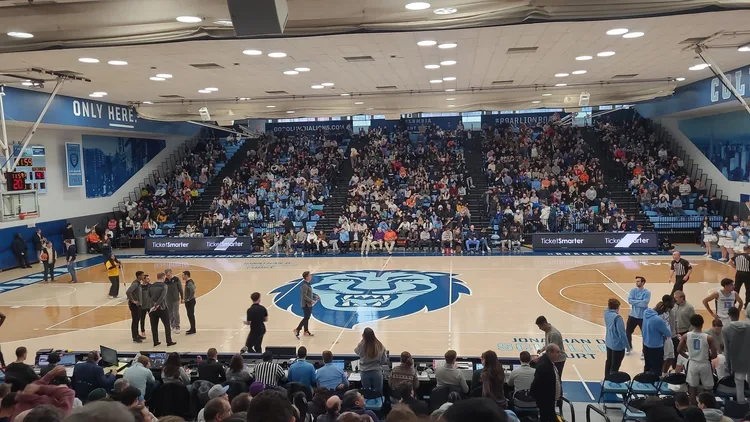
Columbia Suspends Griffith for Three Games, and Her Players Publicly Back Her
Columbia suspended Megan Griffith for the first three games after an outside review of practice conduct, and her players answered with a statement of support.
Gilgeous-Alexander Gets the Push-Off Call the Whole League Was Waiting For
Shai Gilgeous-Alexander was called for a push-off against Indiana on Tuesday, the marquee name in the NBA's new off-arm emphasis, under the Four Fs framework.
Silver's Smart Ball Puts a One-Gram Chip Inside the NBA's Ball, and Fans Smell a Magnet
Adam Silver says the NBA is testing a Wilson smart ball with a one-gram chip that tracks spin and trajectory, could help officials as soon as next year, and has fans joking about magnet balls.
Scottie Barnes Gets First Push-Off Call as NBA's New Emphasis Debuts in Preseason Opener
Scottie Barnes was whistled for an off-arm push-off inside two minutes of the Raptors' preseason opener, the first call under the NBA's new point of emphasis.