
How to Play the Periscope Shot in Cricket
On this page5
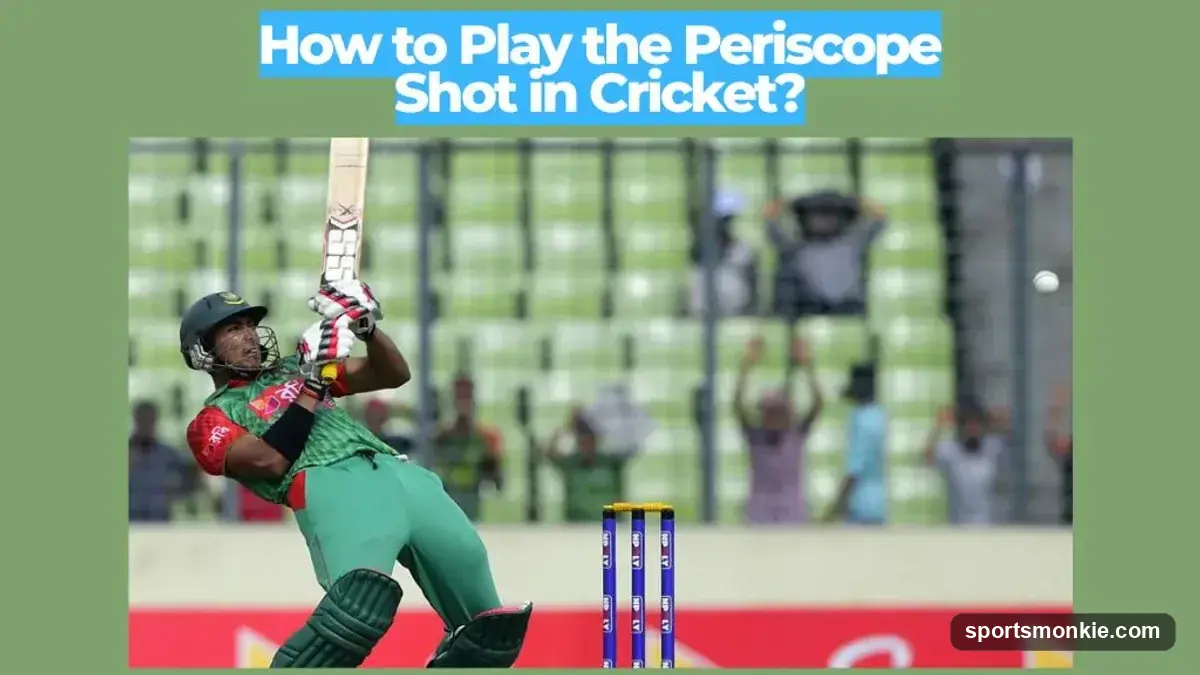
Hold the bat almost vertical, raise it to meet a short ball aimed at the chest or throat, and deflect it upward over the leg-side infield. That’s the periscope shot in one sentence, and it exists because bowlers figured out that cramping a batter for room beats bowling to get them out.
Why the Shot Exists
Fast bowlers in T20 cricket aim at the body on purpose. A cramped delivery is hard to pull, hard to drive, and hard to leave, so the batter ends up surviving instead of scoring. The periscope shot flips that: instead of getting pinned back, the batter uses the ball’s own pace to loft it over the inner ring, picking up runs where a moment earlier there seemed to be none.
The name comes from the submarine instrument. The bat rises straight up, the same way a periscope breaks the surface.
When to Play It
| Situation | Suitable? |
|---|---|
| Short-pitched ball at chest/throat height | Yes, the ideal scenario |
| Full-length yorker or half-volley | No, use a drive or flick |
| Ball angled away outside off | No, leave it or cut |
| Spinner dropping short | Rarely; a pull is usually better |
| Last few overs, field spread | Yes, high risk, high reward |
The shot only works when the ball is genuinely short and directed into the body, giving you no room to play a conventional stroke.
The Technique Step by Step
1. Read the length early. As soon as the ball is pitched short and aimed at the body, commit. Hesitation leads to a top edge or a blow on the gloves.
2. Stay side-on. Keep the body slightly side-on rather than turning square, so the bat can travel in a clean vertical arc.
3. Raise the bat handle first. The grip lifts with the handle leading; that’s the periscope action. The bat face turns to meet the ball at or above chest height.
4. Angle the face. Tilt it slightly toward fine leg or square leg depending on where the gaps sit. This is a deflection, not a shot through the line.
5. Contact above the body. Aim to meet the ball at chest height or just above, arms extended but not locked out.
6. Follow through upward. Let the bat continue its vertical path after contact. Cutting the shot short is what causes top edges.
Risks and How to Manage Them
The main risk is the top edge: a ball clipped off a mis-angled face flies high and gives fielders at fine leg or square leg an easy catch.
- Stay tall. Crouching pulls the bat face off line.
- Don’t over-hit. The ball’s own pace does the work; swinging hard turns a deflection into a top edge.
- Know your exit. If you’re unsure, ducking under the ball or playing it down defensively with a vertical bat is always the safer option.
Drills to Practice
- Hanging ball drill: suspend a ball at chest height on a rope and repeat the vertical bat arc, angling the face each time.
- Short-pitch throw-downs: have a feeder throw into the body from 10 to 12 metres. Focus on picking the line and raising the bat cleanly.
- Video analysis: review footage of the shot in match conditions to study body position and bat path.
Frequently asked questions
What is the periscope shot in cricket?+
The periscope shot involves raising the bat vertically — like a submarine periscope — against a short-pitched delivery aimed into the body, deflecting the ball over the infield on the leg side. It is primarily used in T20 and limited-overs cricket.
Who invented or popularised the periscope shot?+
The shot is associated with innovative T20 batting in the modern era. Several aggressive batters in franchise cricket have used it to neutralise short-pitched bowling when conventional pulls or hooks are not possible.
Is the periscope shot effective in Test cricket?+
It is rarely used in Test cricket. Its value lies in T20 and ODI contexts where a batter needs to score off a difficult short ball that cannot be pulled safely — it turns a defensive situation into a potential scoring opportunity.
Sources
Play & tools
Free browser games and tools — no account, no download.
- Play today's Sports Connections — Today's Sports Connections — daily hints, answers, and play the grid.
- Play Guess the NFL Player — A new mystery NFL player every day. Eight guesses, with a clue on each — plus free unlimited mode.
- Explore all our games →
Related cricket guides
View all →
How to Play a Pull Shot in Cricket: Grip, Stance, and Timing
The pull shot is a back-foot attacking stroke to short deliveries at waist to chest height, hit square on the leg side. Here is how to play it correctly.
How to Play a Sweep Shot in Cricket: Complete Technique Guide
The sweep shot is a front-foot stroke to full-length spin, hitting the leg side with a horizontal bat. Learn the kneeling position, grip, and placement.
How to Play a Hook Shot in Cricket: Technique and Timing
The hook shot punishes short-pitched deliveries, hitting them fine behind square on the leg side. Learn the grip, footwork, and head position to play it.
How to Play the Ramp Shot in Cricket: Technique Guide
The ramp shot deflects a full or back-of-length ball over the keeper toward fine leg or third man. Master the wrist angle and head position for T20.
How to Play a Straight Drive in Cricket: Technique and Timing
The straight drive is cricket's classic front-foot shot, played to a full ball on off stump and hit past the bowler. Learn the stance, grip, and swing.
How to Play a Perfect Square Cut in Cricket: Step-by-Step
The square cut is played to a short, wide delivery outside off stump. Learn the grip, back-foot movement, and bat swing to send the ball through point.