
How to Play the Paddle Sweep in Cricket: Technique & Tips
On this page7
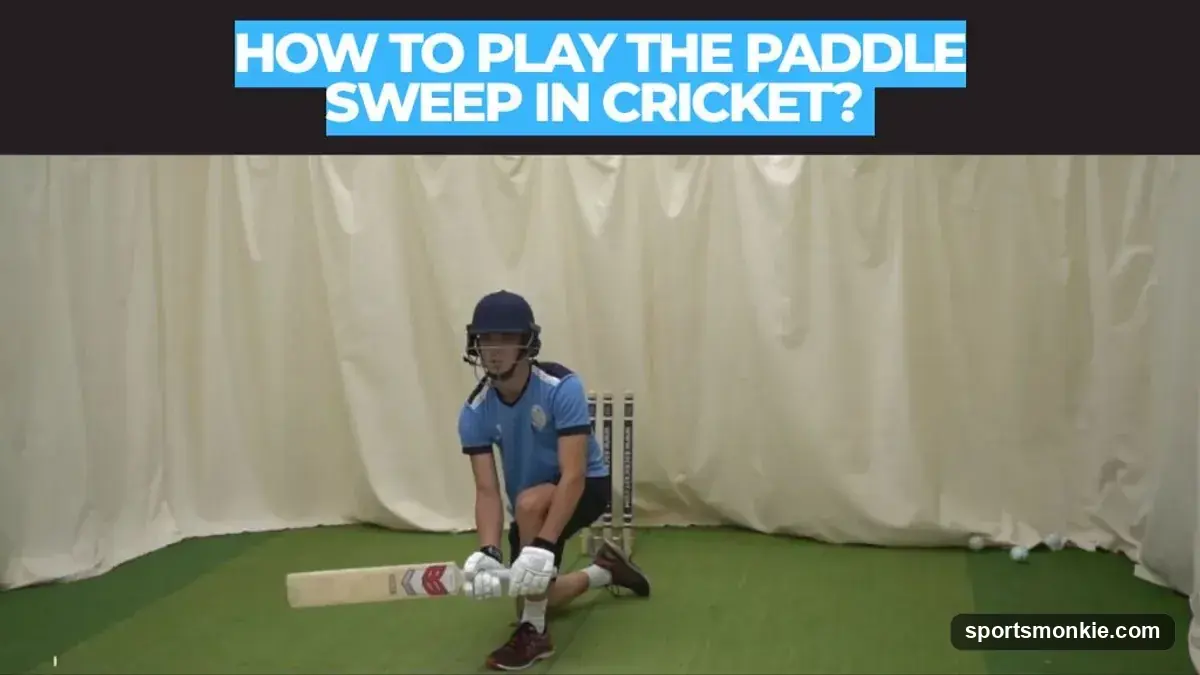
Watch a batter run themselves an easy single off a spinner bowling into their pads and there’s a decent chance you just saw a paddle sweep. It’s not built to find the rope. Kneel into the ball, angle the face, and guide it fine down to backward square leg while the fielding side is still set up for a shot with power behind it.
When to Play It
The paddle works best when:
- The ball is pitched on or outside leg stump, keeping LBW risk low.
- The fine leg fielder is up, leaving a gap behind square.
- A spinner’s bowling into your body and a conventional sweep would go straight to midwicket or square leg.
- You need a run off nearly every ball and the usual scoring areas are covered.
Stance
Start in your normal stance. As the ball’s released:
- Step forward. A small, balanced step of the front foot toward the pitch of the ball, not a full stride.
- Kneel down. Lower the back knee toward the ground. This levels your head, controls the shot, and cuts the chance of a top edge.
- Keep the weight forward, not rocking back.
Grip and Bat Angle
This is what separates it from a normal sweep:
- Soften the bottom-hand grip. Keep the top hand firm.
- Rotate the bat face toward fine leg, picture it pointing backward and fine.
- The bat still travels horizontally, but the open face deflects the ball fine instead of square.
Execution: Step-by-Step
| Phase | What to Do |
|---|---|
| Pick the ball | Identify leg-stump or outside leg line early |
| Step and kneel | Front foot forward, back knee drops |
| Open the bat face | Angle it toward fine leg, grip soft in bottom hand |
| Contact | Meet the ball in front of your body, slightly inside the line |
| Deflect, don’t hit | Let the pace carry the ball fine — minimal follow-through needed |
Common Mistakes
- Playing it to a full, straight ball. The quickest route to an LBW. This shot is for balls going down leg only.
- Too much bottom hand. Trying to hit it hard closes the face and sends the ball to square leg instead of fine.
- Not kneeling. Staying upright sends the ball higher, more catchable at short fine leg.
- Stepping back instead of forward. Takes you out of position and costs you control.
Comparison: Sweep Variations
| Shot | Contact Zone | Power | Best Used Against |
|---|---|---|---|
| Conventional sweep | In front of square | High | Off-spin, medium pace |
| Paddle sweep | Behind square / fine | Low — deflection | Spin, slow medium |
| Reverse sweep | Off side, fine | Low–medium | Off-spin |
| Slog sweep | Square to mid-on | High | Spin, death overs |
Practice Drill
Have a spinner bowl a short over on leg stump and outside. Focus only on the kneel and the bat angle, not on scoring, just redirecting the ball to fine leg consistently. Once that feels natural, start working on which balls to paddle and which to sweep square instead.
Frequently asked questions
What is the difference between a sweep and a paddle sweep?+
A conventional sweep hits the ball square or in front of square on the leg side with power. The paddle sweep is a finer, more delicate deflection — the bat is angled to glide the ball down toward fine leg rather than hit it square.
Is the paddle sweep risky?+
It carries LBW risk if played to a delivery that pitches in line with the stumps and goes straight on. The key is to only paddle balls that are pitched on or outside leg stump, minimising the LBW threat.
Can the paddle sweep be played against pace bowlers?+
Yes, but it is primarily used against spin. Against medium pace it requires good hands to soften the angle; against fast bowling it is rarely attempted as the reaction time window is too small.
Sources
Play & tools
Free browser games and tools — no account, no download.
- Play today's Sports Connections — Today's Sports Connections — daily hints, answers, and play the grid.
- Play Guess the NFL Player — A new mystery NFL player every day. Eight guesses, with a clue on each — plus free unlimited mode.
- Explore all our games →
Related cricket guides
View all →
How to Play a Sweep Shot in Cricket: Complete Technique Guide
The sweep shot is a front-foot stroke to full-length spin, hitting the leg side with a horizontal bat. Learn the kneeling position, grip, and placement.
How to Play a Reverse Sweep in Cricket: Technique Guide
The reverse sweep flips your grip and stance to hit spin to the off side. Learn the exact technique, footwork, and when to use it in a match.
How to Play a Straight Drive in Cricket: Technique and Timing
The straight drive is cricket's classic front-foot shot, played to a full ball on off stump and hit past the bowler. Learn the stance, grip, and swing.
How to Play a Hook Shot in Cricket: Technique and Timing
The hook shot punishes short-pitched deliveries, hitting them fine behind square on the leg side. Learn the grip, footwork, and head position to play it.
How to Play the Ramp Shot in Cricket: Technique Guide
The ramp shot deflects a full or back-of-length ball over the keeper toward fine leg or third man. Master the wrist angle and head position for T20.
How to Play the Cover Drive in Cricket: Technique & Timing
The cover drive is cricket's most celebrated stroke, a front-foot drive through the off side. Master the footwork, head position, and timing here.