
Highest Batting Average in ODI Cricket: Shubman Gill Leads at 60.33
On this page5
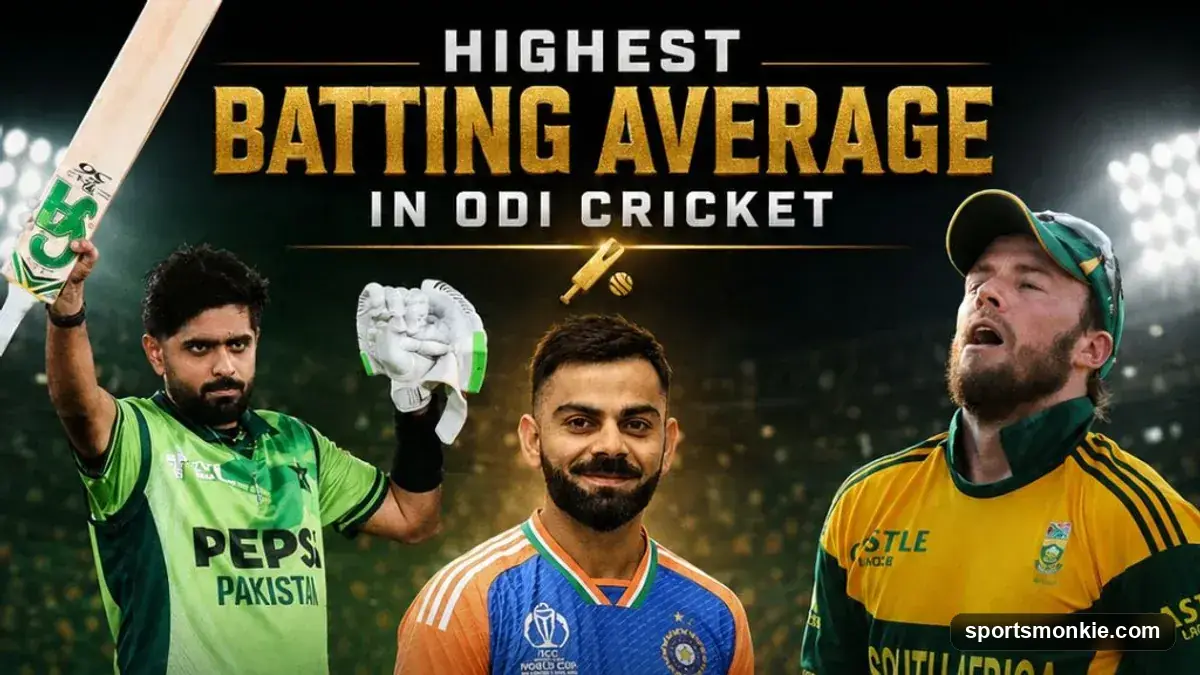
Shubman Gill owns the highest career ODI batting average among genuinely qualified batters as of 2026: 60.33 runs per dismissal across 66 matches. Virat Kohli sits a fraction behind at 58.59 — remarkable given he’s compiled it over 302 innings, more than four and a half times Gill’s sample. Below them, Michael Bevan, AB de Villiers, and Babar Azam form the rest of a top six that all average above 53, before the list settles into a long tail of genuine ODI greats sitting in the high 40s.
The full ranked list: top 20 qualified ODI averages
This table applies a 2,000-run career floor (see methodology below) and is sorted by average. Figures are current as of mid-2026 and will keep moving for every player still active.
| Rank | Player | Career span | Mat | Runs | Average |
|---|---|---|---|---|---|
| 1 | Shubman Gill (IND) | 2019–present | 67 | 3,379 | 60.33 |
| 2 | Virat Kohli (IND) | 2008–present | 314 | 14,941 | 58.59 |
| 3 | Daryl Mitchell (NZ) | 2021–present | 62 | 2,811 | 57.36 |
| 4 | Michael Bevan (AUS) | 1994–2004 | 232 | 6,912 | 53.58 |
| 5 | AB de Villiers (SA) | 2005–2018 | 228 | 9,577 | 53.50 |
| 6 | Babar Azam (PAK) | 2015–present | 143 | 6,626 | 53.43 |
| 7 | Jonathan Trott (ENG) | 2009–2013 | 68 | 2,819 | 51.25 |
| 8 | Joe Root (ENG) | 2013–present | 192 | 7,826 | 51.15 |
| 9 | MS Dhoni (IND) | 2004–2019 | 350 | 10,773 | 50.57 |
| 10 | Rassie van der Dussen (SA) | 2019–2025 | 71 | 2,657 | 50.13 |
| 11 | Ibrahim Zadran (AFG) | 2019–present | 45 | 2,105 | 50.11 |
| 12 | Shai Hope (WI) | 2016–present | 155 | 6,312 | 50.09 |
| 13 | Hashim Amla (SA) | 2008–2019 | 181 | 8,113 | 49.46 |
| 14 | KL Rahul (IND) | 2016–present | 98 | 3,412 | 49.44 |
| 15 | Rohit Sharma (IND) | 2007–present | 288 | 11,895 | 48.95 |
| 16 | Kane Williamson (NZ) | 2010–2025 | 175 | 7,256 | 48.69 |
| 17 | Michael Hussey (AUS) | 2004–2012 | 185 | 5,442 | 48.15 |
| 18 | Zaheer Abbas (PAK) | 1974–1985 | 62 | 2,572 | 47.62 |
| 19 | Ross Taylor (NZ) | 2006–2022 | 236 | 8,607 | 47.55 |
| 20 | Faf du Plessis (SA) | 2011–2019 | 143 | 5,507 | 47.47 |
Averages below this line drift into the high 40s — Kumar Sangakkara (41.98) and Ricky Ponting (42.03) are among the most ODI runs ever scored but fall well short of this table on average alone.
How this list is ranked
ESPNcricinfo’s own “highest career average” record uses a 20-innings floor — which lets low-volume careers like Ryan ten Doeschate’s (32 innings, 67.00) sit above every full-length career in history. That’s accurate but not useful for judging greatness. This list instead requires 2,000-plus career ODI runs, a threshold that still admits players early in long careers (Gill, Mitchell, Zadran) while excluding statistical outliers built on small samples. Every figure here is cross-checked against ESPNcricinfo’s records database and Wikipedia’s ODI records page, both current to mid-2026.
Breaking down the top tier
Shubman Gill reached 2,000 ODI runs faster than anyone in history (38 innings) and has kept scoring at a pace that’s kept his average above 60 — but with only 66 matches played, it’s the least stable number on this list. Virat Kohli is the opposite case: 58.59 compiled over the longest career here, built on 54 centuries — more than any other batter, ahead of Sachin Tendulkar’s 49 — and a record for consistency in highest score chases that other elite batters can’t match. AB de Villiers paired that average with a 101.09 strike rate, the rare combination that made him one of the most feared finishers of his generation, a status echoed among the best finishers in cricket. Babar Azam got to 6,000 ODI runs faster than any Pakistani batter and has stayed above 53 even through a form dip in 2024-25 — a sign of how much a deep career sample smooths out.
Why not-outs skew the picture
Batting average is runs divided by dismissals, not innings — so a not-out doesn’t count against the number. That’s why MS Dhoni (84 not outs in 297 innings, 28%) and Michael Bevan (67 in 196, 34%) sit high on this list despite rarely opening or facing the new ball. Both were finishers who batted at No. 5 or lower, where an innings frequently ends before they’re dismissed. It doesn’t make their averages fake — Dhoni built a career on exactly that skill — but it does mean comparing a finisher’s average against an opener’s like Gill or Kohli isn’t a clean, apples-to-apples read.
Where this stands in 2026
This table moves with every completed ODI innings from an active player. Gill, Kohli, Root, Babar, Rahul, Zadran, Hope, and Williamson are all still adding to their numbers, so this exact order is a snapshot rather than a settled record. For context on the format’s broader hierarchy, most centuries in cricket and most ODI wickets track the complementary batting and bowling leaderboards, while players like Misbah-ul-Haq show up on the separate most ODI runs without a century list — proof that volume, average, and conversion rate are three different skills, not one.
Frequently asked questions
Who has the highest ODI batting average in 2026?+
Among batters with at least 2,000 career ODI runs, Shubman Gill leads at 60.33, narrowly ahead of Virat Kohli's 58.59. Gill has played far fewer innings (66 vs. 302), so his average is more volatile and could shift with his next few knocks.
What is the qualification rule for ODI batting average records?+
ESPNcricinfo's default cutoff is 20 innings, but that lets low-volume careers dominate the top of the list. This guide raises the bar to 2,000 career ODI runs, which filters those out while still including active players early in long careers.
Why is Virat Kohli's average so high despite 302 innings?+
Kohli has sustained 58.59 across the longest career on this list because he rarely gets out cheaply and converts starts into hundreds at an elite rate — 54 ODI centuries, the most in history. Most batters' averages decline over a 15-plus-year career; his has held.
Does MS Dhoni's average get inflated by not-outs?+
Partly. Dhoni finished 84 of his 297 ODI innings unbeaten (28%), well above most top-order batters, because he usually batted at No. 6 or lower where the innings often ends before he's dismissed. His 50.57 average reflects genuine finishing skill, but the not-out rate is a real factor.
Is Babar Azam still among the top ODI averages?+
Yes. Babar Azam sits at 53.43 across 140 innings, sixth on the qualified list, with 20 centuries. His average has held up well despite a form dip in white-ball cricket through 2025, because his career sample is now large enough that a few lean series barely move it.
How is batting average calculated in cricket?+
Batting average equals total runs scored divided by number of times dismissed (not total innings). A batter who is 20 not out in an innings isn't counted as dismissed, so that innings doesn't lower the average — which is why not-out-heavy finishers post inflated numbers.
Why isn't Sachin Tendulkar near the top of this list?+
Tendulkar holds the all-time ODI runs record (18,426) but averages 44.83 — lower than the specialists on this list because he played 452 innings across 23 years, opening the batting almost every time and facing new-ball bowling with far fewer not-outs to cushion the number.
Could Shubman Gill's average drop as he plays more innings?+
It's likely to move, in either direction. Averages compiled over 60-70 innings carry more statistical noise than one built over 300; a couple of low scores against a strong bowling attack could pull Gill's 60.33 down toward the low-to-mid 50s, where most career-long elites settle.
Sources
Play & tools
Free browser games and tools — no account, no download.
- Play today's Sports Connections — Today's Sports Connections — daily hints, answers, and play the grid.
- Play Guess the NFL Player — A new mystery NFL player every day. Eight guesses, with a clue on each — plus free unlimited mode.
- Explore all our games →
Related cricket guides
View all →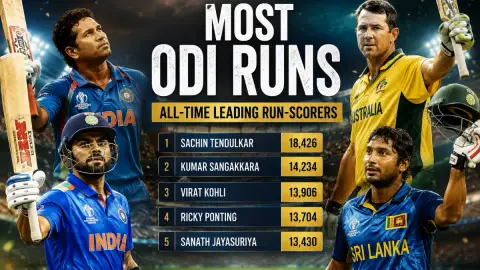
Most ODI Runs Ever: Sachin Tendulkar's 18,426 Leads All-Time List
Sachin Tendulkar's 18,426 runs is the all-time ODI record. See the full ranked top 12, plus 2026 updates on Virat Kohli (14,941) and Rohit Sharma, the closest active chasers.
Most Runs in International Cricket (All Formats)
Sachin Tendulkar has the most runs in international cricket with 34,357 across Tests, ODIs and T20Is. The all-time aggregate run-scorers ranked.
Highest Score in T20I Cricket: Full Leaderboard of Team and Individual Records
Zimbabwe's 344/4 vs Gambia is the highest team total in men's T20Is. See the top 9 team totals, the highest full-member score, and Aaron Finch's 172, updated for 2026.
Fastest Century in ODI Cricket: AB de Villiers' 31-Ball Record
AB de Villiers holds the fastest ODI century ever: 31 balls, South Africa v West Indies, 2015. Ranked list of the 10 fastest ODI hundreds, verified against ESPNcricinfo and Wisden.
Most ODI Wickets in Cricket: All-Time Records and Top Bowlers
Muttiah Muralitharan holds the record for most ODI wickets ever. See the all-time leaders, what makes an elite ODI bowler, and key ODI bowling milestones.
Fastest Century in Cricket (Every Format)
AB de Villiers holds the fastest ODI century at 31 balls. The fastest hundreds in T20, ODI and Test cricket explained, with the record-holders for each format.