
Henderson's Two Throwing Errors Gift the Dodgers Two Runs in NLCS Game 2
On this page7
- 01What happened in the wild third inning?
- 02Why was the pickoff the one throw Henderson could not afford?
- 03What did Milwaukee do immediately after the error?
- 04What happened in the fifth inning?
- 05Why does this keep happening to Milwaukee’s defence?
- 06How did the Brewers climb out of the hole their pitcher dug?
- 07What happens next for Henderson and the Brewers?
Update, October 12: Milwaukee won Game 2, 7-4, to take a 2-0 lead in the NLCS. The errors in this article gifted Los Angeles two of its four runs; the other two came on sacrifice flies, and a first-inning Henderson wild pitch set up the first of them, so the Dodgers scored every run they got without a run-scoring hit, Reuters reports. William Contreras answered almost single-handedly, and the Brewers’ bullpen retired the last 15 Dodgers in order.
A championship series can turn on a throw that is not a pitch. Milwaukee starter Logan Henderson made two of them on Monday, one in the third inning and one in the fifth, and each gifted the Los Angeles Dodgers a run in NLCS Game 2 at American Family Field. The first put Los Angeles ahead 2-1, USA Today reports. The second tied the game 3-3 and ended his afternoon, FOX Sports reports. Milwaukee had won the opener 2-1. Game 2 was decided by the smallest throws on the field.
What happened in the wild third inning?
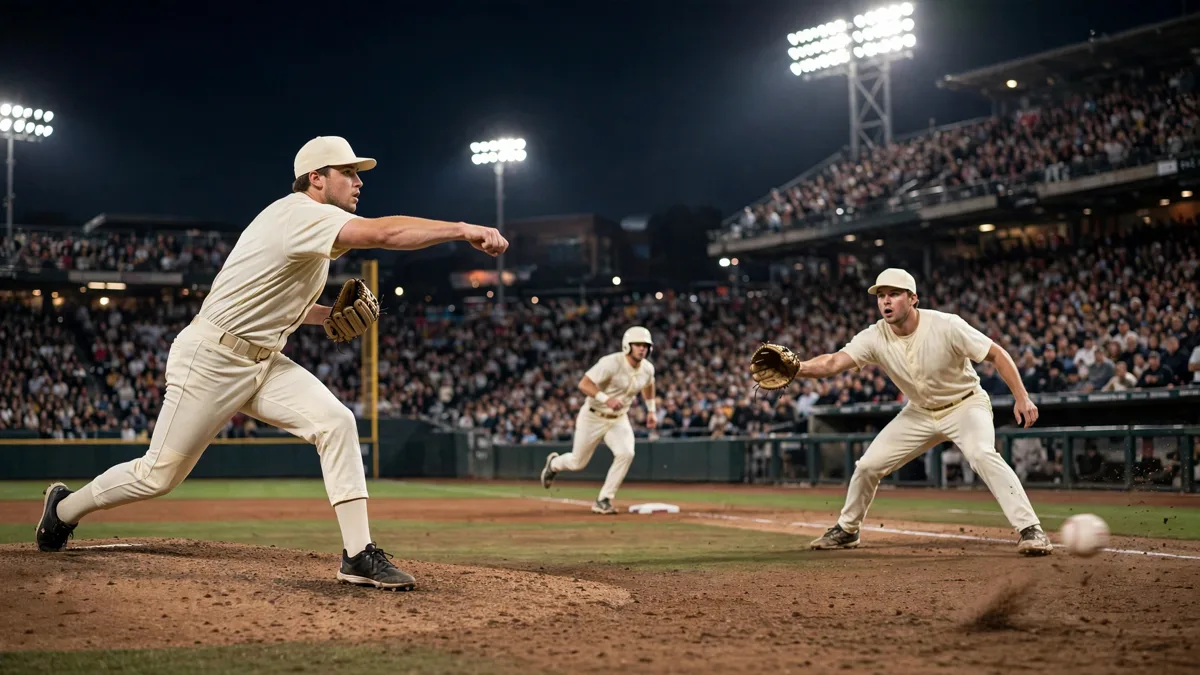
Almost everything, in about ten minutes. Tommy Edman led off with a single, and Mookie Betts followed with a grounder to short that could have been a double play but deflected off the heel of Cooper Pratt’s glove into shallow left, USA Today reports. Freddie Freeman then drove a ball 106.1 mph toward right field, and Sal Frelick, a Gold Glove winner in 2024, leaped and reached behind him to pull it down. Edman tagged to third. With Betts a steal threat at first, Henderson tried a pickoff, spiked it in front of Jake Bauers, and watched it roll into foul territory while Edman walked home. The inning had contained a near double play, a near extra-base hit and a run scored without a ball leaving the infield grass on the scoring play.
Why was the pickoff the one throw Henderson could not afford?
Because of what it defended against. A pickoff with a runner on third and one out is a low-reward gamble: the out at first changes little, while any error scores the runner from third automatically. Henderson was not beaten by a steal or a balk. He created the scoring play himself, against a Dodgers team that had spent Game 1 being held to one run by Milwaukee’s pitching. In a series where Milwaukee’s ace spent his off day trading a signed jersey for his own one-of-one card, the margins were supposed to come from the mound. For two innings on Monday, they came from the dirt in front of first base instead.
What did Milwaukee do immediately after the error?
The loudest possible answer: they chased the Dodgers’ ace. In the bottom of the third, Milwaukee turned 2-1 down into 3-2 up against Yoshinobu Yamamoto, in a 35-pitch inning built on small ball, USA Today’s live coverage reports. David Hamilton singled and stole second, Jake Bauers worked a 12-pitch walk, and Christian Yelich, the captain whose benching framed Game 1, singled in two runs. Yamamoto was relieved in the inning. That rally had been extended before Bauers ever batted by the two ABS challenges Dodgers catcher Will Smith declined on Brice Turang, each on a pitch that would have been a called third strike. Henderson’s error had been answered within the half-inning, which is what made the fifth inning sting more.
What happened in the fifth inning?
The same mistake in a different uniform of a play. Kyle Tucker doubled, and when Henderson moved to field a sacrifice bunt, his throw went astray and Tucker scored to tie the game 3-3, FOX Sports reports. Henderson’s start ended soon after, and Dustin May, a pitcher the Dodgers know well from his years in Los Angeles before his route to Milwaukee via Boston and St. Louis, entered for the Brewers, Heavy reports. Los Angeles then retook the lead in the same inning on a Freeman sacrifice fly, a run Milwaukee challenged at the plate and lost, FOX Sports reports. Two Henderson throwing errors, two Dodgers runs, and a lead built by chasing Yamamoto was gone.
Why does this keep happening to Milwaukee’s defence?
That is the question the home coverage is asking. The Milwaukee Journal Sentinel’s live report noted that defence has been a recurring problem for the Brewers this postseason, and that Monday’s third inning added a pair of miscues to the list, one of them a play its writer thought should have been scored an error on Pratt as well. The pattern matters because Milwaukee’s whole October model is run prevention behind contact pitching: a final-strike walk-off in the division series and a 2-1 opener win are games with no room for free runs. A team built that way can survive a quiet bat. It cannot survive its pitcher scoring runs for the other side, the way a dropped pop in the other league’s series gifted the Dodgers a run earlier this month.
How did the Brewers climb out of the hole their pitcher dug?
On Contreras’s bat and the bullpen’s arm, in that order. Contreras had already tied the game once with a first-inning single; he tied it again at 4-4 with a fifth-inning home run off Kris Bubic and put Milwaukee ahead for good with a sixth-inning RBI single, finishing with three hits and three RBIs, Reuters reports. theScore notes he is only the fourth player ever with three tying or go-ahead RBI hits in a single playoff game. Behind him, Dustin May, JoJo Romero, Abner Uribe and Aaron Ashby retired all 15 batters they faced across five scoreless innings, and Milwaukee’s relievers have now allowed one earned run in 28 2/3 innings this postseason, theScore reports.
The Dodgers’ side of the ledger is the stranger one. Yamamoto’s 2 2/3 innings were the shortest postseason start of his career, theScore reports, and his lineup produced three hits all night. Every Los Angeles run arrived by donation or by fly ball: a wild pitch and a sacrifice fly in the first, the pickoff error in the third, the bunt error and another sacrifice fly in the fifth. Shohei Ohtani went 0-for-4 with two strikeouts. A 2-0 series lead built this way is partly Milwaukee’s resilience and partly a warning: Henderson’s line, four runs and two earned in four innings, is not a start the Brewers can order again in Los Angeles.
What happens next for Henderson and the Brewers?
Game 3 followed on Wednesday at Dodger Stadium, and Milwaukee won it 6-2 behind Robert Gasser’s five scoreless innings to lead the series 3-0. The Dodgers’ lineup question got the harder answer: Ohtani batted sixth, reached base three times, and Los Angeles still fell to the brink of elimination. Los Angeles also spent the week in a different argument entirely, as Dale Murphy and Dodgers outfielder Alex Call asked for the risque ads to come off the playoff broadcasts. The post-game answers on the throws are still to come: Henderson and manager Pat Murphy will be asked about both errors, about whether the pickoff was called from the dugout, and about the fifth-inning bunt play, and this article will be updated in place with what they say. The rotation question follows: whether Henderson takes a normal turn later in the series, on the shortest leash a starter can have in October, or whether Milwaukee shortens its staff around Misiorowski. What Monday settled is narrower. The Brewers are good enough to survive their pitcher throwing two runs to the other side. They would rather not have to prove it a second time. The series itself is now settled: Milwaukee completed the sweep in Game 4 on Thursday, and Murphy summed it up by calling his Brewers gamers rather than Hall of Famers. The sweep produced one more argument after the trophy presentation, started from Boston: Willson Contreras used three Instagram stories to call his brother William the real NLCS MVP over Jake Bauers, then deleted two of them.
Frequently asked questions
What was Henderson's first throwing error in Game 2?+
A pickoff that never arrived. With Tommy Edman on third and Mookie Betts on first in the third inning, Henderson tried to pick Betts off and spiked the ball in front of first baseman Jake Bauers, USA Today reports. The ball rolled deep into foul territory and Edman scored easily from third to put the Dodgers 2-1 ahead.
What was Henderson's second throwing error?+
A fielding throw in the fifth inning. FOX Sports reports the Dodgers tied the game 3-3 in the fifth on a Kyle Tucker double followed by a throwing error on Henderson's attempt to field a sacrifice bunt. Heavy reports Henderson then left the game, with the recently traded Dustin May entering for Milwaukee in what became a battle of the bullpens.
Did the Brewers win Game 2 despite the errors?+
Yes, 7-4, to take a 2-0 lead in the series. Reuters reports William Contreras tied the game with a fifth-inning home run and put Milwaukee ahead for good with a sixth-inning single, on his way to three tying or go-ahead RBI hits, and four Brewers relievers retired all 15 batters they faced. Los Angeles managed three hits and scored all four of its runs on sacrifice flies, a wild pitch and Henderson's two errors.
Who is Logan Henderson?+
Milwaukee's 24-year-old Game 2 starter, in a breakout year. He was handed the ball for the second game of the NLCS with the Brewers leading the series 1-0, against Dodgers ace Yoshinobu Yamamoto, after Jacob Misiorowski had won the opener 2-1 on Sunday. Albat describes him as a rookie right-hander having a breakout season.
Did anything save Henderson from a worse third inning?+
Sal Frelick's glove, one batter earlier. Freddie Freeman drove a low changeup 106.1 mph over Frelick's head in right field, and the 2024 Gold Glove winner leaped and reached behind him to take away an extra-base hit, USA Today reports. Edman tagged up to third on the catch, which put him in position to score on the pickoff error two pitches later.
How did the Brewers answer the first error?+
By chasing Yamamoto in the bottom of the third. Milwaukee turned a 2-1 deficit into a 3-2 lead in an inning that included a 12-pitch walk by Jake Bauers and a two-run single by Christian Yelich, and Yamamoto left the game, USA Today's live coverage reports. It was Yelich, the captain Milwaukee benched for Game 1, driving in the go-ahead runs.
Why do the two errors matter beyond the two runs?+
Because defence is Milwaukee's identity in this series. The Milwaukee Journal Sentinel's live coverage noted defence had already been a problem for the Brewers this postseason and that Monday's pair of miscues came from the pitcher, the one player who touches the ball on every play. Against a lineup as deep as the Dodgers', two free runs in a one-run series is the margin the whole NLCS is being played on.
What happens next in the NLCS?+
The series moves to Los Angeles for Game 3 on Wednesday, with Milwaukee leading 2-0. theScore reports the Dodgers start Blake Snell and the Brewers counter with Robert Gasser. Henderson's next turn, if the rotation holds, would come later in the series, and his and manager Pat Murphy's post-game account of the two throws remains the open follow-up on this article.
Sources
- USA Today: Dodgers take advantage of Brewers' defensive lapses, retake lead in wild inning (the Pratt deflection, the Frelick catch and the spiked pickoff throw in the third)
- USA Today live coverage: Dodgers vs Brewers NLCS Game 2 (the 35-pitch third inning that chased Yamamoto, the Bauers 12-pitch walk and the Yelich two-run single)
- FOX Sports: Dodgers take the lead on a sacrifice fly, call stands after Brewers challenge (the fifth-inning Tucker double and Henderson's bunt-fielding throwing error that tied the game)
- Milwaukee Journal Sentinel live coverage: Brewers vs Dodgers NLCS Game 2 (the pair of third-inning miscues and the note that defence has hurt Milwaukee all postseason)
- Reuters: William Contreras sparks Brewers' Game 2 rally against Dodgers (the 7-4 final, Contreras's tying homer and go-ahead single, the 15 straight retired by the bullpen and Henderson's four runs, two earned)
- theScore: Contreras powers Brewers past Dodgers for 2-0 NLCS lead (Contreras as the fourth player ever with three tying or go-ahead RBI hits in a playoff game, Yamamoto's shortest postseason start and the Game 3 pitching matchup)
- Heavy: Recently traded Dodgers pitcher Dustin May enters NLCS Game 2 for Brewers (Henderson's exit after his second throwing error and the bullpen battle that followed)
Play & tools
Free browser games and tools — no account, no download.
- Play 162-0 — Draft nine and see if your roster can survive a flawless 162-game MLB season.
- Explore all our games →
- Analyze a trade — Compare both sides of a fantasy baseball trade before you accept.
- Run the MLB predictor — Simulate the MLB postseason bracket down to a World Series champion.
- Open the ERA calculator — Work out earned run average from earned runs and innings pitched — handles the .1/.2 thirds convention.
- Explore all our free sports tools →
Related baseball guides
View all →
Ohtani Bats Sixth and Reaches Three Times as Dodgers Fall 6-2 to Trail 3-0
Shohei Ohtani batted sixth in NLCS Game 3 and reached base three times, but the Dodgers lost 6-2 to Milwaukee and now trail the series 3-0.
Miguel Rojas Announces His Retirement in the Dodgers' Clubhouse After the NLCS Sweep
Miguel Rojas told his Dodgers teammates after the Game 4 loss to Milwaukee that he is retiring, ending a 13-year career in the room where it peaked.
Smith Declines Two ABS Challenges on Turang as Roberts Says the Misses Changed Yamamoto's Outing
Dodgers catcher Will Smith twice declined ABS challenges on would-be third strikes to Brice Turang in NLCS Game 2, and both times Turang reached and scored.
Brewers Bench Captain Christian Yelich for NLCS Game 1 Against Tarik Skubal
Milwaukee opened the NLCS with captain Christian Yelich on the bench against left-hander Tarik Skubal, starting Andrew Vaughn at DH in a platoon move.
Murphy Calls His Brewers Gamers, Not Hall of Famers, After Sweeping the Dodgers
Pat Murphy summed up Milwaukee's NLCS sweep in one line about gamers and Hall of Famers. The payroll gap and two sweep records back him up.
Freeman Fires Back at the Dinosaur Label as the Dodgers Face Elimination
Freddie Freeman rejected the idea that the Dodgers are losing the NLCS because they are old, saying Los Angeles is simply not playing well against Milwaukee.