
Greatest Swimmers of All Time, Ranked: Pool and Open-Water Legends
On this page13
- 01Greatest swimmers of all time at a glance
- 02Michael Phelps (USA)
- 03Katie Ledecky (USA)
- 04Mark Spitz (USA)
- 05Ian Thorpe (Australia)
- 06Caeleb Dressel (USA)
- 07Janet Evans (USA)
- 08How we ranked the list
- 09The suit and pool caveat
- 10The current era (2024–2026)
- 11The open-water dimension
- 12All-time Olympic medal leaders
- 13Why the debate endures
We rank on hard Olympic and World Championship medal counts first, then weight world records, dominance within an event, and how many Olympic cycles a swimmer stayed on top. Versatility across strokes and sustained supremacy in one event are treated as two valid paths to greatness, not competing ones.
Greatest swimmers of all time at a glance
| Rank | Swimmer | Olympic golds | Strongest ranking argument |
|---|---|---|---|
| 1 | Michael Phelps | 23 | Most decorated Olympian, with unmatched versatility |
| 2 | Katie Ledecky | 9 | Four straight 800m titles and distance dominance |
| 3 | Mark Spitz | 9 | Seven golds with seven world records at Munich 1972 |
| 4 | Ian Thorpe | 5 | Dominated middle-distance freestyle around three Games |
| 5 | Caeleb Dressel | 9 | Five-gold peak at Tokyo 2020 across sprint events |
| 6 | Janet Evans | 4 | Distance world records that endured for decades |
- Most decorated Olympian
Michael Phelps (USA)
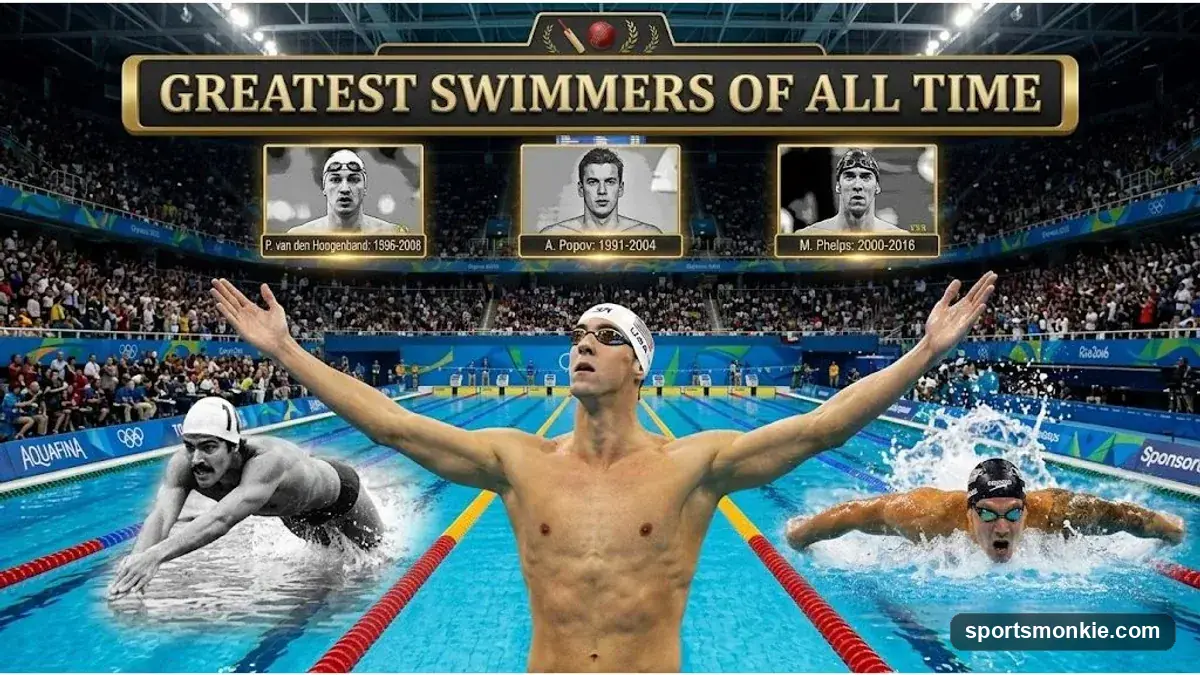
Phelps sits at No. 1 on the raw numbers no one else approaches: 28 Olympic medals, 23 of them gold, across five Games from 2000 to 2016. That is the most medals and the most golds of any athlete in any sport in the modern Olympics, and his 13 individual Olympic golds broke a record that had stood since 152 BC.
What separates him from every other swimmer here is range. He won at the highest level in butterfly, freestyle, and the individual medley in the same Games, and at Beijing 2008 he took eight golds at a single Olympics — passing Mark Spitz's mark of seven that had held for 36 years.
Team: USA · Peak: 8 golds at Beijing 2008 · Career: 28 medals / 23 gold (2000–2016)
- Distance queen
Katie Ledecky (USA)
Ledecky owns the most Olympic gold medals of any female swimmer: nine golds and 14 total medals across four Games from 2012 to 2024, plus 23 individual and relay world titles. Her winning margins in the 800m and 1500m freestyle regularly stretch past 10 seconds — gaps almost unheard of at the elite level.
She ranks above Mark Spitz because her supremacy spanned a full decade, not one Games. She has never lost an 800m freestyle final at the Olympics or World Championships since 2012, and in 2025 she took a seventh straight 800m world title in Singapore, holding off Summer McIntosh and Lani Pallister.
Team: USA · Peak: 4 straight Olympic 800m free titles · Career: 9 gold / 14 medals (2012–2024)
- Perfect Games
Mark Spitz (USA)
Spitz produced the most concentrated performance in swimming history at Munich 1972: seven golds, each in a world-record time. No swimmer had done that before, and only Phelps has since matched the seven-in-one-Games gold haul.
He ranks below Ledecky because his dominance was compressed into a single fortnight rather than sustained across cycles — a 1968 debut aside, his legend rests almost entirely on those eight days in Munich. On pure peak, though, few weeks in any sport rival it.
Team: USA · Peak: 7 golds at Munich 1972 (all world records) · Career: 9 Olympic golds
- The Thorpedo
Ian Thorpe (Australia)
Thorpe ranks fourth as the defining middle-distance freestyler of his era, winning five Olympic golds and nine medals between 1998 and 2004 and setting 13 long-course world records. He remains Australia's most successful Olympian.
He places above the sprinters and specialists below him because he combined range — golds from 200m to 400m freestyle — with an efficient two-beat kick that let him hold form deep into a race. His size-17 feet and long pull became a template distance swimmers still study.
Team: Australia · Peak: 400m free reign 1998–2004 · Career: 5 golds / 9 medals
- Sprint king
Caeleb Dressel (USA)
Dressel earns fifth as the most explosive sprinter of the late 2010s, with world records in the 50m and 100m butterfly and the 100m freestyle. He won five golds at Tokyo 2020, then added two relay golds at Paris 2024 to reach nine Olympic golds and 10 medals.
He sits below Thorpe because his individual dominance was shorter-lived — he struggled at Paris 2024, missing the 50m free podium and the 100m fly final. His underwater work off the walls, built on a powerful dolphin kick, remains a benchmark for sprint technique.
Team: USA · Peak: 5 golds at Tokyo 2020 · Career: 9 gold / 10 medals
- Distance pioneer
Janet Evans (USA)
Evans closes the list as the swimmer who redefined women's distance racing before Ledecky. She won four Olympic golds across 1988 and 1992 and set world records in the 400m, 800m, and 1500m freestyle.
Her 800m freestyle world record lasted nearly 19 years, and her 1500m mark stood almost 20 — longevity that no other entry here can claim for a single event. She proved a smaller-framed swimmer could dominate distance through stroke rate rather than raw power.
Team: USA · Peak: distance freestyle WRs 1987–89 · Career: 4 Olympic golds
Reader interaction
Build your ranking
Drag the names into the order you think is right — or use the arrows — then submit to see how your list compares with everyone else's.
- Michael Phelps (USA)
- Katie Ledecky (USA)
- Mark Spitz (USA)
- Ian Thorpe (Australia)
- Caeleb Dressel (USA)
- Janet Evans (USA)
Audience ranking
How everyone ranked them
Built from reader rankings using position-based points.
The names above are ranked; the sections below explain how we weighed them, where the record book bends, and who is redrawing it right now.
How we ranked the list
Olympic gold carries the most weight, because it is the one stage every era’s best swimmer targets. After that we look at world titles, world records, the size and durability of a swimmer’s dominance in specific events, and how many Olympic cycles they stayed at the front.
Swimming splits into male and female disciplines across dozens of events — 50m sprints to the 1500m, four strokes, plus relays — so the sport produces a lot of one-event specialists. The swimmers who reach this list are the ones who either won across several of those categories, like Phelps and Thorpe, or owned one event so completely that no rival came close, like Ledecky and Evans.
The suit and pool caveat
Raw times mislead across eras, so we lean on medals and margins over stopwatch comparisons. Pool design keeps getting faster: wave-killing lane ropes, deeper water, and better starting blocks all shave time. In a standard 50-meter Olympic pool, those gains compound over a long race.
Swimsuits matter even more. The polyurethane suits of 2008–2009 triggered a flood of world records before regulators banned them, and most analysts still fence off records from that window. It is why a modern swimmer holding a “slower” record than a 2009 mark is often the more impressive athlete.
The current era (2024–2026)
The generation defining swimming now is younger and, in several events, faster than anything before it. Canada’s Summer McIntosh broke through at Paris 2024 with three individual golds — the 200m butterfly, 200m individual medley, and 400m individual medley — becoming the first Canadian to win three golds at a single Olympics. She holds world records across multiple events and is the most complete female all-rounder since Ledecky emerged.
In the men’s sprints, Pan Zhanle of China lowered the 100m freestyle world record twice in 2024, down to 46.40 seconds on his way to Olympic gold. France’s Léon Marchand delivered four individual golds at his home Games across breaststroke, butterfly, and the medleys, and Australia’s Kaylee McKeown has controlled women’s backstroke. Britain’s Adam Peaty, still the fastest 100m breaststroker in history, took silver at Paris 2024 by two-hundredths of a second.
The open-water dimension
Open-water racing — held in lakes, rivers, and oceans from 5km up to marathon length — has standouts who rarely appear in pool-focused rankings. The Netherlands’ Sharon van Rouwendaal won Olympic gold in the 10km marathon swim at Paris 2024, and Brazil’s Ana Marcela Cunha has built one of the deepest résumés in the discipline. Their achievements sit outside the pool-medal framework this list uses, which is why they are noted here rather than ranked above.
All-time Olympic medal leaders
A quick scan of career Olympic hauls shows how far ahead Phelps sits, and how tightly the names behind him cluster.
| Swimmer | Country | Olympic Gold | Total Medals | Era |
|---|---|---|---|---|
| Michael Phelps | USA | 23 | 28 | 2000–2016 |
| Katie Ledecky | USA | 9 | 14 | 2012–2024 |
| Mark Spitz | USA | 9 | 11 | 1968–1972 |
| Jenny Thompson | USA | 8 | 12 | 1992–2004 |
| Caeleb Dressel | USA | 9 | 10 | 2016–2024 |
| Dara Torres | USA | 4 | 12 | 1984–2008 |
| Ian Thorpe | Australia | 5 | 9 | 1998–2004 |
Counts reflect completed Olympic careers or totals through the 2024 Paris Games, accurate as of 2026. Ledecky’s 14 medals tie Australia’s Emma McKeon for the most by any female swimmer.
Why the debate endures
Swimming rewards opposite kinds of greatness, which is why the argument never settles. Phelps’s versatility across strokes and Ledecky’s crushing distance supremacy are near-inverse forms of dominance, yet both sit at the very top. Add McIntosh, Pan, and Marchand rewriting the record book, and the list stays open — revised every Olympic cycle rather than closed.
Frequently asked questions
Who is the greatest swimmer of all time?+
Michael Phelps is almost universally regarded as the greatest swimmer in history. He is the most decorated Olympian ever with 28 medals, more Olympic golds (23) than any athlete in any sport, and he won a record eight golds at a single Games in Beijing 2008. His versatility across butterfly, freestyle, and individual medley separates him from single-event specialists.
Who is the greatest female swimmer of all time?+
Katie Ledecky is widely considered the greatest female swimmer ever. She holds nine Olympic gold medals — the most by any female swimmer — plus 14 total Olympic medals and 23 world titles as of 2026. Her decade of unbeaten distance freestyle racing, with margins often exceeding 10 seconds in the 800m and 1500m, is what sets her apart.
Is Katie Ledecky better than Mark Spitz?+
By total hardware, yes. Ledecky's nine Olympic golds and 14 medals over four Games outstrip Spitz's nine golds and 11 medals, and her dominance lasted more than a decade versus his one extraordinary Games. Spitz still wins the peak-performance argument: seven golds in world-record time at Munich 1972 remains the most perfect single Olympics any swimmer has produced.
Why is Ian Thorpe ranked above Caeleb Dressel?+
Thorpe combined middle-distance range — Olympic golds from 200m to 400m freestyle — with a six-year reign at the top, and he set 13 long-course world records. Dressel was a more explosive sprinter but his individual dominance was briefer; he struggled badly at Paris 2024. Their gold counts are close, but Thorpe's sustained versatility edges Dressel's shorter peak.
Who are the best swimmers competing in 2025 and 2026?+
Canada's Summer McIntosh, who won three golds at Paris 2024 and holds multiple world records, is the dominant emerging all-rounder. China's Pan Zhanle owns the men's 100m freestyle world record at 46.40 seconds. Katie Ledecky still leads distance freestyle, France's Léon Marchand won four individual golds in Paris, and Australia's Kaylee McKeown rules women's backstroke.
Who holds the men's 100m freestyle world record?+
As of 2026, China's Pan Zhanle holds the men's 100m freestyle world record at 46.40 seconds, set winning Olympic gold at Paris 2024. He lowered the mark twice in 2024, first to 46.80 in Doha and then to 46.40 in Paris, finishing roughly a full second clear of the field — one of the largest winning margins ever seen in an Olympic 100m freestyle final.
Sources
Play & tools
Free browser games and tools — no account, no download.
- Play today's Sports Connections — Today's Sports Connections — daily hints, answers, and play the grid.
- Play Guess the NFL Player — A new mystery NFL player every day. Eight guesses, with a clue on each — plus free unlimited mode.
- Explore all our games →
Related records & rankings guides
View all →
Best Pool Players of All Time: The Greatest in Billiards
The greatest pool players of all time include Efren Reyes, Earl Strickland, Ralph Greenleaf and Shane Van Boening — ranked by world titles, U.S. Open wins and longevity at the top of the pro game.

Greatest Cyclists of All Time: Legends Who Defined the Sport
The greatest cyclists ever, from Eddy Merckx's Grand Tour dominance to modern icons like Tadej Pogacar and Marianne Vos who redefined the sport.
Greatest Female Bodybuilders of All Time: The Legends
The greatest female bodybuilders of all time, athletes who redefined strength, symmetry, and conditioning across decades of IFBB competition.
Medley Relay Explained: Stroke Order, Exchanges & Strategy
The medley relay swims backstroke, breaststroke, butterfly, then freestyle. Learn the medley relay swimming order, exchange rules, and race strategy.
What Is the Individual Medley in Swimming? Order, Distances & Rules
Individual medley swimming has one swimmer race all four strokes in a fixed order: butterfly, backstroke, breaststroke, freestyle. Here's how it works.
Most Olympic Gold Medals Ever
Michael Phelps won 23 Olympic gold medals, the most by any athlete. The full leaderboard of the most Olympic golds ever won, explained.