
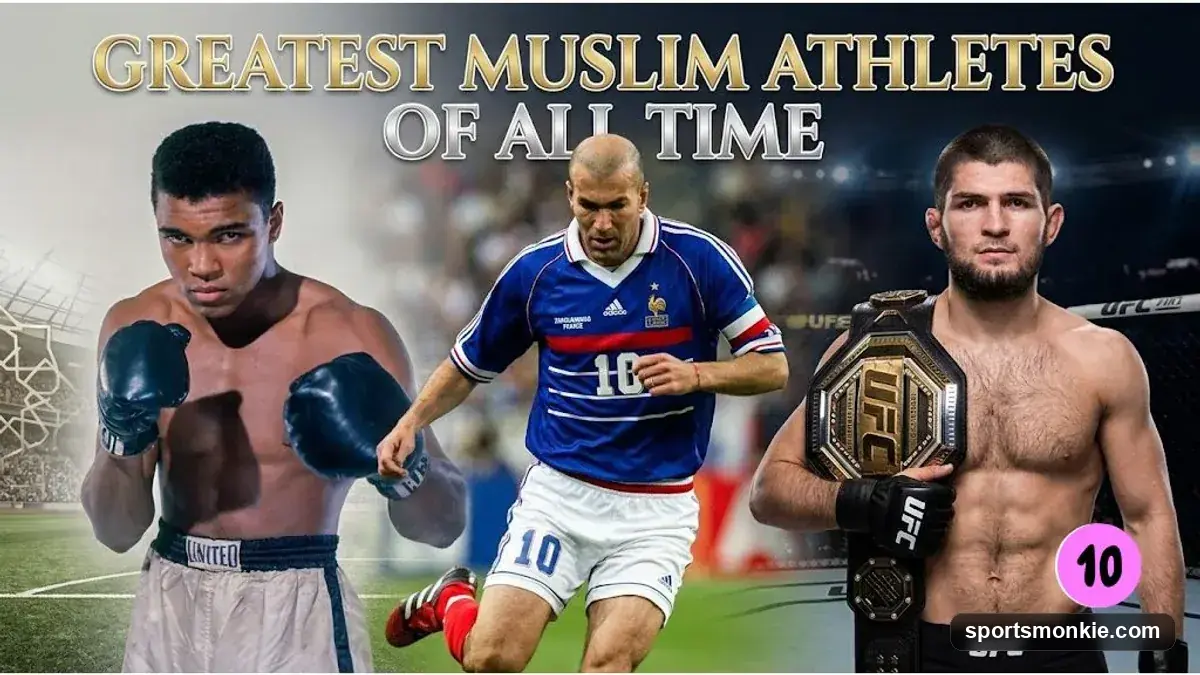
Greatest Muslim Athletes of All Time: Ranked Icons Across Sport
On this page14
- 01Greatest Muslim athletes of all time at a glance
- 02Muhammad Ali
- 03Zinedine Zidane
- 04Hakeem Olajuwon
- 05Hicham El Guerrouj
- 06Khabib Nurmagomedov
- 07Mo Farah
- 08Mohamed Salah
- 09Nawal El Moutawakel
- 10How We Ranked This List
- 11At a Glance
- 12Faith in Public View
- 13Regional Powerhouses Beyond the Top Eight
- 14Who Just Missed
We ranked on three measured things: peak dominance in the athlete's sport (titles, records, head-to-head results), how long they stayed at that peak, and the scale of their cultural imprint as visibly Muslim figures. Raw talent without trophies, or a single hot season, does not crack the top tier.
Greatest Muslim athletes of all time at a glance
| Rank | Athlete | Sport | Strongest ranking argument |
|---|---|---|---|
| 1 | Muhammad Ali | Boxing | Three-time heavyweight champion with unmatched cultural impact |
| 2 | Zinedine Zidane | Football | World Cup winner and three-time FIFA World Player |
| 3 | Hakeem Olajuwon | Basketball | Two NBA titles and a singular 1994 awards sweep |
| 4 | Hicham El Guerrouj | Athletics | Olympic 1500m–5000m double and lasting records |
| 5 | Khabib Nurmagomedov | MMA | Retired 29–0 as UFC lightweight champion |
| 6 | Mo Farah | Athletics | Four Olympic golds across 5,000m and 10,000m |
- Boxing
Muhammad Ali
Ali sits at the top because no other athlete on this list combined in-ring greatness with off-field consequence at his scale. He won the heavyweight title three separate times, beat George Foreman and Joe Frazier in fights still dissected frame by frame, and took Olympic light heavyweight gold at Rome 1960 as an 18-year-old. He ranks above Zidane and Olajuwon because his impact reshaped how sport and faith are discussed at all — not just how one game is played. See our fuller list of the greatest boxers for where he stands against the rest of the division.
His 1964 conversion to Islam and 1967 refusal of the Vietnam draft cost him roughly three-and-a-half years of his athletic prime and his title belt. He accepted that trade on principle, then came back and won the championship again.
Sport: Boxing · Nation: USA · Peak: 3x heavyweight champion, 1960 Olympic gold · Defining feat: beat Foreman at the 1974 'Rumble in the Jungle'
- Football
Zinedine Zidane
Zidane, of Algerian Kabyle heritage, edges the basketball and athletics greats below him because he won the two biggest prizes in his sport and was individually decorated three times as the best player alive. He captained France to the 1998 World Cup — scoring twice in the final — added the 2000 European Championship, and won the FIFA World Player of the Year award in 1998, 2000 and 2003.
He then closed his playing career with the goal many still call the finest in a Champions League final: a left-footed volley for Real Madrid in 2002. His career pairs peak team success with sustained individual recognition, which is why he outranks single-team dynasties below.
Sport: Football · Nation: France · Peak: World Cup + Euro winner · Defining feat: 3x FIFA World Player of the Year
- Basketball
Hakeem Olajuwon
Olajuwon ranks third on dominance density: he is the only player in NBA history to win a championship, MVP, Defensive Player of the Year and Finals MVP in the same season (1994). He led the Houston Rockets to back-to-back titles in 1994 and 1995 and remains the league's all-time leader in blocked shots. He appears among our greatest NBA players for good reason.
Born in Lagos, he was the first international player taken first overall in an NBA Draft (1984). He also played through Ramadan while fasting and repeatedly said the discipline sharpened his game rather than sapping it — a rare on-record example of elite performance during a full fast.
Sport: Basketball · Nation: Nigeria/USA · Peak: 2x NBA champion, 1994 MVP · Defining feat: only player to sweep MVP, DPOY, title and Finals MVP in one year
- Athletics
Hicham El Guerrouj
El Guerrouj is the most statistically dominant athlete on this list. Over roughly a nine-year span he won 83 of 86 finals at 1500m and the mile, took four straight world titles (1997–2003), and set world records in both the 1500m and the mile that still stood entering 2026.
His signature moment was the 1500m/5000m double at the 2004 Athens Olympics — the first man to win both in one Games since Paavo Nurmi in 1924. He ranks just below the team-sport icons only because middle-distance running commands a smaller global stage, not because his supremacy is in any doubt.
Sport: Athletics · Nation: Morocco · Peak: 4x world champion · Defining feat: 1500m/5000m Olympic double, Athens 2004
- MMA
Khabib Nurmagomedov
Khabib earns the fifth spot for perfect competitive closure: he retired 29-0 as UFC lightweight champion, having lost only a single round across 13 UFC bouts. He defended the belt against Conor McGregor, Dustin Poirier and Justin Gaethje, submitting the last two.
He ranks below the longer-tenured legends above mainly on career length — he walked away at 32, keeping a promise to his mother after his father's death. His faith was not incidental: the post-fight sujood and his Dagestani wrestling-and-discipline identity defined his public image as much as his grappling did.
Sport: MMA · Nation: Russia (Dagestan) · Peak: undefeated UFC lightweight champion · Defining feat: retired 29-0
- Distance running
Mo Farah
Farah, who arrived in Britain from Somalia as a child, doubled up the 5000m and 10,000m at both the 2012 London and 2016 Rio Olympics — a distance double no man had ever completed at consecutive Games. That is four Olympic golds plus six world titles on the track.
He ranks sixth rather than higher because his dominance was concentrated in a five-year championship window, where El Guerrouj's spanned nearly a decade and Ali's cultural weight was singular. His 2012 home-crowd 10,000m win remains one of the defining images of a British Olympics.
Sport: Athletics · Nation: Somalia/UK · Peak: 4x Olympic gold · Defining feat: 5000m/10,000m double at two straight Olympics
- Modern football
Mohamed Salah
Salah is the leading active player on this list. He has won the Premier League Golden Boot four times (2017/18, 2018/19, 2021/22, 2024/25), matching Thierry Henry, and his 32 goals in 2017/18 set the single-season record for a 38-game Premier League campaign before Erling Haaland later surpassed it.
He ranks seventh because his trophy haul, while large, is still being written, and he lacks the World Cup or Olympic capstone the names above hold. His open celebration of his faith — the sujood after goals — made him one of the most visible Muslim athletes of the streaming era.
Sport: Football · Nation: Egypt · Peak: 4x PL Golden Boot · Defining feat: record 32 goals in a 38-game PL season (2017/18)
- Trailblazer
Nawal El Moutawakel
El Moutawakel makes the list on historic weight rather than trophy volume: at the 1984 Los Angeles Olympics she won the inaugural women's 400m hurdles to become the first Muslim woman — and first African woman — to win Olympic gold. Morocco's king reportedly ordered newborn girls named after her that day.
She ranks eighth because a single Games cannot outweigh the sustained dominance above, but her barrier-breaking result reshaped the ceiling for women across the Muslim world and she later became an International Olympic Committee member.
Sport: Athletics · Nation: Morocco · Peak: 1984 Olympic 400m hurdles gold · Defining feat: first Muslim woman to win Olympic gold
Reader interaction
Build your ranking
Drag the names into the order you think is right — or use the arrows — then submit to see how your list compares with everyone else's.
- Muhammad Ali
- Zinedine Zidane
- Hakeem Olajuwon
- Hicham El Guerrouj
- Khabib Nurmagomedov
- Mo Farah
- Mohamed Salah
- Nawal El Moutawakel
Audience ranking
How everyone ranked them
Built from reader rankings using position-based points.
The ranking above spans four sports and six decades, so a like-for-like comparison is impossible on stats alone. Here is how we weighted the field, plus the context that explains why faith sits at the center of so many of these careers.
How We Ranked This List
Three inputs decided placement, in this order:
- Peak dominance: how far above the field the athlete stood at their best — titles, records, and head-to-head results against the era’s other elites.
- Longevity at the top: a single golden season counts for less than a decade of it. El Guerrouj’s near-total command of the mile and Ali’s multiple title reigns rate higher than a short, brilliant peak.
- Cultural imprint as a Muslim athlete: how visibly and consequentially their faith featured in public life, from Ali’s draft stand to Khabib’s post-fight sujood.
Raw ability with a thin trophy cabinet does not make the top tier. Neither does fame without dominance. Athletes had to clear the competitive bar first, and the cultural weight then broke ties — which is exactly why Ali outranks a technically superb footballer, and why a barrier-breaking Olympic champion still places below athletes with longer reigns.
At a Glance
| Rank | Athlete | Sport | Signature achievement |
|---|---|---|---|
| 1 | Muhammad Ali | Boxing | 3x heavyweight champion, 1960 Olympic gold |
| 2 | Zinedine Zidane | Football | World Cup + Euro, 3x FIFA World Player of the Year |
| 3 | Hakeem Olajuwon | Basketball | 2x NBA champion, 1994 MVP |
| 4 | Hicham El Guerrouj | Athletics | 4x world champion, 1500m/5000m Olympic double |
| 5 | Khabib Nurmagomedov | MMA | Retired 29-0, UFC lightweight champion |
| 6 | Mo Farah | Athletics | 4x Olympic gold, distance double x2 |
| 7 | Mohamed Salah | Football | 4x Premier League Golden Boot |
| 8 | Nawal El Moutawakel | Athletics | First Muslim woman to win Olympic gold |
Faith in Public View
For every athlete here, Islam showed up on the world stage rather than staying private. Ali’s name change and draft refusal, Olajuwon’s fasting during championship runs, Khabib’s prayer in the octagon, Salah’s sujood after goals — each moment put belief in front of a global audience and started its own conversation about religion in sport.
Ramadan is the recurring flashpoint: elite athletes fasting from food and water through daylight while still expected to perform. Footballers, basketball players and track athletes have all addressed it publicly. Scholars generally allow deferral when competition demands it, but whether to fast, defer, or make up days later stays an individual decision, and these athletes have handled it in visibly different ways.
Regional Powerhouses Beyond the Top Eight
Muslim-majority nations have produced sustained excellence in events Western sports media has historically undercovered. Moroccan and Algerian runners have dominated middle-distance athletics for decades. Egyptian players have controlled the world squash rankings for years — a run of team and individual supremacy few countries match in any discipline.
Cricket is another deep well. Pakistan’s roll call of all-time greats includes Imran Khan, Wasim Akram, Waqar Younis and Saeed Ajmal — names that would lengthen this list considerably if it were sport-by-sport rather than cross-discipline. The point of the ranking above is not that these players fall short, but that a single blended list can only hold so many before it stops being a ranking and becomes a directory.
Who Just Missed
The eight ranked names are not the only candidates. Karim Benzema (a Ballon d’Or winner), Sadio Mane, Riyad Mahrez and Paul Pogba all have strong football cases; Ibtihaj Muhammad broke ground as the first American to compete at the Olympics in a hijab and won a team fencing medal. They sit just outside the top tier here on the same criteria applied throughout — dominance, longevity, and impact — but any of them would headline a longer edition of this list.
Frequently asked questions
Is Naomi Osaka a Muslim athlete?+
No. Naomi Osaka is often grouped into diversity conversations because of her Haitian-Japanese heritage, but there is no public record of her practicing Islam, so she does not belong on a list of the greatest Muslim athletes. Older versions of many such lists included her by mistake. We removed her here and ranked only athletes whose Muslim faith is documented and, in most cases, publicly expressed.
Why is Muhammad Ali ranked above great footballers like Zidane and Salah?+
Ali tops the list because he combined the highest tier of sporting achievement — three heavyweight titles and Olympic gold — with cultural impact no other athlete here matched. His conversion and draft refusal changed the global conversation about faith and sport itself. Zidane and Salah were or are elite footballers, but their influence stayed largely within their game rather than reshaping how sport and belief intersect worldwide.
Which Muslim athletes have won Olympic gold medals?+
Several on this list did. Muhammad Ali won light heavyweight gold in 1960, Hicham El Guerrouj took the 1500m/5000m double in 2004, Mo Farah won four track golds across 2012 and 2016, and Nawal El Moutawakel won the 400m hurdles in 1984. Beyond them, athletes from Algeria, Egypt, Pakistan, Indonesia and Azerbaijan have won Olympic gold across boxing, weightlifting, wrestling and more.
How do Muslim athletes handle fasting during Ramadan?+
It varies by individual. Islamic scholars generally permit athletes under physical hardship to defer fasts and make up the days later, so some compete without fasting and repay the days off-season. Others, like Hakeem Olajuwon, fasted through competition and said it sharpened their focus. The choice to fast, defer, or fast only on rest days stays personal and is usually made with religious guidance.
Who is the greatest active Muslim athlete right now?+
Among currently competing athletes, Mohamed Salah has the strongest case. He has won the Premier League Golden Boot four times — level with Thierry Henry — and once held the single-season scoring record for a 38-game Premier League campaign. Other prominent active Muslim stars include footballers Karim Benzema, Sadio Mane and Riyad Mahrez, though none currently match Salah's individual haul in a major domestic league.
Why is Khabib ranked below athletes with longer careers?+
Khabib retired undefeated at 29-0, which is a flawless competitive record, but he stepped away at 32 after only 13 UFC fights to honor a promise to his mother following his father's death. Ranking weighs longevity alongside dominance, so athletes like El Guerrouj and Farah, who ruled their events across a longer span and larger sample of contests, edge ahead despite Khabib's spotless ledger.
Sources
Play & tools
Free browser games and tools — no account, no download.
- Play today's Sports Connections — Today's Sports Connections — daily hints, answers, and play the grid.
- Play Guess the NFL Player — A new mystery NFL player every day. Eight guesses, with a clue on each — plus free unlimited mode.
- Explore all our games →
Related records & rankings guides
View all →
Greatest Judo Players (Athletes) of All Time
The greatest judo players of all time, including Teddy Riner, Yasuhiro Yamashita, and Ryoko Tani, who dominated World and Olympic podiums for decades.
Most Followed Athletes on Twitter/X, Ranked
Cristiano Ronaldo leads the most followed athletes on X/Twitter with 113M+ followers, ahead of Virat Kohli and Neymar. See the full ranked top 11 with counts.
Best Female MMA Fighters of All Time, Ranked
The greatest female MMA fighters ever, ranked with the case for each: Amanda Nunes, Valentina Shevchenko, Ronda Rousey, Cris Cyborg, Zhang Weili and more.

Greatest Lacrosse Players of All Time
From Jim Brown to Paul Rabil, these are the greatest lacrosse players in history — ranked by dominance, legacy, and impact on the sport.

Most Popular Athletes on Social Media: The Biggest Followings
Ranked: the 10 most-followed athletes on social media, led by Cristiano Ronaldo's 946M+ combined followers across Instagram, Facebook, and X, as of 2026.

Best Pool Players of All Time: The Greatest in Billiards
The greatest pool players of all time include Efren Reyes, Earl Strickland, Ralph Greenleaf and Shane Van Boening — ranked by world titles, U.S. Open wins and longevity at the top of the pro game.