
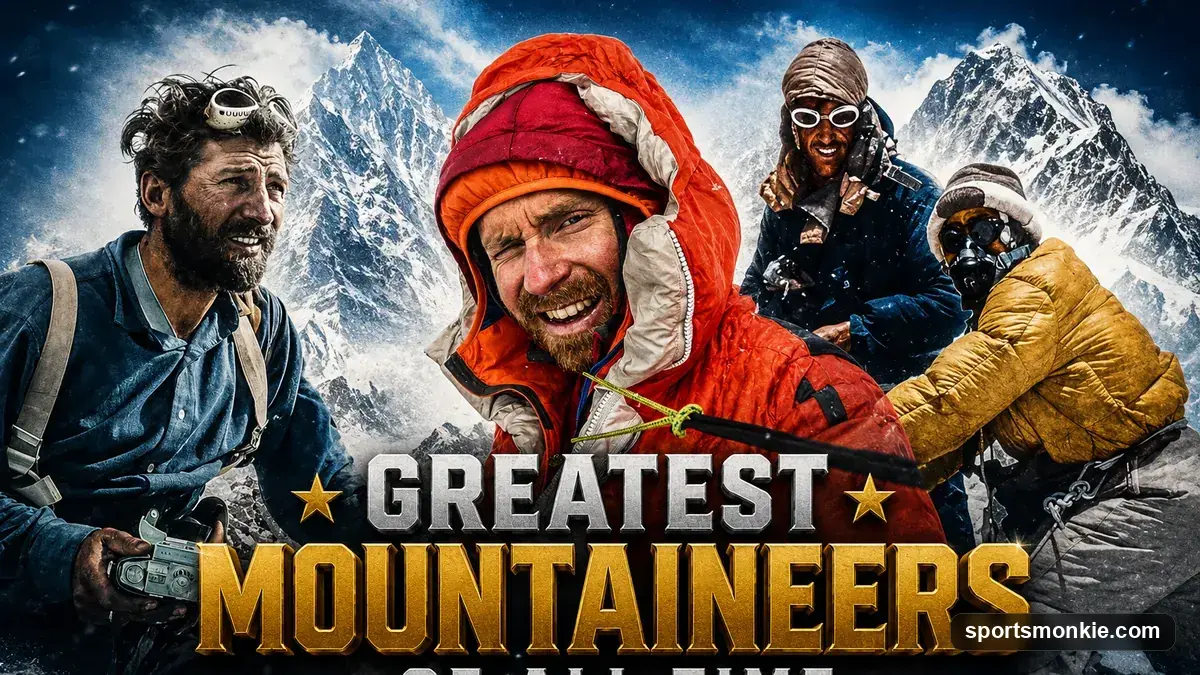
Greatest Mountaineers of All Time
On this page13
- 01Greatest mountaineers of all time at a glance
- 02Reinhold Messner
- 03Edmund Hillary & Tenzing Norgay
- 04Jerzy Kukuczka
- 05Nirmal Purja
- 06Junko Tabei
- 07George Mallory
- 08Alex Honnold
- 09How we ranked the greatest mountaineers
- 10How mountaineering measures “greatest”
- 11Key achievements at a glance
- 12The Sherpa contribution
- 13The record book in 2026
We weighted three things above all: firsts that opened the sport (first ascents, first oxygen-free climbs), the difficulty of the line taken (winter, solo, new route beats a guided fixed-rope ascent), and lasting influence on how people climb. Raw summit counts matter least.
Greatest mountaineers of all time at a glance
| Rank | Mountaineer | Landmark achievement | Strongest ranking argument |
|---|---|---|---|
| 1 | Reinhold Messner | All 14 eight-thousanders without bottled oxygen | Redefined high-altitude alpine style |
| 2 | Edmund Hillary & Tenzing Norgay | First confirmed Everest summit | Mountaineering's most consequential first ascent |
| 3 | Jerzy Kukuczka | Second to climb all 14 eight-thousanders | New routes on 10 peaks and winter firsts |
| 4 | Nirmal Purja | All 14 eight-thousanders in 6 months 6 days | Reset the speed benchmark in 2019 |
| 5 | Junko Tabei | First woman on Everest | Also first woman to complete the Seven Summits |
| 6 | George Mallory | 1924 Everest attempt | Enduring influence on exploration and climbing culture |
- The complete alpinist
Reinhold Messner
Messner is the name every "greatest ever" argument starts with because he moved every goalpost at once. In 1978 he made the first ascent of Everest without bottled oxygen alongside Peter Habeler, a feat physiologists had called fatal; in 1980 he repeated it solo, during the monsoon, with no support above base camp. In 1986 he became the first person to summit all 14 eight-thousanders, every one without supplemental oxygen.
He ranks above Hillary and Norgay here not for a single date but for redefining the ceiling of the possible across a whole career, then winning the argument that lightweight alpine style is the more honest way to climb. If you want to build the engine for it, start with our pushup routine for climbers.
Nation: Italy · Peak feat: All 14 eight-thousanders, oxygen-free (1986) · Signature: First oxygen-free Everest (1978), first solo Everest (1980)
- The first summit
Edmund Hillary & Tenzing Norgay
Hillary of New Zealand and Norgay of Nepal own mountaineering's most famous date: 29 May 1953, the first verified ascent of Everest after three decades of failed British attempts. No summit before or since carries the same cultural weight, which is why the "first" alone earns the number-two slot despite the modern support of a large expedition.
What sets them apart from a one-summit footnote is what came after. Hillary spent decades building schools and hospitals for Khumbu Sherpa communities; Norgay founded a mountaineering institute that trained a generation of Nepali climbers. The partnership, not just the summit, is why both names travel together.
Nations: New Zealand / Nepal · Peak feat: First confirmed Everest summit (1953) · Legacy: Himalayan Trust schools; Nepal's first mountaineering institute
- The hardest 14
Jerzy Kukuczka
Kukuczka finished the 14 eight-thousanders in 1987, a year behind Messner, but the manner is why many climbers rate his list the tougher one. He opened new routes on ten of the fourteen and climbed several in winter, when Himalayan storms and cold turn standard routes lethal. Messner himself acknowledged the Pole's climbs as the harder collection.
He ranks just behind Messner because he was second to the milestone, not because the climbing was lesser. Kukuczka died in 1989 on a new line up Lhotse's South Face when his rope snapped, still pushing the difficulty that defined him.
Nation: Poland · Peak feat: Second to all 14 eight-thousanders (1987) · Signature: New routes on 10 of 14; multiple winter first ascents
- The speed era
Nirmal Purja
Purja compressed a challenge that once took climbers most of a decade into six months and six days, summiting all 14 eight-thousanders in 2019 on a campaign he called Project Possible. The Netflix film "14 Peaks" turned the logistics — helicopters between base camps, oxygen, relentless acclimatization — into a template later climbers copied.
He sits below the pioneers because his ascents used bottled oxygen and heavy support, the opposite of Messner's ethic. But no one did more to prove the human body could be pushed through the full set that fast, and his record stood until Kristin Harila and Tenjen "Lama" Sherpa cut it to 92 days in 2023.
Nation: Nepal · Peak feat: All 14 eight-thousanders in 6 months 6 days (2019) · Legacy: Blueprint for the modern speed campaign
- The barrier-breaker
Junko Tabei
Tabei became the first woman to summit Everest in 1975 and later the first woman to complete the Seven Summits, the highest peak on each continent. She reached Everest's top days after an avalanche buried her camp and left her briefly unconscious, then kept climbing.
She earns the fifth spot for opening the sport to half the population against direct resistance: Japanese climbing clubs of the era largely refused female members, so she founded a women's club to get to the mountains at all. The firsts she logged reset expectations that had stood since the sport began.
Nation: Japan · Peak feat: First woman up Everest (1975) · Signature: First woman to finish the Seven Summits
- The unsolved first
George Mallory
Mallory disappeared near Everest's summit in 1924, high enough that no one has ever ruled out that he topped out before he died — 29 years before Hillary and Norgay. His body was found in 1999; the camera that might settle the question was not, keeping the mystery alive.
He ranks here on influence rather than a confirmed summit. His answer to why he wanted to climb Everest — "Because it's there" — became the sport's defining line, and his attempts mapped the North Ridge route Chinese climbers later used for the first confirmed ascent from Tibet in 1960.
Nation: United Kingdom · Peak feat: Reached extreme altitude on Everest (1924) · Signature: Climbing's enduring 'first or not' mystery
- Adjacent extreme
Alex Honnold
Honnold free-soloed El Capitan's Freerider route in Yosemite in 2017 — 3,000 feet of granite with no rope — a climb documented in "Free Solo," which won the 2019 Academy Award for Best Documentary Feature. The margin between success and a fatal fall was as thin as anything in the sport.
He ranks last here only because free soloing is rock climbing rather than high-altitude mountaineering, a different discipline with different risks. On the axis this list rewards least — pure summit tally — he scores nothing; on nerve and consequence, few feats in any branch compare. New to the vertical world? Our climbing tips for beginners start at ground level.
Nation: USA · Peak feat: First free solo of El Capitan's Freerider (2017) · Note: Rock discipline, not 8000m mountaineering
Reader interaction
Build your ranking
Drag the names into the order you think is right — or use the arrows — then submit to see how your list compares with everyone else's.
- Reinhold Messner
- Edmund Hillary & Tenzing Norgay
- Jerzy Kukuczka
- Nirmal Purja
- Junko Tabei
- George Mallory
- Alex Honnold
Audience ranking
How everyone ranked them
Built from reader rankings using position-based points.
There is no federation that ranks mountaineers, and no scoreboard settles the argument. Reputation in this sport is earned in the judgment of the climbing community, weighed across achievements that do not reduce to a single number. The ranking above reflects how that community tends to weigh them.
How we ranked the greatest mountaineers
We placed the most weight on three things, in this order:
- Firsts that opened the sport. A first ascent, the first oxygen-free climb, the first woman to a summit — these move the ceiling for everyone who follows.
- Difficulty of the line taken. A new route opened in winter without bottled oxygen counts for far more than a guided ascent on pre-fixed ropes. The how outranks the what.
- Lasting influence. Did the climber change how people approach mountains? Messner’s alpine-style argument reshaped the sport; Purja’s logistics rewrote the speed game.
Raw summit tallies matter least. Repeating a commercial Everest route ten times is a genuine feat of endurance and guiding, but it does not reset the sport the way a single bold first ascent can.
How mountaineering measures “greatest”
Because the sport pulls in several directions at once, the same climber rarely leads every category. The axes that matter most:
- First ascents of major peaks or hard new routes
- Completing all 14 eight-thousanders (peaks above 8,000 m)
- Climbing without supplemental oxygen at extreme altitude
- Style: winter, solo, or fast-and-light beats siege tactics
- Longevity and safety record across a full career
A climber who scores across several axes — Messner, most obviously — outranks a specialist who dominates only one.
Key achievements at a glance
| Mountaineer | Nation | Notable achievement | Year |
|---|---|---|---|
| Reinhold Messner | Italy | All 14 eight-thousanders, oxygen-free | 1986 |
| Hillary & Norgay | NZ / Nepal | First ascent of Everest | 1953 |
| Jerzy Kukuczka | Poland | All 14, mostly new routes and winter | 1987 |
| Nirmal Purja | Nepal | All 14 in 6 months 6 days | 2019 |
| Junko Tabei | Japan | First woman to summit Everest | 1975 |
| Alex Honnold | USA | Free solo of El Capitan’s Freerider | 2017 |
The Sherpa contribution
No account of mountaineering greatness holds together without the Sherpa community. For more than a century, Sherpa climbers have fixed the ropes, carried the loads, and made routes safe enough for the expeditions that collect the headlines. Ang Rita Sherpa, who died in 2020, was the first to reach Everest’s summit ten times without oxygen. Today the community holds the sport’s most durable records, from most ascents of Everest to the fastest 14-peak campaigns.
The record book in 2026
The modern era belongs largely to Nepali guides. On 17 May 2026, Kami Rita Sherpa summited Everest for the 32nd time at age 56, extending a record he has led since 2018; Pasang Dawa Sherpa reached his 31st that same season. The same month, Lhakpa Sherpa topped Everest for an 11th time, the most by any woman. On the 8,000-meter speed front, the 2023 mark of Kristin Harila and Tenjen “Lama” Sherpa — all 14 in 92 days — still stood in 2026. Tenjen was killed on Shishapangma in October 2023, a blunt reminder that the sport’s biggest achievements are won at genuine risk. For endurance greatness in a lower-altitude discipline, compare our greatest cyclists of all time.
Frequently asked questions
Who is considered the greatest mountaineer of all time?+
Reinhold Messner is the consensus pick. In 1986 he became the first person to summit all 14 eight-thousanders, and he did every one without bottled oxygen. He also made the first oxygen-free Everest ascent in 1978 and the first solo Everest ascent in 1980. His case rests less on any single climb than on redefining what was physically possible while championing lightweight alpine style, which reshaped how the sport is practiced today.
Who first climbed Mount Everest?+
Edmund Hillary of New Zealand and Tenzing Norgay of Nepal made the first verified ascent on 29 May 1953. George Mallory and Andrew Irvine disappeared high on the mountain in 1924, and whether they reached the top before dying remains climbing's most famous open question. Mallory's body was recovered in 1999, but his camera was never found, so the 1924 attempt is still unconfirmed.
Who holds the speed record for all 14 eight-thousanders?+
Norway's Kristin Harila and Nepal's Tenjen 'Lama' Sherpa hold the mark, climbing all 14 eight-thousanders in 92 days in 2023. It still stood in 2026. Their run nearly halved Nirmal Purja's earlier benchmark of six months and six days, set during his 2019 Project Possible. Tenjen died in an avalanche on Shishapangma in October 2023, underscoring the real risk behind the record.
Who has climbed Everest the most times?+
Kami Rita Sherpa of Nepal holds the record. He reached the summit for the 32nd time on 17 May 2026 at age 56, extending a mark he has led since 2018. His closest rival, fellow Nepali guide Pasang Dawa Sherpa, reached his 31st summit days later in the same 2026 season. The nearest non-Sherpa climber, Britain's Kenton Cool, trails far behind at around 20 ascents.
Which women rank among the greatest mountaineers?+
Junko Tabei of Japan led the way as the first woman up Everest in 1975 and the first to finish the Seven Summits. Kristin Harila set the 14-peak speed record with Tenjen Sherpa in 2023. Lhakpa Sherpa reached Everest for a record 11th time in May 2026, the most by any woman. Each pushed a different frontier — firsts, speed, and durability — rather than one shared benchmark.
What is the difference between alpine style and expedition style?+
Expedition style uses fixed ropes, a chain of stocked camps, supplemental oxygen, and large support teams working in relay to prepare the route. Alpine style strips that away: one continuous push, minimal gear, no fixed lines, and often no bottled oxygen. Messner argued alpine style was the purer form, and climbers like Ueli Steck proved it on terrain expedition teams needed weeks to fix. It carries far thinner safety margins.
Sources
Play & tools
Free browser games and tools — no account, no download.
- Play today's Sports Connections — Today's Sports Connections — daily hints, answers, and play the grid.
- Play Guess the NFL Player — A new mystery NFL player every day. Eight guesses, with a clue on each — plus free unlimited mode.
- Explore all our games →
Related records & rankings guides
View all →
Greatest Lacrosse Players of All Time
From Jim Brown to Paul Rabil, these are the greatest lacrosse players in history — ranked by dominance, legacy, and impact on the sport.

Best Pool Players of All Time: The Greatest in Billiards
The greatest pool players of all time include Efren Reyes, Earl Strickland, Ralph Greenleaf and Shane Van Boening — ranked by world titles, U.S. Open wins and longevity at the top of the pro game.
Greatest Boxers of All Time: The Complete Ranked List
The greatest boxers ever, ranked — from Sugar Ray Robinson and Muhammad Ali to Manny Pacquiao — weighed by pound-for-pound skill, opposition, titles, and reigns.

Best Volleyball Players of All Time: The Greatest Ever
A ranked look at the greatest volleyball players in history, covering legendary setters, outside hitters, and blockers who defined the sport across decades.

Greatest Judo Players (Athletes) of All Time
The greatest judo players of all time, including Teddy Riner, Yasuhiro Yamashita, and Ryoko Tani, who dominated World and Olympic podiums for decades.

Greatest Muslim Athletes of All Time: Ranked Icons Across Sport
The greatest Muslim athletes ever, ranked — from Muhammad Ali and Zidane to Khabib, El Guerrouj, Salah and Mo Farah, weighed by titles, dominance and impact.