
Greatest Formula 1 Drivers of All Time, Ranked
On this page14
- 01The greatest Formula 1 drivers at a glance
- 02Lewis Hamilton
- 03Michael Schumacher
- 04Ayrton Senna
- 05Juan Manuel Fangio
- 06Alain Prost
- 07Max Verstappen
- 08Jim Clark
- 09Fernando Alonso
- 10How we ranked the greatest F1 drivers
- 11Why comparing eras is so hard
- 12The reigning champion and the next wave
- 13The next tier at a glance
- 14Why the numbers never settle it
Placement rewards four things over raw totals: peak dominance in a driver's best years, how they fared against a teammate in identical machinery, sustained excellence across changing regulations, and what they extracted from a car that wasn't the fastest. Championships and wins inform the order but never decide it alone.
The greatest Formula 1 drivers at a glance
| Rank | Driver | Defining record |
|---|---|---|
| 1 | Lewis Hamilton | Seven titles; record 106 wins |
| 2 | Michael Schumacher | Seven titles; five straight with Ferrari |
| 3 | Ayrton Senna | Three titles; qualifying and wet-weather benchmark |
| 4 | Juan Manuel Fangio | Five titles with four constructors |
| 5 | Alain Prost | Four titles and 51 wins |
| 6 | Max Verstappen | Four titles; record 19 wins in 2023 |
- Career leader
Lewis Hamilton
Hamilton holds the all-time records for race wins (106) and pole positions (104) and shares the seven-title record with Michael Schumacher. What edges him ahead of Schumacher is spread: he won across four distinct regulation eras — the 2008 grooved-tyre cars, the blown-diffuser V8s, the V6 hybrids and the 2022 ground-effect rules — beating a wider set of teammates and rivals than anyone above or below him.
The counterweight is machinery. Five of his titles came in the dominant Mercedes hybrid era, so critics discount the hardware. His 2021 duel with Verstappen and his 2025 switch to Ferrari answer that: a difficult debut season in red gave way to a maiden Ferrari victory at the 2026 Spanish Grand Prix in Barcelona, his 106th career win after a near-two-year drought.
Titles: 7 · Wins: 106 (record) · Poles: 104 (record) · Teams: McLaren, Mercedes, Ferrari
- Serial champion
Michael Schumacher
Seven titles and 91 wins are the headline, but the ranking case is the Ferrari rebuild. The team had not won a drivers' championship since 1979 when he arrived; he then delivered five in a row from 2000 to 2004, a span of dominance no driver has matched over a comparable stretch. He ranks just behind Hamilton because his titles came against a narrower pool of front-running rivals.
The caveats are real and specific: the title-deciding collisions in 1994 and 1997, and the 2006 Monaco qualifying stunt that parked his car to block rivals. His 2010–2012 comeback with Mercedes produced a single podium, evidence that the aura was tied to peak-era Ferrari rather than being portable.
Titles: 7 · Wins: 91 · Signature: 5 straight Ferrari titles (2000–04) · Era: 1990s–2000s
- Peak talent
Ayrton Senna
Three championships (1988, 1990, 1991) undersell him because his edge was single-lap speed. His 65 pole positions stood as the record for 12 years until Schumacher passed it, and no driver of his generation could match him over one qualifying lap. He sits below Fangio and Schumacher on silverware but above them on peak, which is why his name surfaces first in any "pure talent" argument.
His wet-weather drives live in their own category — the 1984 Monaco Grand Prix charging through the field in an uncompetitive Toleman, and the opening lap of the 1993 European Grand Prix at Donington. He was killed at Imola in 1994 while leading the title fight, which froze the debate over how many more he would have won.
Titles: 3 · Poles: 65 · Signature: wet-weather mastery · Died: Imola, 1994
- 1950s master
Juan Manuel Fangio
Five titles with four different constructors — Alfa Romeo, Maserati, Mercedes and Ferrari — a feat of adaptability no multiple champion has repeated. He won 24 of his 51 championship starts, a win rate near 47% that remains the highest in the sport's history and the reason he anchors every era-adjusted ranking.
The era caveat cuts both ways. He raced only seven or eight events a season against small fields, so his raw totals look modest beside Hamilton's. But his method — moving teams to sit in whatever was fastest, then winning in it — is exactly the skill a fair cross-era comparison is built to reward.
Titles: 5 · Win rate: ~47% (highest ever) · Constructors: 4 · Era: 1950s
- The strategist
Alain Prost
Four titles and 51 wins built on tyre and fuel management — what he called "the science of driving." Where Senna, ranked above him, won on raw speed, Prost won on attrition: calculating the least effort needed to win and finishing races that rivals threw away. He collected crowns with McLaren, Williams and a title-less-then-title stint that spanned three of the sport's best teams.
His rivalry with Senna at McLaren across 1988 and 1989 — team orders ignored, cars colliding at Suzuka — is still the defining teammate feud in F1. He is routinely underrated precisely because his method looked calm and undramatic next to Senna's theatre.
Titles: 4 · Wins: 51 · Signature: tyre and fuel management · Rival: Senna
- Modern dominator
Max Verstappen
Four consecutive titles from 2021 to 2024 and the single-season wins record of 19 in 2023, an 86% strike rate across a 22-round calendar that is the most dominant campaign the sport has seen. He ranks below the drivers above him only because his title haul is still climbing and his career is roughly half as long.
His 2025 season tested a different skill. Red Bull's car slipped off the pace and he lost the championship to Lando Norris by two points at the Abu Dhabi finale, still dragging an off-form machine to the last round. That near-miss arguably did more for his standing than another runaway year would have.
Titles: 4 · Single-season wins: 19 (2023 record) · Team: Red Bull · Era: 2020s
- 1960s natural
Jim Clark
Two titles (1963, 1965) and 25 wins from just 72 starts, but the framing number is dominance: in 1963 he won seven of the ten championship rounds. The same year he took his second title, he won the 1965 Indianapolis 500 — a cross-discipline range none of the drivers ranked above him attempted, let alone pulled off.
The era defines what his placement can never include. He raced when driver fatality rates were brutal and died in a 1968 Formula 2 crash at 32, ending a career still at its peak. Longevity, the metric that lifts Hamilton and Alonso up this list, was simply never on offer to him.
Titles: 2 · Wins: 25 from 72 starts · Also won: 1965 Indy 500 · Era: 1960s
- The ironman
Fernando Alonso
Two titles, in 2005 and 2006, both won by beating Schumacher's Ferrari at its peak. What earns him a place over several higher-title drivers left off this list is durability: more than two decades of extracting results from midfield cars, still racing at the front of the grid's second tier and among the best-paid drivers in the sport.
The frustration is the story. After 2007 he never again had a car capable of a championship — Renault's decline, Ferrari's near-misses in 2010 and 2012, then the McLaren-Honda collapse. He remains the strongest candidate for the best driver never to win a third crown.
Titles: 2 · Career span: 2001–present · Signature: results in midfield cars · Nickname: El Plan
Reader interaction
Build your ranking
Drag the names into the order you think is right — or use the arrows — then submit to see how your list compares with everyone else's.
- Lewis Hamilton
- Michael Schumacher
- Ayrton Senna
- Juan Manuel Fangio
- Alain Prost
- Max Verstappen
- Jim Clark
- Fernando Alonso
Audience ranking
How everyone ranked them
Built from reader rankings using position-based points.
Ask ten F1 people to rank the greatest drivers ever and you get ten different lists, an argument about what “greatest” even means, and at least one person insisting Fangio and Hamilton simply cannot be compared. The hesitation is fair, but the exercise still holds up — because the disagreements keep circling the same handful of names. The cards above are our order; the sections below explain how it was built and where the argument goes next.
Formula 1 is only one branch of the argument. Our wider ranking of the greatest race car drivers also weighs IndyCar, NASCAR and endurance racing, where versatility across machinery can matter more than an F1 title count.
How we ranked the greatest F1 drivers
Seven decades of Formula 1 make raw stats a trap. A win in a 24-race modern season is not the same currency as a win in an eight-race 1950s calendar, and safety, testing and data have all been rewritten several times over. So the ranking leans on four era-neutral questions instead:
- How did the driver fare against a teammate in identical machinery?
- How deep was the field of champions and rivals they actually beat?
- How long did they stay at the front — a career, not one golden season?
- What did they do in a car that was not the fastest on the grid?
Title counts and win totals feed those answers but never settle them alone. That is why Fangio’s five titles from a handful of starts can outrank a modern driver’s larger raw haul, and why Alonso’s two titles earn a place over drivers with more.
Why comparing eras is so hard
Fangio raced a fraction of the events Hamilton has, against grids a third the size. Clark competed when driver fatality rates were high enough that “longevity” was barely an available achievement. Senna’s 65-pole record looked untouchable until the calendar expanded and Schumacher, then Hamilton, blew past it on sheer volume of races.
None of that makes cross-era ranking pointless — it just means the honest version weighs context, not just the scoreboard. A driver who dominated his own time against the best of his own time has done the most any era allows.
The reigning champion and the next wave
The current grid is actively reshaping this list. Lando Norris won the 2025 title with McLaren, taking it to the final round in Abu Dhabi and finishing two points clear of Verstappen, with teammate Oscar Piastri third. One championship is too thin to rank him among the all-time names yet, but at 26 he is on the clock, and Piastri sits right behind him in the same conversation.
Where Verstappen and Norris eventually land depends entirely on what they do from here. That open question — not the settled history — is what keeps a list like this alive.
The next tier at a glance
These drivers sit just outside the ranked eight, each with a case that keeps them in the wider debate.
| Driver | Championships | Defining strength | Era |
|---|---|---|---|
| Jackie Stewart | 3 | Precision and safety reform | 1960s–70s |
| Niki Lauda | 3 | Technical feedback, 1976 comeback | 1970s–80s |
| Sebastian Vettel | 4 | Qualifying pace, Red Bull dynasty | 2010s |
| Nigel Mansell | 1 | Aggressive, high-commitment racecraft | 1980s–90s |
| Lando Norris | 1 | Reigning 2025 champion, still climbing | 2020s |
Vettel’s four titles match Prost and Verstappen on paper; he ranks below them here because that haul came in a single dominant Red Bull period rather than across shifting regulations. Stewart and Lauda shaped the sport’s safety and engineering as much as its results, which is its own kind of legacy the pure-stats view misses.
Why the numbers never settle it
Win rate favors Fangio. Total wins and poles favor Hamilton. Peak-season dominance favors Verstappen’s 2023 or Schumacher’s early Ferrari years. Wet-weather genius and one-lap pace favor Senna. Every metric crowns a different driver, which is the whole reason the argument survives — no single number is built to hold all of it at once.
Frequently asked questions
Who is the greatest Formula 1 driver of all time?+
There is no consensus. Lewis Hamilton and Michael Schumacher share the record of seven world titles, Juan Manuel Fangio holds the highest win rate ever, and Ayrton Senna is the name most often cited for raw talent. Our ranking places Hamilton first on the strength of his all-time wins and poles records across four regulation eras, but the top four are close enough that a defensible case exists for any of them.
Is Max Verstappen already an all-time great?+
Yes. Verstappen won four straight championships from 2021 to 2024 and set the single-season record with 19 wins in 2023, an 86% strike rate. His 2025 season was different: Red Bull's car fell back and he lost the title to Lando Norris by two points at the Abu Dhabi finale. Fighting for a crown in an off-pace car arguably strengthened his case more than another dominant season would have.
Who is the reigning Formula 1 world champion?+
Lando Norris won his first Formula 1 World Drivers' Championship with McLaren in 2025, sealing it at the Abu Dhabi season finale. He finished two points ahead of Max Verstappen, with McLaren teammate Oscar Piastri third — all three arrived at the final race still able to win. Norris is the first British champion since Lewis Hamilton and ended Verstappen's four-year reign at the top of the sport.
Who has the highest win percentage in Formula 1 history?+
Juan Manuel Fangio, who won 24 of his 51 championship starts in the 1950s — a rate of roughly 47% that no driver has approached since. He also took five titles with four different constructors. The caveat is era: Fangio raced seven or eight events a season against small fields, so his raw win total looks modest next to Hamilton's 106, even though his efficiency remains untouched.
How do you compare F1 drivers from different eras?+
You cannot do it cleanly, because cars, safety, testing budgets and calendar length have all changed enormously since the 1950s. Rather than lean on raw totals, most analysts weigh a driver against the teammate in identical machinery, the rivals they actually faced, how long they stayed at the front, and what they managed in a car that was not the fastest. No single metric closes the argument.
Who is the best F1 driver never to win a title?+
Stirling Moss is the classic pick: he finished championship runner-up four times in the 1950s and third three times without ever taking the crown, partly by choosing British cars over faster foreign machinery. Chris Amon is another — quick enough to lead often across the 1960s and 70s but famously unlucky, retiring without a single Grand Prix win. Both feature in nearly every 'greatest without a title' debate.
Sources
Play & tools
Free browser games and tools — no account, no download.
- Play 24-0 — Draft an F1 chassis and two drivers, then chase a perfect 24-0 — win every race on the 24-round calendar.
- Explore all our games →
Related motorsport guides
View all →
Fastest F1 Cars Ever: The Machines That Redefined Speed
A look at the fastest Formula 1 cars in history, judged by lap records, technical innovation, and dominance over their competitive era.
Best Race Car Drivers of All Time: Ranked Across Motorsport
The greatest race car drivers ever, ranked across F1, IndyCar, NASCAR and Le Mans — from Hamilton and Schumacher to Fangio and Andretti, with the case for each.
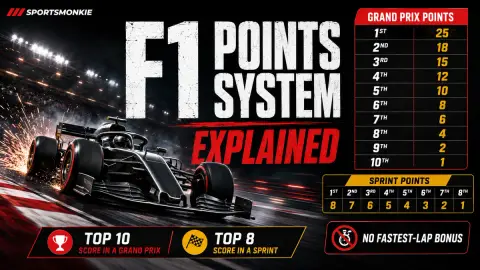
F1 Points System Explained: How Formula 1 Scoring Works
The top 10 finishers in a Formula 1 race score points on a 25-18-15 scale down to 1. Here's the full breakdown, sprint points, and the reduced-points rule.
Alonso Calls Albon and the Back of the Grid 'Very Low Quality' After US GP Clash
Fernando Alonso branded the lower third of the F1 grid very low quality after Alex Albon's lap-one hit at Austin wrecked his Aston Martin, cost him half a second a lap, and went unpunished.
Alpine Backs Colapinto After Clarkson's Argentina Joke on Sky F1
Alpine issued a statement backing Franco Colapinto after guest Jeremy Clarkson joked on Sky Sports F1 that the driver's Austin grid penalty was for being Argentinian.
Antonelli Takes COTA Pole With Title on the Line as FIA Clears Delta-Time Investigation
Kimi Antonelli took pole for the United States Grand Prix at Austin, where a win plus help from Russell and Hamilton would make him F1's youngest champion.