
Fielding Restrictions in ODI Cricket: Powerplay Rules Explained
On this page6
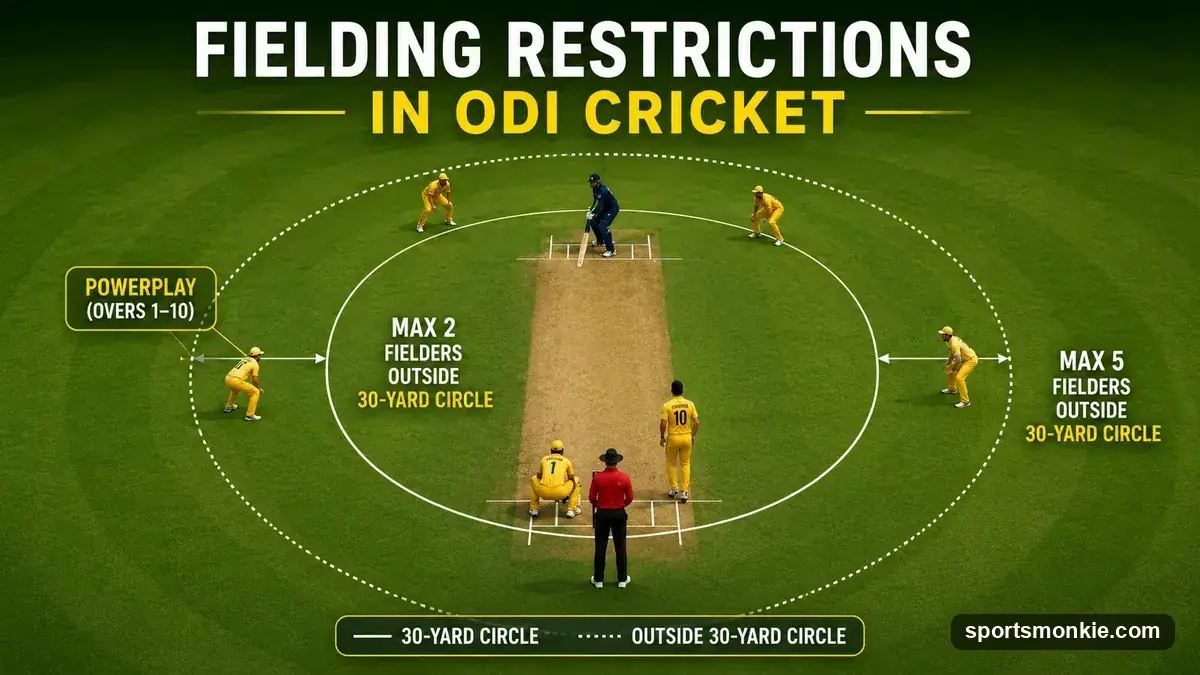
Take away fielding restrictions and a captain could park every player on the boundary rope from ball one, daring the batters to hit through nine men guarding the edge of the ground. Nobody would score, nobody would take risks, and one-day cricket would grind to a halt. So the rules force the issue: only so many fielders are allowed outside the 30-yard circle at any given point in the innings, and that number changes three times over the course of 50 overs.
The three phases of fielding restrictions in an ODI
| Phase | Overs | Max fielders outside circle |
|---|---|---|
| Mandatory powerplay | 1–10 | 2 |
| Middle overs | 11–40 | 4 |
| Death overs | 41–50 | 5 |
The circle itself is an oval marked out on the grass. A fielder counts as “outside” it if no part of their body touches the ground within the line at the moment the ball is bowled.
The mandatory powerplay (overs 1-10)
For the first 10 overs, the batting side has the upper hand. With only 2 fielders allowed beyond the ring, the gaps are there and boundaries come easily if the shot is timed right. That’s the whole reason ODI openers are built to attack early: the rules are practically begging them to.
Two fielders also need to stay inside the circle in close-catching positions through these overs, usually a slip and a gully depending on what the captain wants from the bowler.
Middle overs (overs 11-40)
Once over 10 ends, the fielding captain can push up to 4 fielders out past the circle. The gaps shrink. Boundaries get harder to find, and batting sides shift their approach, rotating strike and picking singles rather than trying to clear the rope every over.
Death overs (overs 41-50)
In the last 10 overs, 5 fielders can go out to the boundary. That’s enough to cover fine leg, square leg, both covers, and a long-on or long-off, protecting the rope on nearly every angle. But it also thins out the ring, and a batter who can find those gaps, or simply go over the top, does real damage in this phase.
Why the rule exists
The tension the powerplay creates is the whole appeal of the format: can the batting side cash in while the gaps are open early, and can the fielding side hold their nerve and defend once they’re allowed to spread the field? Strip that tension out and ODI cricket loses the thing that separates it from a procession of singles.
Fielding restrictions in T20 vs ODI
T20 compresses the same idea into a shorter window, just 6 overs of powerplay with 2 fielders allowed outside the circle. The principle carries over unchanged, but with only 20 overs to work with, cashing in during that window matters even more than it does in the 50-over game.
Frequently asked questions
How many fielders can be outside the circle during a powerplay in ODI cricket?+
During the mandatory powerplay (overs 1–10), only 2 fielders may be outside the 30-yard circle. Outside the powerplay, up to 5 fielders may be placed outside the circle.
How long is the mandatory powerplay in ODI cricket?+
The mandatory powerplay in ODI cricket runs for the first 10 overs of each innings.
What is the 30-yard circle in cricket?+
The 30-yard circle is an oval fielding restriction marked on the ground, approximately 30 yards (27.4 metres) from the centre of the pitch. Fielding restrictions dictate how many players can be placed outside this circle at different stages of the innings.
How many powerplays are there in an ODI innings?+
An ODI innings has three fielding-restriction phases. In overs 1–10, a maximum of two fielders may be outside the circle; in overs 11–40, up to four are allowed outside; and in the final overs 41–50, up to five may be positioned outside the 30-yard circle.
Why do ODIs have fielding restrictions?+
Fielding restrictions encourage attacking cricket and boundary-hitting, especially early in the innings, by preventing captains from setting purely defensive fields. They create a balance between bat and ball, make matches more entertaining, and shape the tactics of both batting and bowling teams across the innings.
What happens if a team breaks the fielding restrictions?+
If a fielding side has too many players outside the circle when the ball is delivered, the umpire calls a no-ball. The batting side receives a penalty run and, in limited-overs cricket, the following delivery is a free hit, from which the batter can only be run out.
Are T20 fielding restrictions the same as ODIs?+
No. T20 cricket has a single powerplay covering the first six overs, during which only two fielders may be outside the circle. After the powerplay, up to five fielders are allowed outside for the remaining overs, making the restrictions shorter and simpler than the three-phase ODI structure.
Sources
Play & tools
Free browser games and tools — no account, no download.
- Play today's Sports Connections — Today's Sports Connections — daily hints, answers, and play the grid.
- Play Guess the NFL Player — A new mystery NFL player every day. Eight guesses, with a clue on each — plus free unlimited mode.
- Explore all our games →
Related cricket guides
View all →
What Is a Powerplay in Cricket? Rules Explained
A powerplay is a fixed set of overs where the fielding side may keep only two fielders outside the 30-yard circle. Here are the exact ODI, T20 and T20I rules.
Cricket Pitch Length in Feet: Test, ODI & T20 Dimensions
A cricket pitch is 22 yards (66 feet / 20.12 m) long in Test, ODI, and T20 - the length is the same across all senior formats; only the overs differ.

What Is a Dead Ball in Cricket? Rule and Common Situations
A dead ball is a delivery from which no runs score and no batter is out. Learn when the ball goes dead, who decides, and why it matters in a tight finish.
DLS Method in Cricket Explained: How Rain Targets Are Set
The Duckworth-Lewis-Stern (DLS) method resets targets in rain-hit limited-overs cricket using overs and wickets left. Here's the logic, with examples.
What Is LBW in Cricket? Leg Before Wicket Explained
LBW means the ball would have hit the stumps but struck the pad first. Here are the exact conditions umpires check and how DRS decides close calls.
Appealing in Cricket: What It Is and How It Works
An appeal in cricket is the fielding side's formal request for a dismissal. Without one, an umpire cannot give a batter out, even one who clearly is.