
Fielding Positions in Cricket: A Clear Guide to Every Spot
On this page5
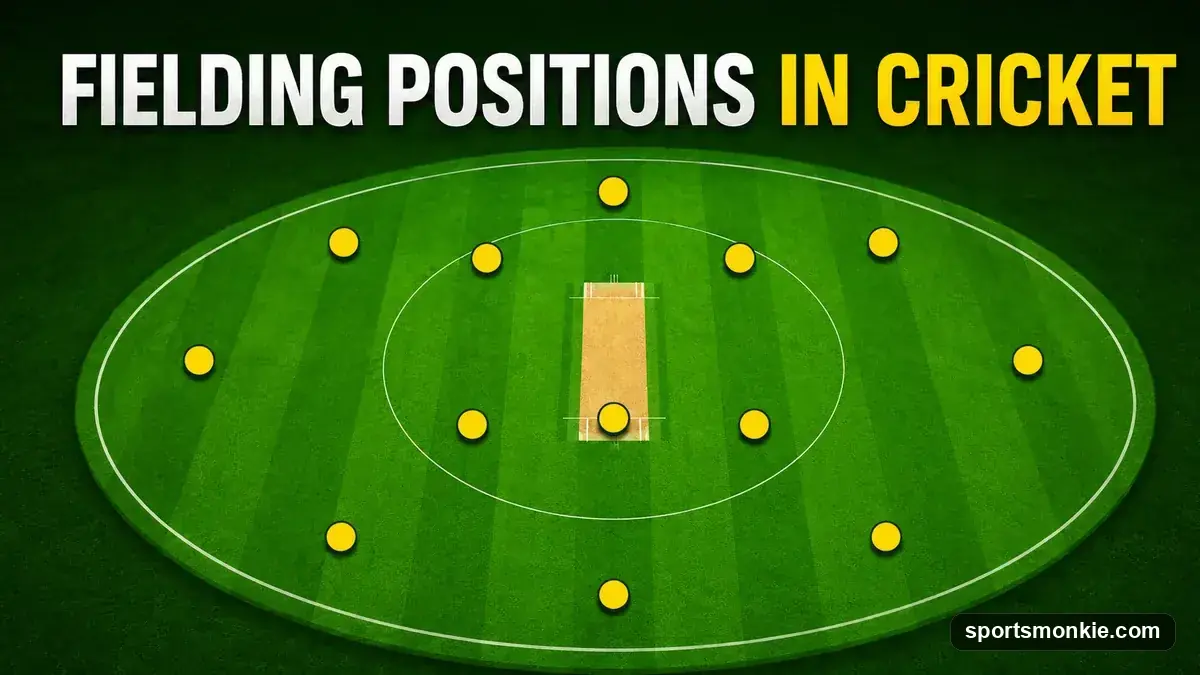
Ask a new fan why a fielder is standing exactly where he is and you’ll usually get a shrug. There’s no jersey number or grid reference to point to. Every spot on a cricket field has a name instead, built from two things: which side of the pitch it’s on, and how far it sits from the batter. Once those two rules click, the whole map of the field starts to make sense, and you can watch a captain set a field and guess what he’s planning before the next ball is bowled.
Off side vs leg side
Picture a line running straight down the pitch through the batter’s stance. Everything in front of that line, on the side the bat faces, is the off side. Everything behind it is the leg side (sometimes called the on side).
For a right-hander, off side is to the right, leg side to the left. Flip it for a left-hander: off side swaps to the left, leg side to the right. That’s why fielders jog to new spots the moment a left-handed batter comes to the crease, even though nobody has changed the names of the positions, only which side of the pitch they now sit on.
Three extra words refine the picture further. “Square” means level with the batter. “Fine” means close to the line of the stumps, behind the batter. “Forward” means in front of the batter, toward the bowler.
Close catching positions
These are the fielders standing a few metres from the bat, close enough to hear the batter breathe. They come out when a bowler is attacking, or when the ball is gripping and turning off the pitch.
- Wicketkeeper — crouches behind the stumps, takes the ball, and is often the one completing stumpings and run-outs.
- Slips (first, second, third, and so on) — line up beside the keeper on the off side, waiting for outside edges.
- Gully — squarer than the slips, still on the off side, for the thicker edges that fly wider.
- Silly point — right in front of the bat on the off side. The name says it all: it’s a dangerous place to stand.
- Short leg (bat-pad) — the leg-side mirror of silly point, crouched and close, hunting the same bat-pad chance.
Infield positions
Move out to roughly 15 to 30 metres and you’re in the infield ring, where fielders cut off singles and stop the ball before it reaches the rope.
- Point — square on the off side, there to cut off the cut shot.
- Cover — a little forward of point, covering anything driven through the off side.
- Mid-off — straight down the pitch on the off side, near the bowler.
- Mid-on — mid-off’s twin on the leg side.
- Mid-wicket — sits between mid-on and square leg, on the leg side.
- Square leg — level with the batter on the leg side, behind the umpire, watching for flicks and pulls.
Outfield and boundary positions
Push these same fielders back to the rope and they become boundary riders, guarding against fours and sixes. Limited-overs cricket, where batters take more risks, leans on them heavily.
- Third man — deep behind the slips on the off side, mopping up edges that beat the keeper.
- Long-off — deep and straight on the off side, well behind mid-off.
- Long-on — deep and straight on the leg side, behind mid-on.
- Deep cover — cover’s job, just done from the boundary.
- Deep mid-wicket — mid-wicket’s job, also from the boundary.
- Fine leg — deep and behind square on the leg side, there for the hook and the fine glance.
| Position | Side | Typical role |
|---|---|---|
| Wicketkeeper | Behind stumps | Catches, stumpings, run-outs |
| Slip | Off | Catch outside edges |
| Gully | Off | Catch thick edges |
| Silly point | Off | Close bat-pad catches |
| Short leg | Leg | Close bat-pad catches |
| Point | Off | Stop the cut, save singles |
| Cover | Off | Stop drives, save singles |
| Mid-off | Off | Guard straight off-side drives |
| Mid-on | Leg | Guard straight leg-side drives |
| Mid-wicket | Leg | Stop flicks and clips |
| Square leg | Leg | Stop pulls and glances |
| Third man | Off | Stop edges past the keeper |
| Long-off | Off | Catch and stop lofted drives |
| Long-on | Leg | Catch and stop lofted drives |
| Fine leg | Leg | Stop glances and hooks |
Knowing the names explains where each player stands; our ranking of cricket’s best fielders shows how specialists such as Jonty Rhodes and Ravindra Jadeja turned those positions into match-changing roles.
How captains change the field
A captain can place nine fielders around the bowler and wicketkeeper, but not without limits. Test fields can crowd the bat with slips and short catchers when wickets matter most. In ODIs and T20s, the fielding restrictions cap how many players can patrol the boundary during each phase, forcing captains to balance catching chances against run prevention.
The exact spacing also changes from venue to venue because boundary dimensions are not identical. Our cricket ground size guide explains the permitted range and why a position such as deep mid-wicket can require a very different run on two grounds.
Frequently asked questions
What is the difference between the off side and the leg side?+
The off side is the half of the field the batter faces when in their stance, while the leg (or on) side is the half behind their legs. For a right-handed batter the off side is to their right and the leg side to their left; for a left-hander it is reversed.
How many fielders can a captain place behind square on the leg side?+
Under the Laws of Cricket, no more than two fielders are permitted behind square on the leg side at the moment the bowler delivers the ball. Exceeding this results in a no-ball.
Why are some fielding positions called 'silly'?+
Positions with 'silly' in the name, such as silly point and silly mid-on, are placed dangerously close to the batter to take bat-pad catches. The word reflects how risky it is to field that near the striker.
What are the slip fielders in cricket?+
Slips are close catchers positioned behind and to the side of the batter on the off side, next to the wicketkeeper. They catch edges that fly off the bat, particularly against fast bowling. A group of them is called a slip cordon, numbered first slip, second slip, and so on.
What is the difference between mid-on and mid-off?+
Mid-on and mid-off are fielders positioned straight down the ground on either side of the bowler. Mid-off is on the off side and mid-on on the leg side. Both are infield positions used to stop drives and quick singles played straight back past the bowler.
How many fielding positions are there in cricket?+
There are dozens of named fielding positions, though only nine fielders (plus the bowler and wicketkeeper) are on the field at once. Positions are grouped into close catchers, the infield inside the 30-yard circle, and boundary riders, and their names change depending on which side of the pitch they are on.
Who decides where fielders stand in cricket?+
The captain sets the field, usually in consultation with the bowler, positioning fielders based on the batter, the bowler's plan, the match situation, and any fielding restrictions in place. Adjusting the field to build pressure and cut off scoring is a key tactical skill in cricket.
Sources
Play & tools
Free browser games and tools — no account, no download.
- Play today's Sports Connections — Today's Sports Connections — daily hints, answers, and play the grid.
- Play Guess the NFL Player — A new mystery NFL player every day. Eight guesses, with a clue on each — plus free unlimited mode.
- Explore all our games →
Related cricket guides
View all →
Popping Crease in Cricket: The Batting Line Explained
What the popping crease is, how all the cricket creases are measured, and why the popping crease decides no-balls, stumpings, and run-outs.
Types of Bowling in Cricket: Pace and Spin Explained
A clear guide to the types of bowling in cricket, from fast and swing bowling to off spin, leg spin, and deliveries like the yorker, googly, and doosra.

Conventional vs Reverse Swing in Cricket: The Difference
Conventional swing moves the new ball toward the shine; reverse swing makes an old ball curve the opposite way at pace. Here's what separates them.
Why Cricket Is Not in the Olympics: The Full Story
Cricket has never been a permanent Olympic sport due to governance disputes, calendar conflicts and ICC reluctance to cede control to the IOC. Here is why.
Volleyball Referee Signals: Every Official Hand Signal Explained
Volleyball referee signals explained: point, ball in/out, four hits, double contact, net touch, foot fault, ball touched, delay, substitution, and end of set.
Dropped Third Strike Rule in Baseball, Explained
On an uncaught third strike, the batter can try to reach first base if it's unoccupied or there are two outs — the strikeout doesn't automatically end the at-bat.