
Fastest F1 Pit Stop Ever: The Full Leaderboard (1.80s Record)
On this page5
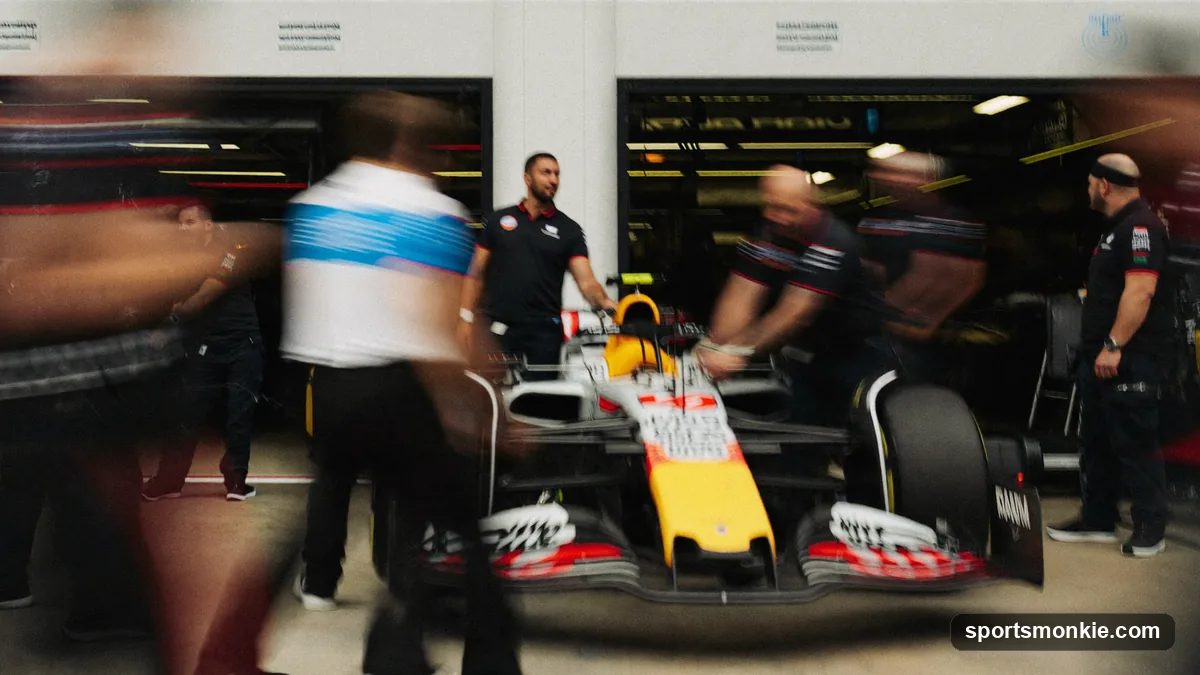
The fastest Formula 1 pit stop on record is 1.80 seconds, set by McLaren for Lando Norris at the 2023 Qatar Grand Prix and ratified by Guinness World Records. As of the 2026 season, no team has beaten it — the closest anyone has come since is 1.90 seconds. Behind that number sits a genuine leaderboard: nine verified stops, all from three teams, all packed inside a 0.12-second window.
The full leaderboard: fastest F1 pit stops ever
| Rank | Team | Driver | Time | Race |
|---|---|---|---|---|
| 1 | McLaren | Lando Norris | 1.80s | 2023 Qatar Grand Prix |
| 2 | Red Bull | Max Verstappen | 1.82s | 2019 Brazilian Grand Prix |
| 3 | Red Bull | Max Verstappen | 1.88s | 2019 German Grand Prix |
| 4 | Red Bull | Max Verstappen | 1.90s | 2024 Chinese Grand Prix |
| 4 | McLaren | Oscar Piastri | 1.90s | 2024 Mexico City Grand Prix |
| 6 | Red Bull | Pierre Gasly | 1.91s | 2019 British Grand Prix |
| 6 | McLaren | — | 1.91s | 2025 Italian Grand Prix |
| 8 | Red Bull | Mark Webber | 1.92s | 2013 Malaysian Grand Prix |
| 8 | Williams | Felipe Massa | 1.92s | 2016 Azerbaijan Grand Prix |
Ties are given equal rank. Sources: Guinness World Records, Formula1.com 2025 award results.
1. McLaren, 1.80s — Lando Norris, 2023 Qatar GP
Still the only sub-1.85-second stop in the sport’s history. McLaren’s crew changed all four tyres and released Norris in a time so close to Red Bull’s old mark that Guinness had to confirm it electronically before ratifying it as the new world record — beating the previous benchmark by two-hundredths of a second.
2-3. Red Bull, 1.82s and 1.88s — Max Verstappen, 2019
Red Bull owned this record for four years. Verstappen’s 1.82-second stop at Interlagos in 2019 stood as the mark McLaren eventually chased down in Qatar, and it came weeks after the same crew ran a 1.88-second stop at the German Grand Prix — part of a run of Red Bull dominance that also produced a 1.91-second stop for Pierre Gasly at Silverstone that same season.
4. Red Bull and McLaren, 1.90s — 2024 season
The two teams that have owned the record since 2019 tied at 1.90 seconds in 2024: Verstappen’s Red Bull crew in China, and Oscar Piastri’s McLaren crew in Mexico City. It was the closest anyone came to 1.80s in either the 2024 or 2025 seasons.
What the record actually measures
This is the part that trips people up. The record is stationary time only: it starts when the car comes to rest on its marks and stops the instant it is released and moving again. It is captured electronically, and the season-long DHL Fastest Pit Stop Award is the body that tracks and ranks these figures race by race — it runs on a 25-to-1 points scale, just like the drivers’ championship, and Ferrari won the 2025 title with nine race victories despite never owning the single fastest time.
What it does not include is everything that makes a pit stop cost real time: braking into pit entry, the pit-lane speed limit of around 80km/h, and accelerating back out. Add those and a “1.8-second” stop still costs a driver 20 to 30 seconds of race position. So when a broadcast flashes up a sub-two-second stop, that is the crew’s isolated work, not the true cost of pitting.
Why the record is so hard to break
There is a floor here, and the sport is pressed right against it. About 1.8 to 2 seconds is close to the fastest that roughly 20 humans can jack a car, break four wheel nuts, pull four tyres, fit four more, and get an all-clear signal from every corner. The single central wheel nut already removed the biggest chunk of time years ago; what is left now is rehearsal and equipment — faster guns, better-drilled hand-offs, an automated release light that fires the instant the last nut is confirmed. Each of those buys hundredths, not tenths, which is why the outright record moved by just 0.02 seconds between 2019 and 2023.
Could 1.80 seconds fall in 2026?
It is genuinely possible. Every top crew — McLaren, Red Bull, and Ferrari — now runs sub-2-second stops as routine, and the gap between the record and the season’s best has shrunk to well under 0.15 seconds most years. The 2026 season brings a full technical reset with new chassis and power-unit regulations, which typically scrambles competitive order in the garage as much as on track; teams rebuilding their cars from scratch also tend to rebuild pit-stop choreography, and that has produced record-breaking runs before. Still, McLaren’s mark survived two full seasons (2024 and 2025) untouched, so betting on exactly when it falls is harder than betting that it eventually will.
The bottom line
McLaren’s 1.80 seconds for Lando Norris in Qatar is still the number to beat, with Verstappen’s Red Bull runs and the 2024-25 McLaren stops forming the chasing pack just behind it. Remember what the figure measures — the crew’s stationary work, not the real time lost by pitting — and you will read every “world record pit stop” headline correctly from here on.
For the full choreography behind that 1.8 seconds, see our explainer on how F1 pit stops work. For the strategy that decides when teams spend those seconds, read our guide to F1 tyre compounds, and for how points translate into championships, see our F1 points system explained.
Frequently asked questions
What is the fastest F1 pit stop ever?+
The fastest recorded F1 pit stop is 1.80 seconds, achieved by McLaren for Lando Norris at the 2023 Qatar Grand Prix. It was ratified by Guinness World Records and, as of the 2026 season, remains unbeaten. The figure measures only the stationary time, from the car stopping in the box to being released.
Who held the pit stop record before McLaren?+
Red Bull Racing held the previous benchmark of 1.82 seconds, set for Max Verstappen at the 2019 Brazilian Grand Prix. Before Verstappen, Mark Webber's 1.92-second stop at the 2013 Malaysian Grand Prix was the first Guinness-monitored sub-two-second Formula 1 pit stop.
How is an F1 pit stop timed for the record?+
The official time, tracked by the DHL Fastest Pit Stop Award, measures only the stationary period: from the moment the car stops on its marks to the moment it is released and starts moving again. It excludes the drive down the pit lane, which adds 20-plus seconds of real race time.
What is the fastest pit stop by team in 2025?+
McLaren recorded the season's quickest individual stop at 1.91 seconds during the 2025 Italian Grand Prix at Monza. Ferrari won the season-long DHL Fastest Pit Stop Award with nine race wins, ahead of Red Bull's seven and McLaren's six, despite not owning the single fastest time.
Why isn't the pit stop record even faster than 1.80 seconds?+
Human reaction and physics set a floor. Roughly 1.8 to 2 seconds is close to the limit of how quickly around 20 crew members can jack the car, remove four wheels, fit four new ones, and confirm every nut is secure. Teams now shave hundredths, not tenths, through rehearsal and equipment.
Does a fast pit stop always help a team win?+
Not on its own. A record-breaking stationary time is wasted if the driver is released into traffic or the strategy call was wrong. Teams still chase fast stops because tenths matter in a tight field, but track position, tyre choice, and pit-lane timing usually decide more than the stop itself.
What is the DHL Fastest Pit Stop Award?+
It is a season-long award that ranks teams by pit-stop speed across every race, awarding points from 25 down to 1 much like the drivers' championship. Red Bull and Ferrari have dominated it in recent years, and it is the closest thing F1 has to an official pit-stop record book.
Could McLaren's 1.80-second record be broken in 2026?+
It is plausible but not guaranteed. Every top team is now within roughly 0.15 seconds of the record, and the 2026 rules reset — new chassis and power-unit regulations — will scramble competitive order and put fresh pressure on pit crews to find marginal gains. No team beat 1.80s across the 2024 or 2025 seasons.
Sources
Play & tools
Free browser games and tools — no account, no download.
- Play 24-0 — Draft an F1 chassis and two drivers, then chase a perfect 24-0 — win every race on the 24-round calendar.
- Explore all our games →
Related motorsport guides
View all →
Verstappen Gets a New Voice in Austin as Hart Takes Over From Lambiase at Three Races
Tom Hart will engineer Max Verstappen in Austin, Brazil and Las Vegas as Red Bull phases in Gianpiero Lambiase's successor before his move to McLaren.

Norris Appears to Mock Stroll in a Nightclub Video Hours After His Singapore Apology
Lando Norris was filmed at a Singapore nightclub appearing to mock Lance Stroll hours after apologising to McLaren for his sprint collision with Piastri.
F1 Pit Crew Salary: What Mechanics Really Earn
F1 pit crew members are team mechanics who earn a reported £30,000-£100,000+ a year depending on role. Here's how the pay breaks down by job.
How F1 Pit Stops Work: The 20-Person, 2-Second Job
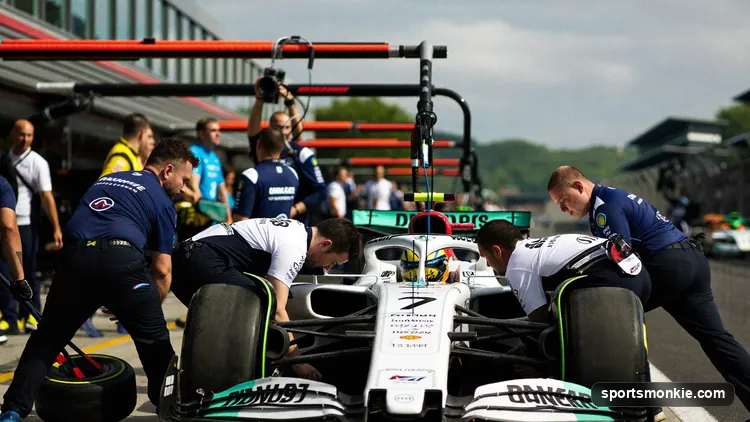
An F1 pit stop swaps all four tyres in around 2-3 seconds using a crew of about 20. Here's every role, why it's so fast, and what can go wrong.
Undercut vs Overcut in F1: The Two Pit Strategies Explained
The undercut means pitting earlier to jump a rival on fresh tyres; the overcut means staying out longer to pass them. Here's exactly when each one wins.
FIA approves strict new 2027 rules to stop F1 cost cap exploitation
The FIA has approved strict 2027 rules forcing physical and IT separation between F1 teams and their sister companies, closing a major cost cap loophole.