
The Most Difficult Sports to Master, Ranked and Explained
On this page9
- 01What makes a sport hard to master
- 02The hardest sports to master, at a glance
- 03Boxing: the toughest test in ESPN’s grid
- 04Gymnastics: the pinnacle of physical mastery
- 05Ice hockey: the ultimate multi-skill sport
- 06Water polo: the hidden difficulty
- 07Golf: where perfection is never permanent
- 08The measurement problem: why 2026 rankings still disagree
- 09Mental difficulty: the overlooked factor
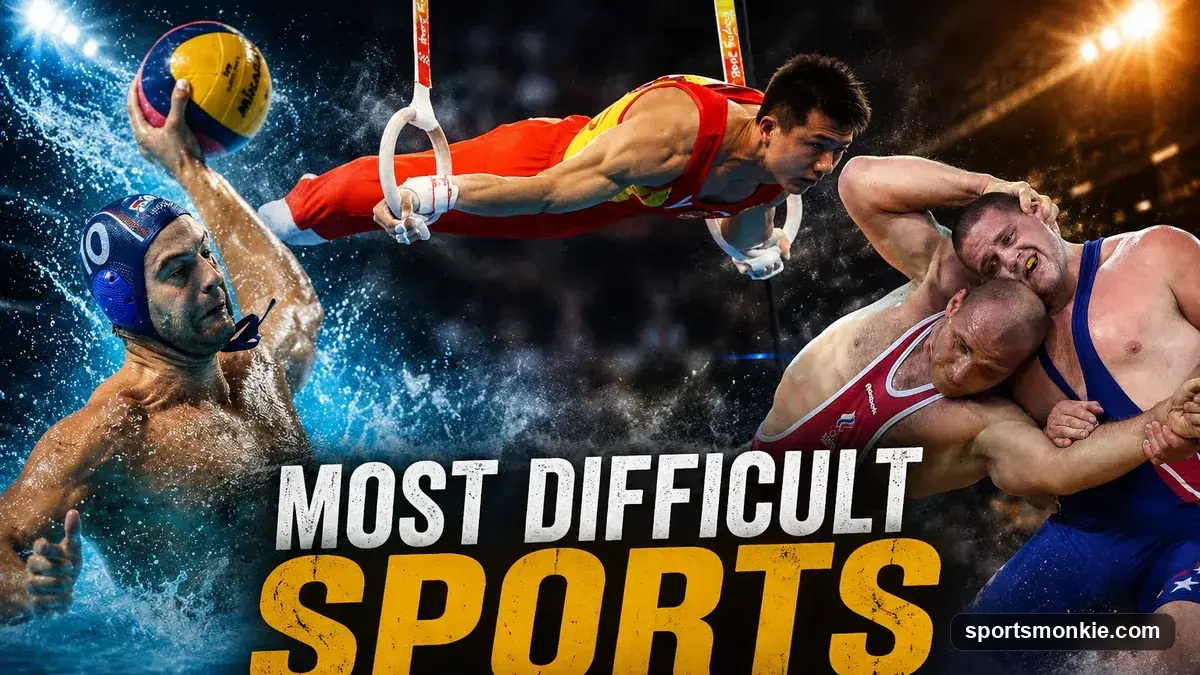
Boxing is the hardest sport to master according to the most widely cited ranking, ESPN’s Sport Skills study, which scored 60 sports across 10 skill components and placed boxing first. But difficulty has no scoreboard, and gymnastics, ice hockey, golf, and water polo all sit near the top of serious lists because they punish the smallest mistakes and take a decade or more just to reach a competent level.
What makes a sport hard to master
Difficulty isn’t one thing. A sport can wreck your body without asking much of your brain, or grind down your focus without requiring elite coordination. The sports that end up hardest tend to hit several of these at once:
- Physical demands: strength, speed, endurance, flexibility, or power
- Skill ceiling: how much technique must be refined before competing at a high level
- Mental demands: focus, pressure management, split-second decision making
- Learning curve: how long it typically takes to reach functional competency
- Margin for error: how much a small mistake affects the outcome
ESPN’s expert panel formalized this by scoring sports across ten separate categories — endurance, strength, power, speed, agility, flexibility, nerve, durability, hand-eye coordination, and analytic aptitude. The sports that finished hardest weren’t the ones that maxed out a single category, but the ones that scored high across almost all of them.
The hardest sports to master, at a glance
| Sport | Key Difficulty Dimension | Typical Years to Elite Level | Primary Demand |
|---|---|---|---|
| Boxing | Combat + conditioning | 5-10 years | Skill under physical danger |
| Gymnastics | Skill ceiling + physical | 10+ years | Precision and power |
| Ice Hockey | Speed + coordination | 8-12 years | Multi-skill integration |
| Water Polo | Endurance + coordination | 7-10 years | Aquatic athleticism |
| Golf | Mental + technique | 10+ years | Consistency under pressure |
| Figure Skating | Artistry + technical | 10+ years | Precision and performance |
| Tennis | Reaction + tactics | 7-12 years | Adaptability |
Boxing: the toughest test in ESPN’s grid
Boxing sits at the top of ESPN’s Sport Skills ranking because it demands more categories of excellence at once than almost any other sport. A boxer needs explosive power, lightning reflexes, aerobic and anaerobic conditioning, footwork, tactical intelligence, and the nerve to keep composing under fire while being hit. Few sports layer that much technical skill on top of genuine physical danger. Mastering it means training the body and mind to perform precisely at the exact moment fatigue and fear peak.
Gymnastics: the pinnacle of physical mastery
Gymnastics asks for strength, flexibility, spatial awareness, and technical control at the same time, with almost no room to get any of it wrong. A gymnast performs complex routines under competition pressure where a fraction of a degree in body position separates a medal from a missed podium — and where a tiny technical breakdown can turn instantly into a major fall. Most elite gymnasts start as young children and spend a decade or more just building the foundation they need to compete, which is why it’s routinely called the hardest sport to learn.
Ice hockey: the ultimate multi-skill sport
Ice hockey requires skating at speed, handling a puck with precision, reading a fast game, and absorbing physical contact, all at once. Skating alone takes years before a player can even start refining puck skills and positioning. Add conditioning, tactical awareness, and the need to coordinate with teammates moving just as fast, and hockey becomes one of the most complete tests in sport — ESPN’s panel ranked it second overall, behind only boxing.
Water polo: the hidden difficulty
Water polo doesn’t get much credit outside the pool, but it’s one of the more grueling team sports around. Players tread water for the entire match, sprint back and forth repeatedly, and still have to throw accurately while defending against opponents and reading offensive patterns. Because so much of the effort happens below the waterline, viewers rarely see how demanding it is. The endurance load alone is extreme, and the shooting and defending skills take years of dedicated training to build.
Golf: where perfection is never permanent
Golf looks simple and plays punishing. Unlike reactive sports where instinct takes over, golfers have unlimited time to think between shots, and that often works against them. The swing has to repeat almost identically through fatigue, changing conditions, and the weight of a tournament leaderboard. Even a golfer with years of practice can watch their technique unravel under pressure. The difficulty isn’t one dramatic moment; it’s holding form for four or five hours straight.
The measurement problem: why 2026 rankings still disagree
Here’s what modern sports science has made clear: there is no single “hardest sport,” because difficulty isn’t one measurable quantity. Recent analyses split the question into separate dimensions — metabolic demand, skill-acquisition time, injury rate, competitive density, and psychological load — and each dimension produces a different order. Boxing wins on combined combat and conditioning demands; gymnastics wins on skill acquisition and margin for error; endurance sports win on pure metabolic cost.
That’s why a 2025 or 2026 list can crown a different sport than ESPN’s grid did and still be defensible. What doesn’t change is the shortlist: boxing, gymnastics, ice hockey, and water polo keep resurfacing near the top no matter which factor a ranking prioritizes. The disagreement is about the order, not the tier.
Mental difficulty: the overlooked factor
In golf, figure skating, and gymnastics, the mental side matters as much as the physical. Staying composed after a mistake, managing expectations, and performing under pressure — that’s what separates good athletes from great ones. Plenty of physically gifted athletes never reach the top because the mental grind wears them down before their bodies do. Any honest ranking of the hardest sports has to weigh that invisible load alongside the visible athleticism.
Frequently asked questions
What is the hardest sport in the world to master?+
There is no single agreed answer, but boxing tops the best-known ranking — ESPN's Sport Skills project, which rated 60 sports across 10 skill components and placed boxing first. Gymnastics, ice hockey, and water polo also appear near the top of most serious lists because they combine extreme physical demands, huge skill ceilings, and long learning curves.
Why is boxing ranked the hardest sport by ESPN?+
ESPN's expert panel scored boxing highest across a blend of endurance, strength, power, speed, agility, flexibility, nerve, durability, hand-eye coordination, and analytic aptitude. No other sport in the study demanded excellence across as many of those categories at once, and few carry the same level of physical danger. That breadth is why boxing edged out football, hockey, and basketball.
Why is golf considered one of the hardest sports?+
Golf requires near-perfect technique across dozens of shot types, demands intense mental focus for four or five hours, and offers almost no margin for error at elite levels. Unlike reactive sports, golfers have unlimited time to think between shots, which often works against them. Small technique flaws compound over an entire round.
What makes a sport difficult to master?+
A sport's difficulty is shaped by its physical demands, coordination requirements, mental pressure, length of the learning curve, and how precisely technique must be executed under competitive conditions. Sports that rank hardest usually punish small mistakes severely and take many years just to reach a competent level. No single dimension defines difficulty on its own.
Is gymnastics harder than boxing?+
It depends on how you measure difficulty. Boxing ranks first for overall physical and combat demands in ESPN's grid, while gymnastics is often called the hardest to learn because of its microscopic margin for error and the years of training required before an athlete can compete. Boxing tests danger and durability; gymnastics tests precision and body control.
How long does it take to reach an elite level in the hardest sports?+
In sports like gymnastics, figure skating, golf, and ice hockey, most elite athletes train for roughly 8 to 12 years before competing at the highest level, and many start in early childhood. There is no shortcut — these sports reward accumulated deliberate practice far more than raw talent alone. The learning curve is one of the biggest reasons they rank as hard.
Why is water polo so underrated in difficulty rankings?+
Water polo happens mostly below the waterline, so viewers rarely see the treading, wrestling, and repeated sprinting that players endure for a full match. Athletes must stay afloat without touching the bottom while shooting accurately, defending, and reading offensive patterns. The hidden endurance load is why coaches and sports scientists consistently rank it among the toughest team sports.
Do difficulty rankings for sports actually agree with each other?+
Not fully. Sports science splits difficulty into separate dimensions — metabolic demand, skill-acquisition time, injury rate, competitive density, and psychological load — and each dimension ranks sports differently. Boxing, gymnastics, ice hockey, and water polo recur near the top across most methods, but the exact order shifts depending on which factor a list prioritizes.
Sources
Play & tools
Free browser games and tools — no account, no download.
- Play today's Sports Connections — Today's Sports Connections — daily hints, answers, and play the grid.
- Play Guess the NFL Player — A new mystery NFL player every day. Eight guesses, with a clue on each — plus free unlimited mode.
- Explore all our games →
Related records & rankings guides
View all →
7 Best Gymnasts in the World: All-Time Ranking
Simone Biles leads our ranking of the seven best gymnasts ever, followed by Kohei Uchimura, Larisa Latynina, Nadia Comaneci, and other all-time greats.

Richest Boxers in the World: Who Earned the Most?
The 10 richest boxers ranked by 2026 net worth and career earnings, from Mayweather and Canelo to Foreman, Pacquiao, Usyk, and Mike Tyson's cautionary fall.
The 10-Point Must System Explained
The 10-point must system scores each round 10 to the winner, 9 or fewer to the loser. How it works in boxing and MMA, with 10-8 and 10-7 rounds.
Boxing Weight Classes in Order: All 17 Divisions
Professional boxing has 17 weight classes, from minimumweight (105 lb) to heavyweight. Every division in order with limits in pounds and kilograms.
How Long Are Boxing Rounds? Length & Rest Times
Men's boxing rounds are three minutes with a one-minute rest; women's rounds are usually two minutes. Round length, rest and total fight time explained.
How Many Rounds Are in a Boxing Match?
Professional title fights are 12 rounds, non-title bouts 4–10, and amateur fights 3 rounds. Round counts explained, plus why boxing dropped 15-round bouts.