
Current Fastest Bowlers in Cricket: 2026 Ranking
On this page7
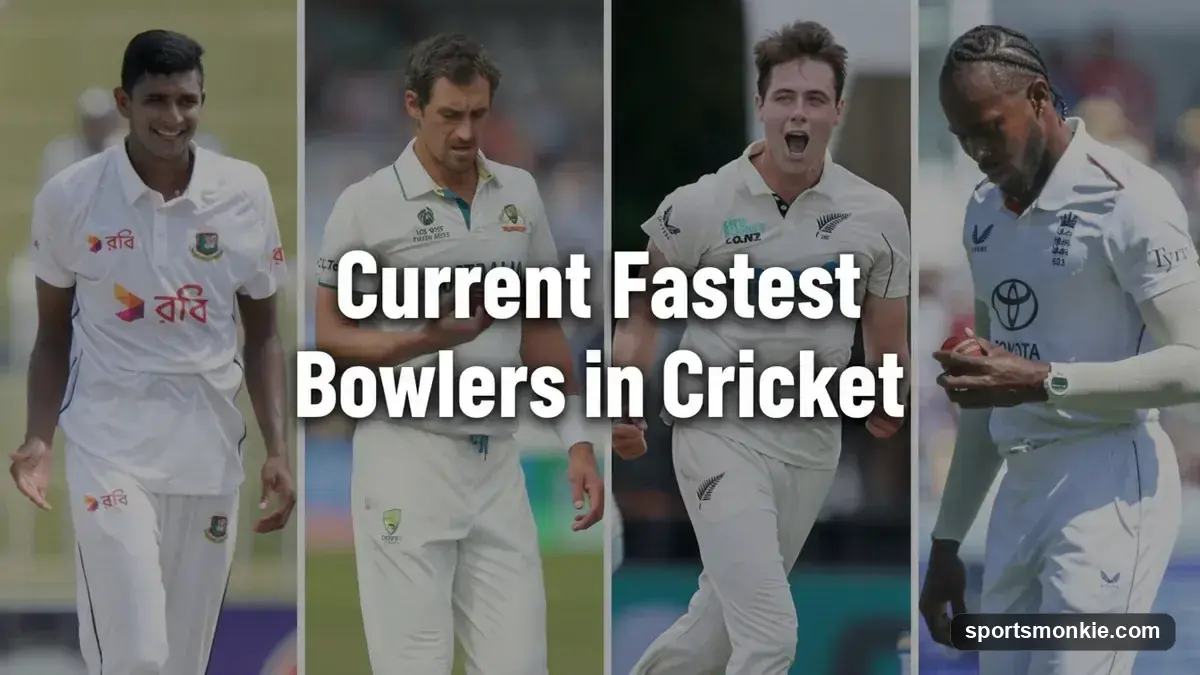
Mitchell Starc’s 160.4 km/h (99.66 mph) yorker to Ross Taylor at the WACA in November 2015 is the fastest ball bowled by anyone still playing professional cricket in 2026, and Guinness World Records still recognises it as the quickest delivery ever measured in a Test match. That single fact separates this list from every “fastest bowler” ranking that quietly mixes in retirees: this one only counts bowlers who are actively playing right now, ranked strictly by the fastest delivery each has ever been verified to bowl.
How This List Is Ranked
Three rules govern the ranking below. First, a bowler has to be actively playing professional cricket as of the 2026 season, international, franchise T20, or domestic, to qualify; the all-time greats who have retired belong on our separate fastest bowlers in cricket history list instead. Second, ranking is by each bowler’s best documented delivery, not average pace. Third, the match or competition context must be identifiable in published coverage. Where speed-gun readings or reports conflict, the uncertainty is stated instead of smoothing the figures into a false consensus.
The Fastest Active Bowlers in 2026
| Rank | Bowler | Country | Top Recorded Speed | Where & When |
|---|---|---|---|---|
| 1 | Mitchell Starc | Australia | 160.4 km/h (99.66 mph) | Test vs New Zealand, Perth, Nov 2015 |
| 2 | Mark Wood | England | 157.3 km/h (97.7 mph) | Ashes Test vs Australia, Dec 2021 |
| 3 | Lockie Ferguson | New Zealand | 157.3 km/h | IPL, 2022 |
| 4 | Umran Malik | India | 157.0 km/h | IPL vs Delhi Capitals, May 2022 |
| 5 | Mayank Yadav | India | 156.7 km/h | IPL vs RCB, April 2024 |
| 6 | Anrich Nortje | South Africa | 156.2 km/h | IPL vs Rajasthan Royals, 2020 |
| 7 | Jofra Archer | England | 155.0 km/h (96.1 mph) | Ashes Test debut, Lord’s, Aug 2019 |
| 8 | Haris Rauf | Pakistan | 154.7 km/h documented* | PSL vs Islamabad United, 2022 |
| 9 | Shaheen Shah Afridi | Pakistan | 154.6 km/h | T20 World Cup vs West Indies, Oct 2021 |
| 10 | Kagiso Rabada | South Africa | 154.2 km/h | IPL, 2020 |
| 11 | Naseem Shah | Pakistan | 148.7 km/h | PSL vs Peshawar Zalmi |
*Haris Rauf’s speed is genuinely disputed: 154.7 km/h from PSL 2022 is the figure that shows up in written match coverage, but a widely shared clip claims 159 km/h against England, a number no major cricket database has independently confirmed. We’ve ranked him on the documented figure.
Mitchell Starc remains the standout nine years after that Perth yorker, still bowling in the mid-150s in Tests at 36 and rated among the fastest in world cricket through the 2025-26 home summer. Mark Wood and Lockie Ferguson share second place at 157.3 km/h; Wood’s came in an Ashes Test to David Warner, Ferguson’s during an IPL spell. Umran Malik owns the fastest ball ever bowled by an Indian in the IPL, but recurring hip injuries have limited him to squad involvement rather than regular selection through IPL 2026, worth knowing before ranking him on reputation alone.
Current Fastest Bowlers vs. the All-Time List
It’s worth being precise about what this list is and isn’t. Shoaib Akhtar’s 161.3 km/h delivery at the 2003 World Cup is still the outright fastest ball ever recorded in international cricket, and it isn’t on this list because Akhtar retired in 2011. The same goes for Brett Lee, Shaun Tait, and Jeff Thomson, all faster in career-best terms than most names above, all long retired. For that full historical picture, see our all-time fastest bowlers in cricket history list, and for the bowlers who paired that pace with genuine longevity and skill rather than a single hot radar reading, our greatest fast bowlers in history ranking covers that separately.
Why there is no official worldwide 2026 speed table
Cricket has no single governing-body database that receives every speed-gun reading from international matches, franchise leagues, and domestic competitions. Broadcasters and leagues use different tracking systems, and a number shown on screen is not automatically preserved in an official match record.
That is why this ranking uses each active bowler’s best documented career delivery rather than claiming to identify the fastest ball bowled anywhere during 2026. The distinction also reflects a recurring concern in cricket communities: fans often question an isolated reading when it is far above the rest of the same spell. A useful record should identify the match and measurement source, not repeat a viral graphic without context.
Format and Context Differences
Raw top speed doesn’t map cleanly onto match impact, and it varies by format. Tests reward a bowler who can hold pace into a second session of a long spell rather than flash it for one ball, exactly why Starc’s Perth yorker stands out: it came deep into an innings, not a fresh new-ball burst. T20 and franchise cricket reward something different, hitting a full, blockhole-length delivery at pace under pressure in the final over, the exact skill our guide to bowling a yorker breaks down. Franchise leagues like the IPL and PSL also generate more raw speed-gun readings than international cricket, simply because more overs get bowled under radar, which is part of why so many entries above come from IPL spells.
Injuries, Workload, and Availability in 2026
Extreme pace carries a physical cost, and this list’s own composition proves it. Umran Malik has battled recurring hip trouble since 2024. Jofra Archer has missed extended international stretches to back and elbow issues throughout his career, still managing to bowl every delivery in an over above 90 mph at Lord’s in 2025 when fit. Lockie Ferguson skipped the early stretch of IPL 2026 by choice rather than injury, prioritising family and international commitments, a reminder that even fully fit express bowlers now manage their workload deliberately rather than bowling flat-out in every match they’re available for.
Why Verified Top Speed Isn’t the Whole Picture
A speed-gun reading captures one ball, not a bowling career. Kagiso Rabada and Shaheen Shah Afridi both sit mid-table here by peak speed alone, yet both rank among the most consistently dangerous bowlers in the world because they pair that pace with seam movement, swing, and control most out-and-out speedsters lack. It’s the same reasoning that separates raw velocity from craft in baseball’s fastest pitchers, or from the deception a top current spin bowler relies on instead of speed altogether: the number on the gun opens the conversation, it never closes it.
Frequently asked questions
Who is the fastest active bowler in cricket right now?+
By verified top speed, Mitchell Starc holds the mark among currently active bowlers: 160.4 km/h (99.66 mph), bowled to Ross Taylor at the WACA in November 2015, still recognised by Guinness World Records as the fastest delivery ever measured in a Test match. Mark Wood and Lockie Ferguson are next, both at 157.3 km/h.
What is the fastest ball bowled in 2026?+
There is no authoritative global registry that compares every delivery bowled across international, franchise, and domestic cricket in 2026. Tournament broadcasters publish isolated speed readings, but measurement systems differ. A claim about the year's single fastest ball should name the competition, match, tracking source, and date rather than treating scattered readings as one worldwide table.
How does this list differ from the all-time fastest bowlers list?+
This list only counts bowlers who are still playing professional cricket in 2026, ranked by their fastest verified delivery ever. Retired greats like Shoaib Akhtar (161.3 km/h), Brett Lee, and Shaun Tait sit on the separate all-time list, since none of them are active any longer.
Is Mitchell Starc really faster than Shoaib Akhtar?+
Not quite, and only in one narrow sense. Starc's 160.4 km/h is the fastest delivery ever recorded in a Test match specifically, but Shoaib Akhtar's 161.3 km/h at the 2003 World Cup remains the fastest ball recorded in any format of international cricket, a record Starc has never bettered.
Who is the fastest Indian bowler currently playing?+
By fastest recorded ball, Mayank Yadav leads active Indian quicks at 156.7 km/h, bowled during IPL 2024. Umran Malik owns a marginally faster 157.0 km/h from IPL 2022, but recurring hip injuries have limited his match time and IPL 2026 playing status.
What speed counts as genuinely fast in modern cricket?+
Anything sustained above 145 km/h (90 mph) is considered genuinely fast, and consistently clearing 150 km/h places a bowler in a small elite tier. Very few bowlers in the world, active or retired, have ever touched 155 km/h or beyond even once in a match.
Why do bowling speed readings vary between competitions?+
Different leagues and broadcasters use different radar or camera-based tracking systems, and measurement points differ, some capture speed at release, others slightly later in the ball's flight. That is why the same bowler's peak speed can be reported a few km/h differently depending on the source.
Can any current bowler break Shoaib Akhtar's 161.3 km/h record?+
It hasn't happened in over 20 years, and no active bowler has come within a full km/h of it under an officially ratified reading. Mitchell Starc's 160.4 km/h Test delivery is the closest any current bowler has managed, so the record has real staying power.
Sources
Play & tools
Free browser games and tools — no account, no download.
- Play today's Sports Connections — Today's Sports Connections — daily hints, answers, and play the grid.
- Play Guess the NFL Player — A new mystery NFL player every day. Eight guesses, with a clue on each — plus free unlimited mode.
- Explore all our games →
Related cricket guides
View all →
Tallest Bowlers in Cricket History
Mohammad Irfan, at 7 ft 1 in, is the tallest bowler in cricket history. Here are the giants of fast bowling and how their height turned into steepling bounce.

Conventional vs Reverse Swing in Cricket: The Difference
Conventional swing moves the new ball toward the shine; reverse swing makes an old ball curve the opposite way at pace. Here's what separates them.
How to Bowl Reverse Swing in Cricket: Technique Explained
Reverse swing makes an old, scuffed ball curve opposite to normal swing. Keep the shiny side toward your target, angle the seam, and bowl at high pace.
Types of Bowling in Cricket: Pace and Spin Explained
A clear guide to the types of bowling in cricket, from fast and swing bowling to off spin, leg spin, and deliveries like the yorker, googly, and doosra.
Best Spin Bowlers in Current Cricket: Top Active Spinners Ranked
The best active spin bowlers in cricket right now, ranked across Tests and white-ball — from Rashid Khan's two-format No. 1 to Nathan Lyon's 560-plus Test wickets.
Fastest Bowlers in Cricket History: Verified Speeds
Shoaib Akhtar's 161.3 km/h at the 2003 World Cup is still cricket's fastest recorded ball. All 12 quickest bowlers ever, ranked by speed, year, and venue.