
Cricket Pitch Length in Feet: Test, ODI & T20 Dimensions
On this page6
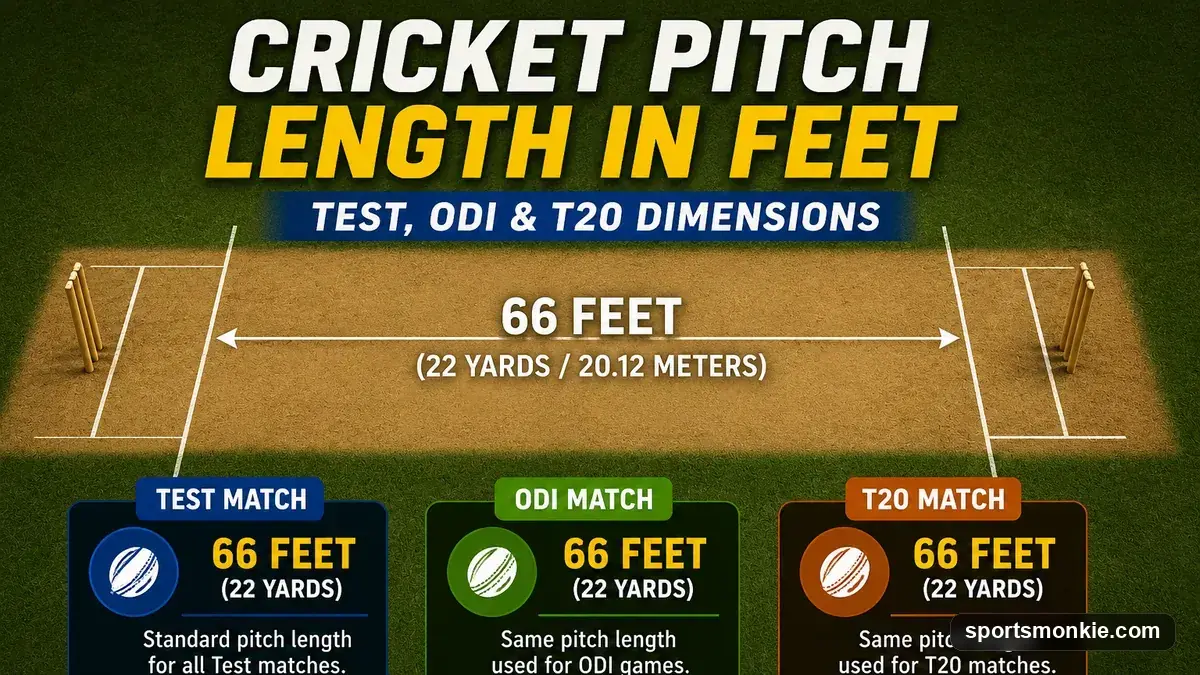
New fans sometimes assume T20’s faster pace comes from a shorter pitch, the way a five-a-side football pitch shrinks the whole game. It doesn’t work that way in cricket. A pitch is 22 yards long, 66 feet, 20.12 metres, and that number is identical whether you’re watching a five-day Test or a 20-over slog. The format changes the overs and the rules around them. It leaves the actual strip of turf between the stumps untouched.
Cricket pitch dimensions
| Dimension | Feet | Yards | Metres |
|---|---|---|---|
| Pitch length (stump to stump) | 66 ft | 22 yd | 20.12 m |
| Pitch width (prepared surface) | 10 ft | 3.33 yd | 3.05 m |
| Popping crease to stumps | 4 ft | 1.33 yd | 1.22 m |
| Return crease (each side, from middle stump) | 4 ft 4 in | 1.44 yd | 1.32 m |
The crease markings, and what each one does
The bowling crease sits level with the stumps, running the full width of the pitch, and it’s literally where the stumps are planted. Four feet in front of it, parallel, is the popping crease: a batter needs to have bat or body behind this line to be safe from a run-out or stumping. At right angles to both, on either side of the stumps, is the return crease, marked 4 ft 4 in (1.32 m) from the middle stump, and a bowler’s back foot has to land inside it at the point of delivery or the umpire calls a no-ball.
Why 22 yards, specifically
Blame land surveying. A “chain” was a common English unit of measurement in the 18th century, and it happened to be exactly 22 yards. Early cricket laws borrowed the chain as the pitch length, and nobody’s changed it since, which makes it one of the oldest fixed measurements still used in any sport.
The format changes plenty. The pitch isn’t one of them
T20 overs are capped at 20, ODIs at 50, Tests have none. Powerplay rules differ by format. The ball is white for the limited-overs formats and red for Tests. All of that is real. None of it touches the 22 yards between the stumps, which stays exactly the same whether 20,000 people are watching a T20 finish in three hours or a Test grinds into its fifth day.
Pitch surface types
While the length is fixed, the pitch surface varies by location and conditions:
| Surface type | Characteristics | Common regions |
|---|---|---|
| Dry / dusty | Crumbles, aids spin bowling | India, subcontinent |
| Green / grassy | Aids seam movement | England, New Zealand |
| Hard / flat | Pace and bounce, good for batting | Australia, South Africa |
| Worn (later in Test) | Uneven bounce, spin-friendly | Universal in longer matches |
Why 20.12 metres and not some other number
That distance gives a fast bowler enough room to build up real pace off a long run-up, while still leaving the batter a fair chance to react. Shrink it and pace bowling turns genuinely dangerous rather than just difficult. Stretch it and the ball loses enough speed by the time it arrives that quick bowling stops being a threat at all. Somewhere in the 18th century, without any of today’s biomechanics data, cricket landed on a number that still works.
Frequently asked questions
How long is a cricket pitch in feet?+
A cricket pitch is 66 feet long, which equals 22 yards or 20.12 metres. This measurement is the distance between the two sets of stumps.
Is a women's cricket pitch the same length as a men's?+
Yes. Women's cricket is played on the same 22-yard (66-foot) pitch as the men's game at senior level. The differences between the two are the ball — the women's ball is slightly lighter — and some boundary distances, not the strip between the stumps.
What is the width of a cricket pitch?+
The playing surface (the prepared strip) is 10 feet (3.05 metres) wide. The crease markings extend across this width.
Why is a cricket pitch 22 yards long?+
The 22-yard length dates back to early English cricket and is believed to derive from the 'chain', an old unit of land measurement equal to 22 yards. It became standardised in the sport's laws and has remained the fixed distance between the stumps ever since.
What is the length of the pitch between the creases?+
The full pitch is 22 yards (66 feet) from stump to stump. The bowling creases are marked in line with the stumps at each end, and the popping (batting) crease is 4 feet in front of each set of stumps, giving the batter their safe ground.
Is a junior cricket pitch shorter?+
Yes. Youth and junior cricket often uses shorter pitches suited to players' ages and abilities, gradually increasing toward the full 22 yards as children grow. This makes the game safer and more playable for younger cricketers before they move up to the standard adult pitch length.
How wide are the stumps on a cricket pitch?+
The three stumps at each end span 9 inches (22.86 cm) in total width, topped by two bails. This target is what bowlers aim to hit and batters defend, and it sits at the centre of each end of the 22-yard pitch.
Sources
Play & tools
Free browser games and tools — no account, no download.
- Play today's Sports Connections — Today's Sports Connections — daily hints, answers, and play the grid.
- Play Guess the NFL Player — A new mystery NFL player every day. Eight guesses, with a clue on each — plus free unlimited mode.
- Explore all our games →
Related cricket guides
View all →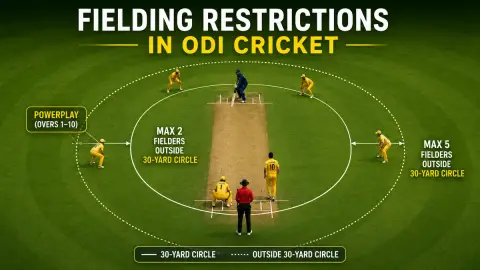
Fielding Restrictions in ODI Cricket: Powerplay Rules Explained
ODI cricket uses fielding restrictions called powerplays that limit the number of fielders outside the 30-yard circle. Here is exactly how they work.
What Is a Dead Ball in Cricket? Rule and Common Situations
A dead ball is a delivery from which no runs score and no batter is out. Learn when the ball goes dead, who decides, and why it matters in a tight finish.
DLS Method in Cricket Explained: How Rain Targets Are Set
The Duckworth-Lewis-Stern (DLS) method resets targets in rain-hit limited-overs cricket using overs and wickets left. Here's the logic, with examples.
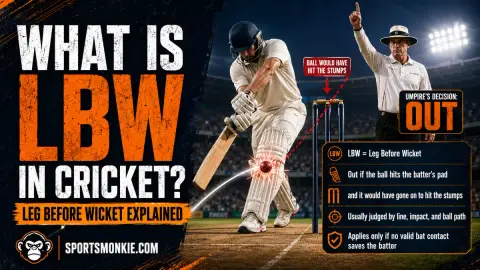
What Is LBW in Cricket? Leg Before Wicket Explained
LBW means the ball would have hit the stumps but struck the pad first. Here are the exact conditions umpires check and how DRS decides close calls.
Appealing in Cricket: What It Is and How It Works
An appeal in cricket is the fielding side's formal request for a dismissal. Without one, an umpire cannot give a batter out, even one who clearly is.
Hitting the Ball Twice in Cricket: Law 34 Explained
Law 34 lets a batter hit the ball twice only to defend the wicket. Do it for any other reason and you are out 'hit the ball twice'. Here is how the rule works.