
How Long Is a Cricket Game? Length by Format Explained
On this page6
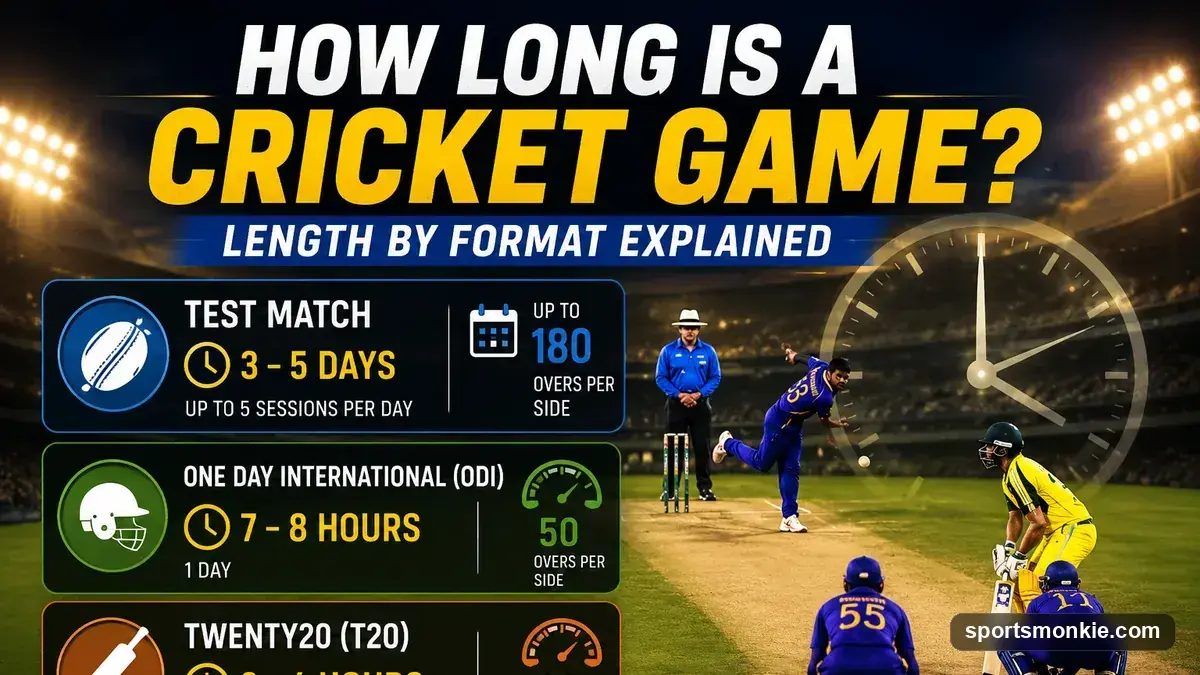
Cricket match duration depends entirely on the format: a T20 lasts roughly 3 hours, an ODI around 7–8 hours across a single day, and a Test match up to 5 days. Weather, slow over rates, and how quickly sides dismiss one another can all shorten or, in Tests, extend play within a day.
Duration by format at a glance
| Format | Overs per team | Typical duration | Days of play |
|---|---|---|---|
| T10 | 10 | ~90 minutes | 1 (short session) |
| The Hundred | 100 balls | ~2.5 hours | 1 |
| T20 | 20 | ~3–3.5 hours | 1 (evening) |
| ODI (50-over) | 50 | ~7–8 hours | 1 (full day) |
| First-class (non-Test) | Unlimited | 3–4 days | 3 or 4 |
| Test match | Unlimited (90 overs/day target) | Up to 5 days | 5 |
What actually sets the length
Cricket has no clock that stops a game the way football or basketball does. Instead, length is governed by two things: the number of overs (or balls) each side is allowed, and how long those deliveries take to bowl. A format caps the overs; the over rate — how quickly bowlers get through them — and how fast wickets fall decide the rest. That is why two matches of the same format can differ by an hour or more.
T20 and shorter formats
Twenty-over cricket is built for a single evening session. Each side’s 20 overs take roughly 80–90 minutes to bowl, plus an innings break of about 20 minutes, for a total of 3 to 3.5 hours. IPL fixtures with strategic timeouts and ceremonies can nudge closer to 4 hours. Shorter still are T10, which finishes in about 90 minutes, and The Hundred, where each team faces 100 balls and matches run about 2.5 hours.
ODI matches
A 50-over match is a full day of cricket. Teams alternate batting across roughly 7–8 hours of play, with a break of about 45 minutes between innings. The Duckworth-Lewis-Stern (DLS) method applies when rain interrupts, recalculating targets over the reduced overs. A game heavily shortened by weather can be over in 5–6 hours.
Test matches
Tests are the longest format, scheduled for up to five days:
- Daily play: about 6 hours across three sessions
- Overs target: a minimum of 90 per day, dropping to 75 before the last hour on day five
- Breaks: lunch and tea, roughly 40 minutes combined
- Extra time: the day can extend up to 30 minutes to make up overs
Many Tests finish in three or four days when one side is bowled out cheaply twice. A Test can also end in a draw — most often when the fifth day is rain-affected or batters defend successfully.
Current rules affecting match length (2025–26)
From June 2025 the ICC extended the stop-clock rule into Test cricket to combat slow over rates. The fielding side must start each new over within 60 seconds of the last one ending; after two warnings per innings, further breaches concede five penalty runs to the batting team. The same clock already operates in white-ball internationals. As of 2026 these measures are aimed at keeping playing time closer to its scheduled length rather than changing the format caps themselves.
Related terms
- Over rate: the pace at which overs are bowled, measured per hour or per day
- DLS method: the calculation that resets targets in rain-hit limited-overs games
- Innings break: the interval between the two teams batting
- Declaration: a captain ending an innings voluntarily, common in Tests to force a result
- First-class cricket: multi-day domestic matches such as county cricket, the Sheffield Shield, and the Ranji Trophy, typically 3 or 4 days
Frequently asked questions
How long does a T20 cricket match last?+
A T20 match typically lasts around 3 to 3.5 hours, including the innings break. Each side bats 20 overs, which take roughly 80–90 minutes to bowl. IPL games with strategic timeouts can run closer to 3.5–4 hours once presentations are added.
How many days does a Test match last?+
A Test is scheduled for up to 5 days, with a minimum of 90 overs targeted per day. Many Tests finish in 3 or 4 days if one side is bowled out cheaply twice. Others end in a draw, especially when the fifth day is rain-affected.
How long is a One Day International (ODI)?+
An ODI takes roughly 7 to 8 hours to complete across a single day. Each team faces up to 50 overs, with a break of around 45 minutes between innings. Rain-shortened games decided by the DLS method can finish in 5–6 hours.
What is the shortest format of cricket?+
T10 is the shortest recognised format, with each team facing just 10 overs. A full T10 match wraps up in about 90 minutes, roughly the length of a football game. It was designed for broadcast windows and fan-friendly evening slots.
How long does a match in The Hundred last?+
A match in The Hundred lasts about 2.5 hours. Each team faces 100 balls rather than a set number of overs, and bowlers deliver in blocks of 5 or 10. The compressed format sits between T10 and T20 in overall running time.
Why do some Test matches finish early?+
A Test ends as soon as one side wins, so it can finish inside three days if wickets fall quickly and the pitch favours bowlers. Fast scoring, collapses, and declarations all speed up a result. Only evenly matched games or bad weather push a Test to the full five days.
Can rain change how long a cricket match lasts?+
Yes. Rain can shorten limited-overs games through the DLS method, which recalculates targets over fewer overs. A T20 still needs at least five overs per side for a result. In Tests, lost time is often made up with extended play or an extra half-hour.
How much playing time is in a single day of Test cricket?+
A standard day of Test cricket is about six hours of play, split into three sessions by lunch and tea breaks. The target is a minimum of 90 overs, dropping to 75 before the last hour on day five. The day can extend by up to 30 minutes to complete overs.
Sources
Play & tools
Free browser games and tools — no account, no download.
- Play today's Sports Connections — Today's Sports Connections — daily hints, answers, and play the grid.
- Play Guess the NFL Player — A new mystery NFL player every day. Eight guesses, with a clue on each — plus free unlimited mode.
- Explore all our games →
Related cricket guides
View all →
Types of Cricket Formats: From Slowest to Fastest
Cricket formats run from multi-day Tests to the explosive 10-over Hundred. This guide ranks every format from slowest to fastest and how they differ.
Fastest Century in Cricket (Every Format)
AB de Villiers holds the fastest ODI century at 31 balls. The fastest hundreds in T20, ODI and Test cricket explained, with the record-holders for each format.

How Long Is a PLL Lacrosse Game?
A PLL game is four 12-minute quarters, 48 minutes of game clock, plus halftime and stoppages, running about two to two-and-a-half hours in real time.

How Long Is an AFL Game? Quarters and Real Time
How long is an AFL game? Four quarters of 20 minutes plus time-on, so a match runs about two to two and a half hours of real time with breaks.
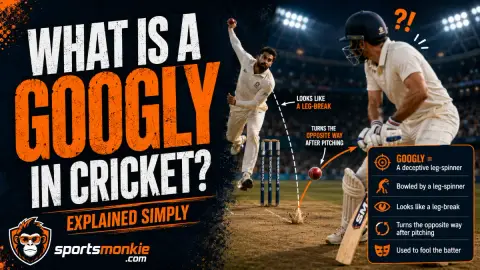
What Is a Googly in Cricket?
A googly is a leg-spinner's disguised delivery that turns the opposite way to a leg break, spinning into a right-hander. See how it's bowled and deceives.
What Is a Nightwatchman in Cricket?
A nightwatchman is a lower-order batter sent in late to shield a specialist from tricky conditions. See why teams use one and when the tactic pays off.