
Chess Pieces That Move Diagonally: A Complete Guide
On this page6
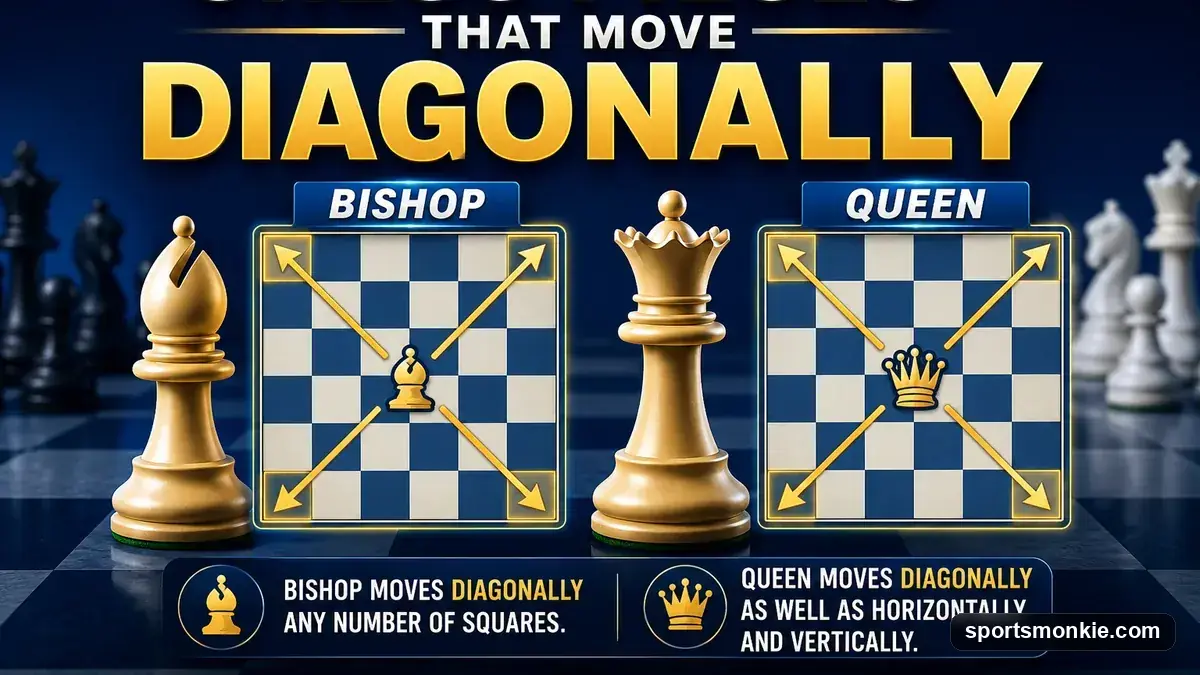
New players usually spend their first few games mixing up the bishop and the rook, and it’s the diagonal-only rule that trips them up. Three pieces touch diagonal squares at all, and each one uses the diagonal for a different job: the bishop lives on it, the queen adds it to an already long list of options, and the pawn only sees it when there’s something to capture.
The bishop: the pure diagonal piece
The bishop is the piece people associate with diagonal movement because it can only move that way. Each side starts with two: one that begins on a light square, one on a dark square, and neither ever switches. A dark-squared bishop stays a dark-squared bishop until it’s captured.
Rules for the bishop:
- It moves any number of squares diagonally, in a straight line.
- It can’t jump over other pieces.
- It never changes the colour of square it sits on.
- It captures the normal way, by landing on the enemy piece’s square.
Because of that colour lock, strong players talk about the “wrong-coloured bishop” in the endgame, a bishop that can’t reach the squares where the pawns or the action actually are. A bishop on light squares is dead weight if all the play is happening on dark ones.
The queen: diagonal, plus everything else
The queen moves diagonally like a bishop and in straight lines like a rook, which is why it ends up doing most of the damage in a typical game.
- It moves any number of squares diagonally, same as a bishop.
- It isn’t locked to one colour. Every diagonal move flips the colour of square it’s standing on.
- It can go diagonal one turn and straight the next, no restriction either way.
The pawn: diagonal only when there’s something to take
Pawns are the odd one out here, because their diagonal move only exists to capture.
- A pawn takes an enemy piece by moving one square diagonally forward, never backward.
- En passant lets a pawn capture an enemy pawn that just advanced two squares past it, treating that pawn as if it had only moved one. The capturing move itself is still just a single diagonal step.
- A pawn can’t move diagonally onto an empty square. If there’s nothing to capture, it just doesn’t have that option.
Diagonal movement, piece by piece
| Piece | Can move diagonally? | Restriction |
|---|---|---|
| Bishop | Yes, exclusively | Any number of squares; stays one colour |
| Queen | Yes, and straight lines | Any number of squares; no colour lock |
| Pawn | Yes, captures only | One square forward-diagonally; not to empty squares |
| King | Yes, one square | One square in any direction, including diagonal |
| Knight | No, L-shape move | Jumps in an L, not a diagonal line |
| Rook | No | Horizontal and vertical only |
The king moves diagonally too
People forget this because the king rarely goes anywhere. But one square diagonally is a legal king move, same as one square in any other direction, and in a king-and-pawn endgame that diagonal step is often the difference between catching a passed pawn and watching it queen.
Why any of this matters at the board
Two bishops together, one on each colour, cover every square on the board between them. That’s the “bishop pair,” and it’s a real advantage in open positions with long diagonals. A single bishop, on the other hand, can be worse than a knight once the position closes up and its diagonals get blocked by pawns.
Spotting which diagonals an opponent’s bishop or queen controls is also just basic board awareness. Miss it and you walk into a pin or a discovered check that a rook or knight could never have set up.
If you found this useful, our breakdown of Best Chess Sets for Fun covers related ground.
Frequently asked questions
Which chess piece can only move diagonally?+
The bishop is the only piece restricted exclusively to diagonal movement. It always stays on the colour of square it starts on and can move any number of squares diagonally in one move.
Can a pawn move diagonally?+
A pawn moves diagonally only to capture — it moves one square diagonally forward to take an opponent's piece, including en passant captures. It cannot move diagonally to an empty square.
Does the queen move diagonally?+
Yes. The queen is the most powerful piece partly because it can move diagonally (like a bishop) as well as horizontally and vertically (like a rook), any number of squares in a straight line.
Why does a bishop stay on one colour?+
Because a bishop moves only diagonally, it can never change the colour of the square it stands on. Each player starts with one light-squared bishop and one dark-squared bishop, and each remains confined to squares of its own colour for the entire game.
What is the bishop pair advantage?+
Having both bishops — the 'bishop pair' — is considered a small but real advantage, because together they cover both light and dark squares and work well in open positions. Losing one bishop leaves gaps on squares of the other colour that the remaining bishop can never control.
How does the king move diagonally?+
The king can move one square in any direction, including diagonally. So while it is not restricted to diagonal movement, diagonal steps are part of its one-square range, useful for both defence and supporting pawns in the endgame.
Which pieces do not move diagonally?+
The rook moves only horizontally and vertically, and the knight moves in an L-shape, so neither travels along diagonals. Every other piece — the bishop, queen, king, and the pawn when capturing — uses diagonal movement in some form.
Sources
Play & tools
Free browser games and tools — no account, no download.
- Play today's Sports Connections — Today's Sports Connections — daily hints, answers, and play the grid.
- Play Guess the NFL Player — A new mystery NFL player every day. Eight guesses, with a clue on each — plus free unlimited mode.
- Explore all our games →
Related chess guides
View all →
Chess Prize Money: The Biggest Events and Top Career Earners, Ranked
The biggest prize funds in chess, ranked: the $2.5m World Championship, the $2m FIDE World Cup, the Grand Chess Tour and Freestyle Chess — plus the highest career earners, led by Magnus Carlsen's $12m-plus.

Greatest Female Chess Players of All Time: Ranked
The greatest female chess players ranked — Judit Polgar, Hou Yifan, Ju Wenjun and the champions who built women's chess, with the record behind each pick.
Best Chess Sets for Fun: Top Picks for Every Player
The best chess sets for fun combine quality pieces, a sturdy board, and satisfying weight — whether you're a casual player, family, or serious hobbyist.

Greatest Chess Players of All Time: A Complete Guide
The greatest chess players in history include Magnus Carlsen, Garry Kasparov, Bobby Fischer, and Anatoly Karpov — players who redefined the game in their eras.

Top Female Chess Players in the World Today
The top female chess players in 2026 by FIDE rating: Hou Yifan leads Lei Tingjie, champion Ju Wenjun, Zhu Jiner and Bibisara Assaubayeva. Ranked with ratings.