
Best Ways to Throw Darts: A Complete Technique Guide
On this page6
The best way to throw darts is to build the motion from the ground up: a relaxed grip near the barrel’s center of gravity, a stable stance with your dominant foot at the oche, and a forearm-driven throw that finishes with your hand pointing at the target. Fix the grip first, then the stance, then the release — in that order — and accuracy improves fast, often within one session.
Most people who pick up a dart for the first time grip it like they are strangling it, plant their feet however feels natural, and throw with the whole arm. All three instincts work against accuracy. The fundamentals below correct each one.
The grip: control without tension
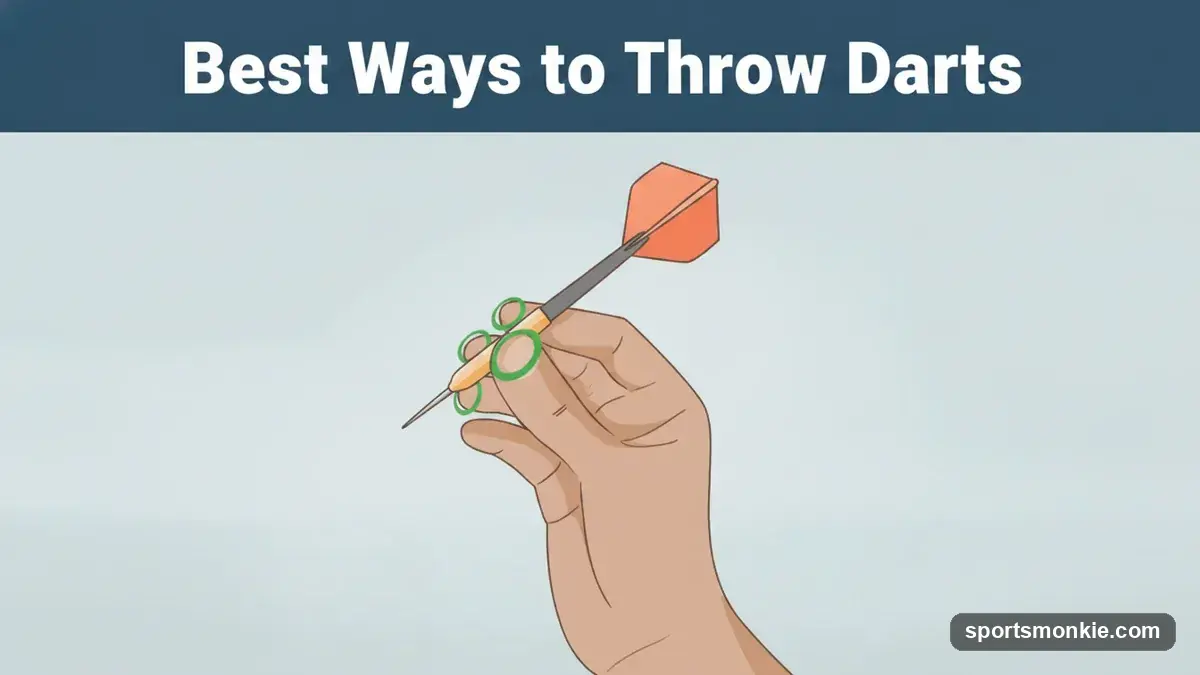
Grip comes first because everything downstream depends on it. Hold the barrel with the pads of your fingers, not the tips. Three fingers — thumb, index, and middle — works for most players, though some add a fourth. A few rules matter more than the rest:
- Place your grip near the center of gravity of the barrel so the dart sits balanced.
- Keep your remaining fingers relaxed and slightly curled, not clenched against the barrel.
- Avoid white-knuckling. Excess tension travels up your arm and disrupts release timing.
Where you hold along the barrel changes the flight: fingers forward and the dart noses down, fingers back and it noses up. Find the spot where it flies level without you having to compensate.
The stance: a stable platform
Everything above the waist depends on what is happening below it. These are the main options:
| Stance | Description | Best for |
|---|---|---|
| Side-on | Dominant foot forward, body turned 90 degrees to the board | Most professionals; maximum stability |
| Angled | Body at roughly 45 degrees to the board | Players who prefer a more open feel |
| Forward-facing | Body square to the board | Beginners learning balance; less common at high levels |
Whichever stance you pick, keep your dominant foot on or behind the oche, weight forward over the front foot, and your upper body still through the throw. A torso that sways mid-throw ruins more shots than a bad grip does.
The throw: forearm, not full arm
The forearm does the work here, not the shoulder. Break it down like this:
- Raise the dart to eye level, pointing roughly at your target. Your elbow should be up and bent near 90 degrees.
- Draw back by hinging at the elbow, pulling the dart toward your face or shoulder without dropping it.
- Drive forward by extending the forearm in a smooth, accelerating arc. Keep the upper arm as still as possible.
- Release when your arm is nearly fully extended. The dart should leave your fingers naturally as the hand opens, not be pushed or flicked.
- Follow through so your hand finishes pointing directly at the target. A cut-short follow-through pulls the dart off line.
Aiming: eyes, dart, and target in line
Line up your dominant eye, the dart tip, and the target segment before you throw. If two-eyed aiming throws you off, squint or close the non-dominant eye. The exact starting position of the dart matters less than doing it the same way every single time. Consistency of routine beats any single “perfect” position.
Common mistakes to avoid
- Dropping the elbow mid-throw sends the dart low.
- Rushing the draw-back causes jerky, inconsistent power.
- Gripping tighter under pressure. Notice the tension building and consciously loosen up.
- Leaning too far over the oche to gain distance. Stay balanced instead.
- Aiming at the whole board rather than one specific segment. Pick a precise point every time.
Practice drills that build accuracy
Structured repetition beats random play for building muscle memory. Try these:
- Single-segment grouping: Throw all three darts at the treble 20 until your grouping tightens, then rotate through other numbers.
- Round the clock: Hit 1 through 20 in order, moving on only after you land each number, to train the whole board.
- 121 checkout practice: Work on finishing combinations to sharpen the scoring that decides real matches.
Keep sessions short and focused — 20 to 30 minutes of deliberate practice beats an hour of casual throwing. Track your three-dart average over time so you can see the fundamentals turning into results.
Related guides
Frequently asked questions
What is the correct way to hold a dart?+
Hold the dart with at least three fingers — thumb, index, and middle — resting on the barrel near its center of gravity. Use the pads of your fingers rather than the tips, and keep the grip relaxed. A loose, balanced hold releases the dart cleanly, while a tight grip introduces tension that pulls throws off line.
How far should you stand from the dartboard?+
The official throwing distance (the oche) is 7 feet 9.25 inches, or 2.37 meters, measured from the face of the board to the front of the throwing line. This standard has long been used by darts' governing bodies across professional steel-tip darts worldwide. Soft-tip electronic darts use a slightly longer 8-foot (2.44-meter) distance.
How high should a dartboard be hung?+
A regulation dartboard is hung with the center of the bullseye 5 feet 8 inches (1.73 meters) above the floor. That height was set around the eye level of an average adult. As a cross-check, the diagonal distance from the front of the oche to the bullseye should measure 9 feet 7.375 inches (2.93 meters).
Should you throw darts with a straight arm or bent elbow?+
Keep your elbow raised and bent at roughly 90 degrees at the start of the throw. As you release, extend your forearm forward in a smooth arc while your upper arm stays mostly still. The forearm is the engine of the throw; involving the whole arm or the shoulder adds moving parts that hurt consistency.
Why do my darts keep landing low on the board?+
Low darts almost always come from dropping the elbow during the throw or cutting the follow-through short. When the elbow sinks before release, the dart launches on a downward angle. Keep the elbow up, release near full extension, and finish with your hand pointing at the target to keep the flight path high enough.
How tight should you grip a dart?+
Grip firmly enough that the dart will not slip, but loose enough that you could still be nudged without the dart moving much. A common test is imagining you are holding a small bird — secure but never crushing. Over-gripping under pressure is one of the most common faults, so consciously relax your fingers before each throw.
What is the best way to practice darts as a beginner?+
Structured, single-target repetition beats casual games for building muscle memory. Throw at one segment — many players start with the treble 20 — until your grouping tightens, then move on. Short, focused sessions of 20 to 30 minutes are more effective than long, unfocused ones, and tracking your three-dart scores gives a clear measure of progress.
Does dart weight affect how you throw?+
Yes. Heavier darts (around 24–26 grams) fly on a flatter line and resist small hand movements, which many beginners find forgiving. Lighter darts (18–21 grams) need a slightly firmer, faster throw to carry. There is no universally best weight; the right choice is the one that lets you release smoothly and repeat the same motion consistently.
Sources
Play & tools
Free browser games and tools — no account, no download.
- Play today's Sports Connections — Today's Sports Connections — daily hints, answers, and play the grid.
- Play Guess the NFL Player — A new mystery NFL player every day. Eight guesses, with a clue on each — plus free unlimited mode.
- Explore all our games →
Related records & rankings guides
View all →
How to Play Darts: Rules and 501 Scoring
How to play darts: the 501 rules, how scoring works, the double-out finish and your first checkout, plus the official oche distance and board height.
Darts Checkout Chart: Every Finish From 170
A darts checkout chart shows the dart routes to finish a 501 leg on a double. Standard finishes from 170 down, bogey numbers, and how to read the notation.
How to Play Cricket Darts: Rules & Scoring
How to play cricket darts: hit the numbers 15 through 20 and the bullseye three times each to open them, then score before your opponent closes them.
What Is a 9-Darter in Darts?
A 9-darter is a perfect leg: finishing 501 in the fewest possible nine darts. How it's done, common routes, how rare it is, and the famous perfect legs.

Greatest Darts Players of All Time, Ranked
The greatest darts players ever, ranked by world titles, major wins, peak dominance, longevity and era strength, from Phil Taylor and Eric Bristow to Luke Littler.
Free Throw Technique: A Repeatable Pre-Shot Routine
Master free throw technique with a repeatable pre-shot routine, alignment to the nail, clean mechanics, and controlled breathing to raise your percentage fast.