
Best Football Agents: The 10 Most Powerful Names in the Game
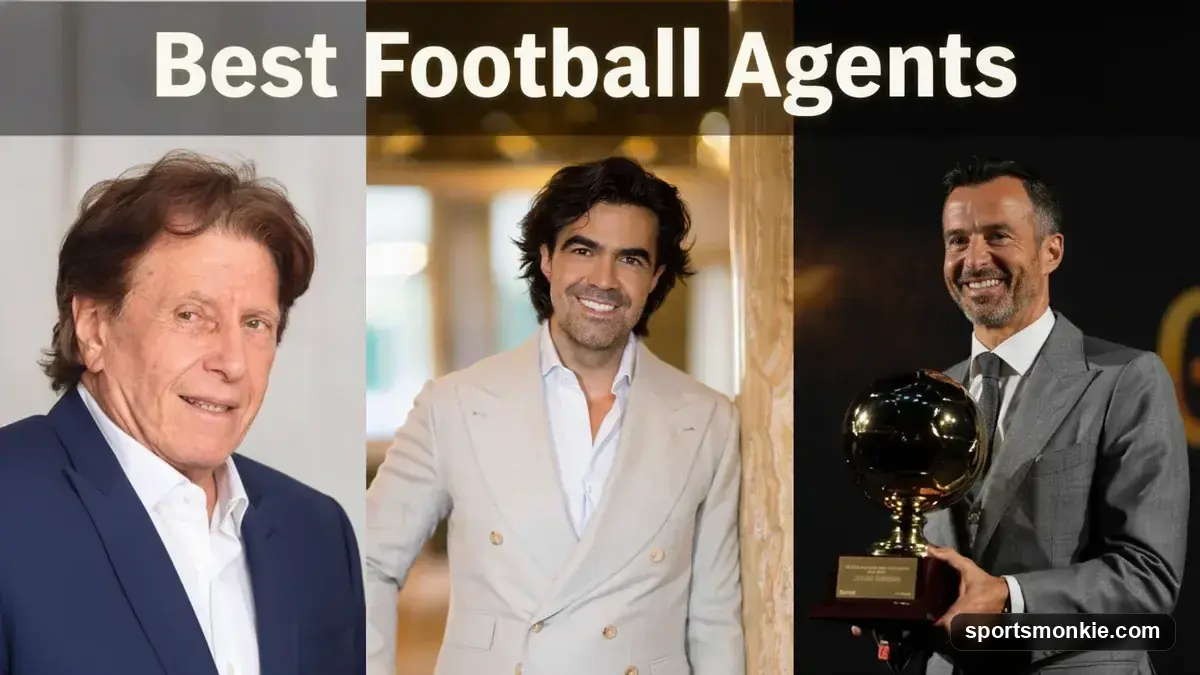
On this page15
- 01The most powerful football agents at a glance
- 02Jorge Mendes
- 03Rafaela Pimenta
- 04Pini Zahavi
- 05David Manasseh
- 06Jonathan Barnett
- 07Volker Struth
- 08Federico Pastorello
- 09Kia Joorabchian
- 10Kees Vos
- 11Leon Angel
- 12How we ranked these agents
- 13Player agent vs. the roles around a transfer
- 14How FIFA’s 2023 rules changed the game
- 15How the rankings could shift
Ranked by present-day leverage: the value and depth of an agent's active portfolio, control of elite players still at the top level, coach and manager clients, reach across multiple leagues, and a record of closing the deals rivals wanted. A roster full of retired stars counts for less than who an agent is closing for today.
The most powerful football agents at a glance
| Rank | Agent | Agency or defining client |
|---|---|---|
| 1 | Jorge Mendes | Gestifute; Cristiano Ronaldo |
| 2 | Rafaela Pimenta | Erling Haaland and Team Raiola portfolio |
| 3 | Pini Zahavi | Robert Lewandowski; Neymar's PSG deal |
| 4 | David Manasseh | CAA Stellar |
| 5 | Jonathan Barnett | Built Stellar; retired in 2024 |
| 6 | Volker Struth | Sports360 |
| 7 | Federico Pastorello | P&P Sport Management; Romelu Lukaku |
| 8 | Kia Joorabchian | Independent; Joshua Zirkzee |
| 9 | Kees Vos | SEG |
| 10 | Leon Angel | CAA Base |
- The benchmark
Jorge Mendes
Mendes is the agent every rival still measures against, and the hardware backs it up: he was named Globe Soccer Best Agent for a 13th time in December 2025. His Gestifute list has run through Cristiano Ronaldo for the striker's entire career and has since renewed itself around a new generation, including Barcelona's Lamine Yamal, Bernardo Silva, and Rúben Dias.
He ranks above Pimenta because his influence is structural, not just portfolio-deep. In 2024 alone he brokered five nine-figure-adjacent moves — including Leny Yoro and Manuel Ugarte to Manchester United and Pedro Neto to Chelsea — steering targets toward specific clubs across the world football map rather than reacting to windows.
Agency: Gestifute · Signature client: Cristiano Ronaldo · Award: 13× Globe Soccer Best Agent · Reach: shapes entire transfer windows
- Most valuable portfolio
Rafaela Pimenta
Pimenta inherited most of Mino Raiola's network after his death in 2022 and turned it into her own operation. Her clearest piece of evidence is Erling Haaland: she negotiated his contract extension tying him to Manchester City through 2034, one of the longest and richest deals in Premier League history.
Her roughly 50-player book also includes Paul Pogba and Matthijs de Ligt, plus Liverpool head coach Arne Slot — the coach-representation lever that separates modern super-agents from pure player brokers. She sits behind Mendes only because his award record and volume of blockbuster closings still run deeper.
Base: Monaco · Signature client: Erling Haaland (to 2034) · Also: Pogba, de Ligt, coach Arne Slot · Note: inherited Raiola's network
- Mr. Fix-It
Pini Zahavi
Zahavi, 81 years old and born in August 1943, has been assembling landmark transfers since before most of his rivals started working. His name is permanently attached to Neymar's €222 million move to Paris Saint-Germain in 2017 — still the world-record fee — a deal that changed how clubs treat buyout clauses.
He is best known as a fixer who unlocks moves other agents can't, and he has represented Neymar since the forward was 17. His current book includes Robert Lewandowski and Christopher Nkunku, keeping him relevant in a market that has otherwise turned over around him.
Nickname: Mr. Fix-It · Signature deal: Neymar's €222m PSG move (2017) · Clients: Lewandowski, Nkunku · Age: 81
- Volume leader
David Manasseh
Manasseh co-founded Stellar with Jonathan Barnett in 1994 and now runs the firm as CAA Stellar after Barnett's 2024 exit and the agency's absorption into Creative Artists Agency. The scale is the story: an estimated 900 active clients and a combined squad market value reported at roughly €2 billion, a spread no single super-agent's boutique can match.
He built that base by signing players before they were stars — Gareth Bale, Ashley Cole, Joe Hart, and Luke Shaw among them. He ranks above the retired Barnett because he is the one still running the machine and signing the next wave.
Agency: CAA Stellar · Scale: ~900 clients, ~€2bn combined value · Method: signs players young · Built from: Stellar (co-founded 1994)
- Founder, retired
Jonathan Barnett
Barnett belongs here for structural reasons: the single-client operation he started in 1992, grew into Stellar, and folded into CAA still runs on relationships he spent three decades building. Forbes once named him the most powerful agent in world sport, and Gareth Bale's 2013 move to Real Madrid — a then-world-record fee — remains a case study agents still cite.
He retired from active representation in 2024 and no longer signs clients; he has also faced a US civil lawsuit, filed in 2025, over allegations he denies. He is ranked on legacy and the agency he built, not on present-day dealmaking.
Status: retired 2024 · Built: Stellar / CAA Stellar · Signature deal: Bale to Real Madrid (2013) · Note: no longer active
- German power broker
Volker Struth
Struth runs Sports360, widely regarded as the most powerful agency in German football, built from the ground up before he sold a minority stake and stayed on to lead it. His list has long been the default for German internationals navigating a contract or a move abroad, anchored for years by Toni Kroos until the midfielder retired in 2024.
He ranks below the global operators above because his gravity is concentrated in one market rather than spread across Europe's biggest clubs. Names like Timo Werner, Niklas Süle, and Mario Götze keep Sports360 central to almost every major German transfer conversation.
Agency: Sports360 · Market: German football · Clients: Werner, Süle, Götze · Former anchor: Toni Kroos
- Serie A specialist
Federico Pastorello
Pastorello's Monaco-based P&P Sport Management is defined by one relationship: Romelu Lukaku, whose 2021 move from Inter to Chelsea for a reported £97.5 million became the biggest deal of Pastorello's career. That year he won Globe Soccer's Best Agent of the Year, the peak of his recognition.
His roster leans into the Italian market — Napoli goalkeeper Alex Meret among the current names — a deliberate niche rather than a scattershot global book. That focus is why he sits behind the volume agencies but ahead of more diffuse operators.
Agency: P&P Sport Management · Signature client: Romelu Lukaku · Award: 2021 Globe Soccer Best Agent · Market: Italy
- The dealmaker
Kia Joorabchian
Joorabchian has spent nearly two decades orchestrating complicated, high-profile moves, from Carlos Tevez and Javier Mascherano's arrival at West Ham to Willian, Philippe Coutinho, and Douglas Luiz. As of 2026 his book includes Manchester United forward Joshua Zirkzee, whose next move he has been actively working.
What sets him apart from everyone else on this list is a direct club link: he has held an ownership stake in Corinthians, a dual role that shapes how rivals and regulators read his deals. That entanglement is also why his standing carries an asterisk the pure agents' don't.
Base: independent · Current client: Joshua Zirkzee · History: Tevez, Mascherano, Coutinho · Wildcard: Corinthians ownership stake
- Eredivisie pipeline
Kees Vos
Vos co-founded SEG (Sports Entertainment Group) and built it into the dominant force behind Dutch football's export pipeline, working a deep bench of specialist agents across both player and coach deals. SEG's channel from the Eredivisie into the Premier League and Bundesliga keeps it among Europe's most consistently active agencies.
He ranks here rather than higher because SEG's model spreads volume across many mid-value moves instead of anchoring on a single global superstar the way Mendes or Pimenta do. That breadth is the asset — and the ceiling.
Agency: SEG · Strength: Eredivisie-to-Europe pipeline · Model: volume across many deals · Reach: Premier League, Bundesliga
- Premier League depth
Leon Angel
Angel founded Base in 1997 and grew it into a real rival to the biggest firms before CAA Sports acquired it in 2019, folding it into CAA Base. Working alongside Frank Trimboli, his client sheet includes Kyle Walker, James Maddison, and the Chalobah brothers, Trevoh and Nathaniel.
The agency's aggregate portfolio has been valued at roughly €1.36 billion, enough to compete with Stellar for Premier League market share even without a single headline superstar. For how much money moves through deals like these, see our breakdowns of the richest football clubs and the richest soccer players.
Agency: CAA Base · Clients: Walker, Maddison, Chalobah brothers · Portfolio: ~€1.36bn · Focus: Premier League
Reader interaction
Build your ranking
Drag the entries into the order you think is right — or use the arrows — then submit to see how your list compares with everyone else's.
- Jorge Mendes
- Rafaela Pimenta
- Pini Zahavi
- David Manasseh
- Jonathan Barnett
- Volker Struth
- Federico Pastorello
- Kia Joorabchian
- Kees Vos
- Leon Angel
Audience ranking
How everyone ranked them
Built from reader rankings using position-based points.
The ranked cards above are the list. The sections below explain how the order was built and give the context that makes an agent’s real leverage legible — the part of a transfer that never shows up in the fee.
How we ranked these agents
Power in this business is not just a famous name on the client sheet. We weighed five things, roughly in this order: the value and depth of an agent’s active portfolio, control over elite players still at the top level, coach and manager clients (an increasingly important lever), reach across multiple leagues and countries, and a track record of closing the deals everyone else in the room wanted.
Historical reputation matters, but a client list stacked with retired stars counts for less than who an agent is closing for today. That is why an active volume operation like Jorge Mendes’s Gestifute outranks a founder like Jonathan Barnett, who no longer signs clients, even though Barnett’s fingerprints are still on the agency running much of the market.
Player agent vs. the roles around a transfer
A modern super-agent does far more than the term “agent” once implied. Seeing the adjacent roles clarifies why the top names hold so much leverage.
| Role | What they control | Why it matters |
|---|---|---|
| Player agent | The player’s contract and next move | Direct leverage over where talent goes |
| Coach/manager agent | A club’s dugout appointment | Access to decision-makers who buy players |
| Intermediary | A single deal, hired per transaction | Narrower influence, deal by deal |
| Agency owner | A whole roster and its junior agents | Scale — hundreds of clients at once |
The agents at the top of this list occupy more than one column. Rafaela Pimenta represents both Erling Haaland and a Premier League head coach; Jorge Mendes steers clubs toward targets while also representing the targets. That overlap is the real currency.
How FIFA’s 2023 rules changed the game
FIFA reintroduced formal agent licensing in 2023 — a standardized exam, service-fee caps, and disclosure requirements — reversing more than a decade of a lightly regulated “intermediary” era. The stated goal was to curb runaway commissions and conflicts of interest where one agent sits on several sides of a deal.
The rollout has been contested. Portions of the fee-cap framework have faced legal challenge in multiple jurisdictions, and enforcement varies by national association. In practice, agents with entrenched club relationships have adjusted faster than newcomers, which tends to reinforce the incumbents already near the top of this list rather than level the field.
How the rankings could shift
This order is not static. A single retirement — like Barnett’s in 2024 — can reshuffle an agency’s standing overnight, and a breakout season can turn a mid-tier agent into a headline name within a year. Coach representation is the fastest-moving variable, because an agent who places a manager gains a direct line to that club’s recruitment.
Anyone choosing an agent should ask what this list was built around: what deals has this person actually closed, do they have genuine access to the clubs a player is targeting, and are the fees spelled out clearly before anything is signed. For the money that flows through these deals, our guides to the richest football clubs and the richest soccer players show the scale the top agents are negotiating over.
Frequently asked questions
Who is the most powerful football agent in the world right now?+
Jorge Mendes is still the most cited, and his 13th Globe Soccer Best Agent award in December 2025 backs that up. His Gestifute list runs from Cristiano Ronaldo to Lamine Yamal, and he brokered five major moves in 2024 alone. Rafaela Pimenta is the closest challenger thanks to Erling Haaland's contract through 2034, while Pini Zahavi remains a serious dealmaker at 81.
Who took over Mino Raiola's clients after he died?+
Rafaela Pimenta, Raiola's longtime legal partner, inherited most of his network after his death in 2022, including Erling Haaland. She has since negotiated Haaland's Manchester City extension through 2034 and represents roughly 50 players, among them Paul Pogba and Matthijs de Ligt, plus Liverpool head coach Arne Slot. That mix has made her one of the sport's leading super-agents in her own right.
How do football agents make money?+
Agents typically earn a commission on player contracts and transfer fees, historically in the 3% to 10% range. FIFA's 2023 return to formal agent licensing introduced caps on service fees, a standardized exam, and tighter disclosure rules, though parts of that framework have faced legal challenges in several jurisdictions. On a nine-figure transfer, even a capped percentage can put an agent's take into eight figures for one deal.
Do football clubs pay agents or do players?+
Both can. In many transfers the selling club, buying club, and player each contribute a share of the agent's fee, which is one reason the practice draws so much regulatory scrutiny. FIFA's licensing reforms specifically target this by limiting how much an agent can collect and requiring clearer disclosure of who is paying whom, aiming to curb conflicts of interest where an agent represents multiple sides of the same deal.
Why is a retired agent like Jonathan Barnett still on the list?+
Barnett retired from active representation in 2024, so he is ranked on legacy rather than current dealmaking. The agency he built from a one-client shop in 1992 into Stellar and then CAA Stellar still runs on relationships he assembled over three decades, and Gareth Bale's record 2013 move to Real Madrid remains a reference deal. David Manasseh, not Barnett, now signs the clients.
What agency represents the most Premier League players?+
CAA Stellar and CAA Base, both under the Creative Artists Agency umbrella, jointly control one of the largest blocks of Premier League talent. CAA Stellar, run by David Manasseh, is reported to carry roughly 900 clients and around €2 billion in combined squad value. CAA Base, led by Leon Angel, adds a portfolio valued near €1.36 billion, giving CAA unusual depth across English top-flight rosters.
Sources
Play & tools
Free browser games and tools — no account, no download.
- Play 38-0 — Sign a 4-4-2 of all-time football legends and chase a perfect 38-0 league season — perfect, not just unbeaten.
- Explore all our games →
Related football guides
View all →
Strongest Football Players: 10 Names Ranked
The strongest football players ranked and named, from Adebayo Akinfenwa's legendary FIFA strength rating to Erling Haaland and Victor Osimhen bullying defenders in 2026.

The Worst Transfers in Football History, Ranked
Ousmane Dembele, Philippe Coutinho, Antoine Griezmann, Paul Pogba and more — the biggest-money football transfer flops ever, with the fees and the reasons they failed.

Best Football Trios: The Most Devastating Attacking Thirds
Barcelona's MSN, Real Madrid's BBC and Liverpool's front three — the best football trios ranked by combined output, trophies and years spent dominating.

Greatest South American Football Clubs
Ranked by Copa Libertadores titles: Independiente, Boca Juniors, Peñarol, Flamengo, River Plate, and the 12 clubs that define South American football.

Best Football Defenders Right Now: Ranked Top 12 (2025-26)
The 12 best football defenders in the world right now, ranked: William Saliba, Virgil van Dijk, Gabriel Magalhães, Achraf Hakimi and more, with the stats behind each spot.
Most Popular Football Goals of All Time, Ranked
Maradona's 1986 run, Zidane's 2002 volley, Roberto Carlos's impossible free kick, Bale's overhead kick and more: the 10 football goals fans never stop rewatching, ranked.